 old
oldchemists old
chemists
remedies old
newsagents Victorian &
Edwardian
post offices old
barbers
shops old
hardware shops old
drapers
shops old
cobblers
shops old
furniture
shops old
pawnbrokers old
corn chandlers
pet shops

Old Ironmongers and Hardware Shops in Britain in the Early 1900s
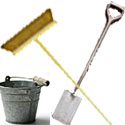
Old ironmongers and hardware shops were once a familiar sight in British towns and villages. Known in some areas as oil shops, they supplied everyday household goods, tools, cookware, paraffin and many other essentials. This page explains how these traditional shops operated, what they sold and how their wares were displayed, using historic photographs and memories from the early 1900s onwards.
Extracted from the memoirs of the webmaster's mother (1906-2002) and edited by the webmaster with further research
Why the name 'oil shop'
'Oil shop' was the informal name because that was what was most frequently bought there. This oil was paraffin for paraffin heaters and oil lamps. Customers would take along their own special can with its long spout and buy the oil by the pint. The oil gave these shops a special smell of their own, which probably contributed to the informal name. Oil shops also sold other goods - see below.
Why the name 'ironmonger'
Quite generally, a 'monger' is an old term for a dealer or trader in a particular commodity. It is seldom used today, although the term fishmonger is probably still recognised as someone who sells fish.
Ironmongers specialised in metal goods - along of course with other household goods. The metal was not only iron. As the pictures further down the page show, aluminium was also common. The was no stainless steel or plastic, although the steel that did stain was sold in knives.
Why the name 'hardware shop'
I suppose that 'hardware' was a reasonably accurate name for the wares, as most of the goods were hard. It is not difficult, though, to think of goods that were not hard, such as paint and string.
Goods sold by ironmongers, oil shops and hardware shops
These old shops specialised in the sorts of goods found today in sections of builders merchants, garden centres and supermarkets, although of course there was nothing electronic.
Something not available today was the gas mantle for gas lights. The shop kept a good stock because they were bought frequently because they were so fragile. They came in little cardboard boxes.
The shops sold a lot of firewood, as it was needed to start the coal fired kitchen range and the copper. It was stacked like a wall in front of the counter in bundles, about a dozen in a bundle, about 6-8 inches long, half an inch thick.
They sold all sorts of other items too, like galvanized buckets and baths, iron hand tools and garden tools.
The following image and those in the next section show more of what was sold: a china vase, a cane flower pot cover, an enamel saucepan, an aluminium saucepan, a cane shoppng basket. There is much more if you look closely. Small items like nails, screws, hinges and locks would have been stored in drawers.
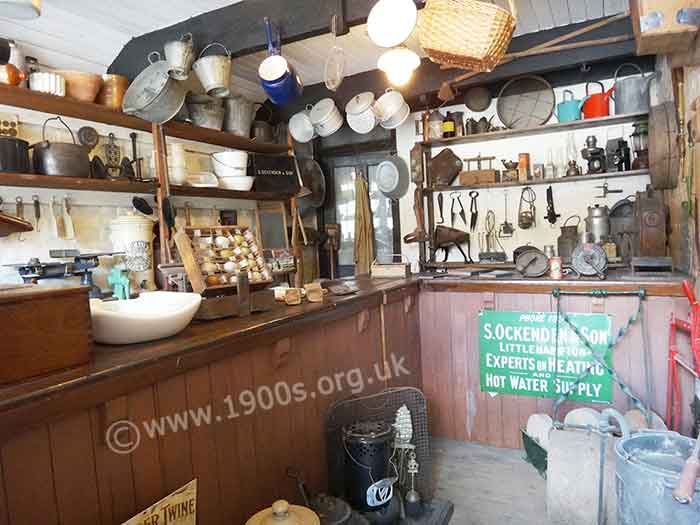
Inside an ironmonger's shop showing its many wares
Displays of wares
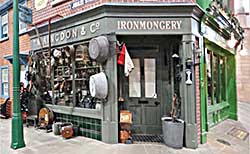
Ironmonger's shop front, displaying goods for sale.
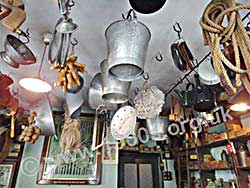
Ironmonger's ceiling, displaying more goods for sale.
As much as possible was crammed into the shop window or hung up inside and outside from windows and door frames. The rest, where space permitted, was hung from the shop ceiling. The outside displays had to be removed for security when the shop closed and set out again when it opened the next day.
Staffing
These shops were small and usually family owned, and one of the family would be the sales assistant. They really knew their business and could be relied on to give sound advice - something missed in the superstores of today.
Our local ironmongers shop
Our local hardware shop in Edmonton was owned by Mr Bryant and was on the corner of Sheldon Road and Silver Street.
Note from the webmaster
Information from the 1911 census
The 1911 census shows that my mother's memory was absolutely right: It shows that Alfred Bryant describes himself as an oilman. He was living at 77 Silver Street, probably above his shop, with his wife Catherine, 56, who assisted with the business and his daughter Mabel, 17 born Bethnal Green. He, like his wife, was born in Stepney.
| sources | webmaster | contact |
Text and images are copyright
If you can add anything to this page or provide a photo, please contact me.

