Sources for the 'Join me in the 1900s' website
From the webmaster
There are four main sources for this website:
- Firsthand related contributions from interested individuals
The emphasis of all of them is on what it was like for ordinary working class people to live in those times, supported with enough factual information and explanation to aid understanding.
The early-mid 20th century sources
These sources consist of:
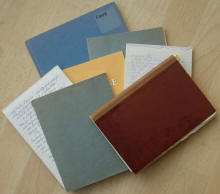
- The unpublished written recollections of my mother, Florence Edith Clarke (born Cole) 1906-2002 in which she recorded what she saw around her as a child in a working class family on a working class Victorian-style terraced housing estate. These memoirs consisted of the seven substantial and closely written volumes shown in the following photo and required considerable editorial work.
- Recollections that my mother talked about but which she omitted from her memoirs.
- Old documents filed away by my father.
- Contributions from other family members and visitors to the website.
- Original research which has involved me in numerous visits to museums and re-enactments, studying books and records and informally interviewing older people. The informal interviews have frequently used a particular technique with photos.
The historical significance of the memoirs
I believe that the memoirs are of considerable historical importance, which is why I laboured long to transcribe them. Let me explain.
My mother, like most children of the time from similar working class estates, left school when she was 14 and received no formal education afterwards. Although her excellent powers of observation and memory are without doubt, as is her obvious enjoyment and satisfaction in writing her memoirs, her punctuation and spelling were not all that they might have been.
She also had the habit of taking her recollections off along sidetracks as thoughts occurred to her. So not only was I faced with transcribing volumes of the spidery writing of her generation and social class, I also had to identify recurring themes and edit them together into topics which I thought would be interesting as web pages.
The work took over a year, but I regarded it as worthwhile. You see, although quite a lot is known about life above and below stairs in the big houses of Victorian and Edwardian England, very little encapsulates so comprehensively the lives and emotions of the working classes who lived on Victorian and Edwardian housing estates without paid help. I am sure you agree that anyone with such knowledge would be an unlikely author.
That is why I believe that the memoirs are of considerable historical importance, why I laboured so long to transcribe them and why I set up this website to bring them to the wider public. But the significance goes further than that. The website has stimulated highly relevant contributions from others who have provided their own recollections and information on everyday life at the time. These have added to the historical value of the website which has been widely appreciated - see what visitors have said about it.
The mid-late 20th century sources
These sources grew out of reactions from visitors to the first version of this website based on everyday life in the early 20th century (see above). Reactions were so positive with messages of thanks arriving from all over the world, that I succumbed to requests to extend the website with my own recollections of everyday life a generation later.
- I approached the task by asking myself what I am seeing around me now in the 21st Century that is different from what I saw and experienced in the 1940s, 50s and 60s - and accordingly what later generations might like to know more about. My emphasis has been on what living in these times was like, what people did, why they did it and how they felt about it.
- To set the context for everyday life in those times, I have included some factual history on some pages. This was collected in numerous visits to museums, re-enactments, informal interviews and book and internet research.
- Various papers and receipts kept by my father have added realism to the pages.
- Additional information and photographs that have come in from numerous visitors to the website and my own family, many of whom lived through the same years as me or were reporting on what their parents or grandparents told them.
- A few pages are written in their entirety by volunteers sympathetic to the ethos of the site.
The Second World War also known as World War Two (WW2 and WWII)
During the mid-late 20th century, six years stand out as particularly significant - and I lived through them with my own memories, as other contributors did with own their firsthand recollections. Although I hope that you may dip into all the pages, I particular hope that you will pay attention to the pages on what ordinary people experienced and felt on the home front of the Second World War. They suffered and stayed undaunted.
Sources and acknowledgements for the pages on pottery industry
The origins of this set of pages are rather different from the other sources. Whereas I have created and still create the other pages as I go along, transcribing my mother's notes, interviewing and receiving contributions, etc, I researched this set of pages many years ago to create a family history record for my family. Whereas I did take copious notes at the time, which have formed the basis for this set of pages, I was less careful about who said or gave what. Below is a list of people and organisations which helped me, but there are gaps in acknowledging which image or snippet of information came from where. For this, I apologise. If you would like to contact me on seriously omissions, I will put them right.
In what follows, individuals are cited in alphabetical order by surname and does not indicate the value of their contributions:
Bill Anderson; (Edwin) Jack Barker; Kenneth Barker; Maureen Barnsley; Bruce Bennett; Christine Bhangoo (born Cole); Gary Boudier; Duncan Bradon; John Beresford Clarke; Edward George Cole II; Henry Cole; James Martin Cole; John Edward Cole; Laurence Ellis Cole; Richard Cole; Sonja Cole; Peter Cook; Joanna Crawley; Andrew Cryer; Emily Cryer; Wendy Cryer; (Elisabeth) Anne Davey (born Cole); Daphne Dell; Mark Ellis; Kenneth Ferdinand; John Green; Katherine Greenwood; Gloria Hart; Peter Luetchford; Hazel Lipton; Neil Mackley; Pam Mahoney; David Marden; Frank Marden; Richard Millett; Bruce Mitchell; Adrian Pettit; Cliff Raven; John Cole Reedman II; Leslie Rodway; Larry Rush; William Rust; Christine Scotland; Nina Singer; John Cole Smith; Trish Smith; Michael Stead; Michael Swift; Brenda Taylor; Joan Taylor and William Utermohlen.
Other main sources of help include:
Bridisco which occupied the site of the Cole Pottery in White Hart Lane at the time of my research; online records from the International Genealogy Index (IGI) of the Latter Day Saints; the Society of Genealogists; Ancestry.com; etc., and various record offices, in particular Bruce Castle Museum, Tottenham; Camden Archives; Islington Archives; the National Archives; the London Probate Office; the Suffolk Record Office; and the Vestry House Museum in Walthamstow. The offices at Abney Park Cemetery and North Adelaide Football Club provided helpful information, and various old books have been consulted. I must also thank my husband Neil, without whose firm but supportive insistence, these pages would never have seen the light of day.
Please understand that some of the photos are very old which explains their poor quality. Rather than excluding them, I felt that even in their current state, they are worthwhile because they do give a good idea of what the times were like.
| webmaster | contact |
Text and images are copyright
If you can add anything to this page or provide a photo, please contact me.

