 shopping
process early
20th century weights
and
measures old bakers
shops old butchers
shops old
fishmongers old grocers
shops old
Co-op shops old
dairies old
greengrocer
shops old sweet
shops

Early fish shops
Shops selling fish in Victorian times and the early years of the 20th Century. From the previously unpublished written recollections of the webmaster's mother, edited by the webmaster with firsthand contributions from others.
Fishmonger - the name
Someone who owned or worked in a shop selling fish was known as a fishmonger, and the shop was known as a fishmonger's. Fresh uncooked fish - as opposed to dried or tinned fish was sold by what was called 'Wet fishmongers', although in later years, this was shortened to just 'fishmongers'. Today, with fish sold in supermarkets, these terms have effectively died out.
The fish
A wide range of fish was available, bought daily, fresh from Billingsgate Market.
It was sold whole, i.e. with the heads on and the innards inside, although the fish monger would gut the fish and remove the head if asked.
Our mothers could ask the fishmonger whether they wanted hard roes or soft roes, and to find out which was which, he would press the side of the fish with his hands and from a small hole out would come a tiny amount of roe, which he could recognize as hard or soft.
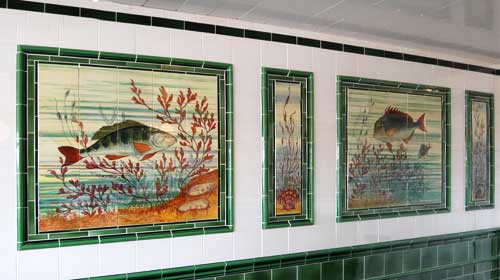
Inside wall of a fishmonger shop, all tiled, for easy cleaning.
Photographed in the Black Country Museum.
Fish and chip shops
There were fish and chip shops as well as 'wet fish shops'. Frying took place at the rear of the shop. We children could watch it because around the counter were sacks of potatoes for the chips and we would climb on them to see over the counter.
The fishmonger's wife would stand over large vats of bubbling oil, with vapour billowing out. She would have two containers, one with flour and the other with batter made with flour and water. She would dip the pieces of fish into the flour, then into the batter and then then drop them into the hot oil. It would sizzle away until it was golden brown. Then she would take it out with a wire slice with a longish handle and put it onto a wire rack to drain off the surplus oil. All the time, noise was going on round the counter with people shouting orders.
When the fried fish was ready, our mothers were asked if they would like any salt or vinegar. Then the whole order was wrapped in newspaper to be taken away.
The pieces of batter that came off the fish were called crackling and we children would buy it in halfpenny portions.
contributed by Carolyn Middleton a family recollection from her great grandfather, and employee in Payne's fish shop
The working hours
My great grandfather, Alfred William de Grussa (an Italian name), went to work for Mr Payne. The shop sold only fresh and smoked fish - no fried fish and chips.
The hours were long. Alfred left home at 5am and never got home until late, after the children were in bed. He worked six full days and had to go back on Sunday mornings to clean up.
Making the bloaters and smoking the haddocks
Alfred also had to prepare and smoke the herrings to make bloaters and also smoke the haddocks. These had to be opened up, soaked in brine and then put on steel rods. Both the herrings and haddocks were then hung on racks in a smoke room, or 'smoke hole' as it was called. A fire was lit and oak sawdust was burned. This just smouldered and gave off thick smoke which smoked the fish.
Eventually Mr Payne offered him the lease and the running of the business which he ran until 1922. By then he owned a horse and a four wheeled 'lorry' and used to go to Billingsgate Market to buy his fish.)
Note from the webmaster
Fish shops in Edmonton, where my mother lived, from the 1911 census
The 1911 census shows that my mother was right in her recollections about one of the fish shops: John Bennett, 39, fishmonger, born Bethnal Green lived at 113 Silver Street with his wife Harriet, 42, born Stepney, and his step daughter Mary Mable, 15 born Bethnal Green.
Yet another fishmonger in Silver Street in 1911 was Amelia Brooks, 53, born Homerton London, living at 87 Silver Street with her daughter Minnie, 20, born Hackney, her son Harold, 16, born Hackney and daughter Violet, 14, born Tottenham. All the older children assisted in the business.
Another fishmonger in Silver Street was George Payne, 32, born Hackney living at 13 Silver Street with his wife Rose, 28, born Stepney, who assisted with business, and sons George 7 and William 2.
| sources | webmaster | contact |
Text and images are copyright
If you can add anything to this page or provide a photo, please contact me.

