 shopping
process early
20th century weights
and
measures old bakers
shops old butchers
shops old
fishmongers old grocers
shops old
Co-op shops old
dairies old
greengrocer
shops old sweet
shops

Early British Grocers shops
Grocers' shops in the early years of the 20th Century. From the previously unpublished written recollections of the webmaster's mother, edited by the webmaster.
Customer care at the grocers
Grocers, like most shops tended to be family shops, where everyone was treated as though their custom mattered. Our grocer would greet my mother by name, saying something like, "Good evening, Mrs Cole." (Yes shops usually opened in the evenings.) "What would you like? Some collar bacon and not too salt?" Then he would hold up a lump of bacon and say, "How about some rashers off here?"
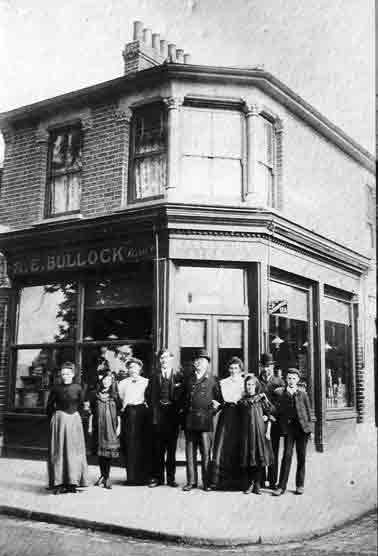
Outside an old grocers shop*
Note a typical corner shop to catch trade from more than one road.
In the early 20th century, there were several grocers and general provisions stores within easy reach.
Cutting and weighing out bacon
There was quite an art to slicing the bacon as there were no bacon slicers.
The scales were the balance sort with a flat pan for the food. Small weights such as half an ounce or an ounce were available.
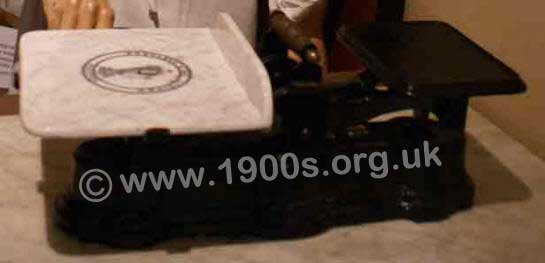
The 'goods' pans of the scales are both flat and easy to clean, making them suitable for weighing out fats and cheese as well as bacon - although in practice a fresh piece of greaseproof paper would be placed on the pan for each customer. This pan is marble but others were china. Photographed at Milestones Museum in Basingstoke.
Before the food etc was put onto the pan, a piece of greasproof paper was laid onto it to keep it clean and to wrap the bacon in afterwards. This was sold with the food inside a paper bag.
Slicing bacon needed considerable experience in order to slice off as near as possible whatever weight and thickness the customer wanted.
When the bacon was first put onto the scale pan, it swung slightly before it stopped, usually slightly heavier one side than the other. Then more or less bacon was added to make the scales balance, and some shopkeepers didn't wait quit long enough. This meant that a customer was over or under sold. I heard my mother say about one shop, "I'm not going there again. He's a bit too tricky on the scales for my liking".
Cutting and weighing out the cheese
The cheese came as a large hunk and had to be cut with a wire to whatever size was wanted.
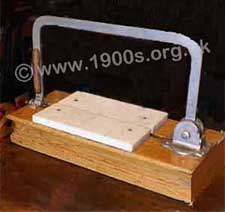
Grocer's cheese wire for cutting cheese. Note the raised handle to allow room for a large block of cheese.
Cutting and weighing out butter
The butter came in large blocks which stood on a marble slab with another slab in front with the word 'butter' engraved in gold coloured letters. Butter was not pre-packed into convenient weights for sale. It had to be cut to weight with butter pats made of wood and kept in a pail of water to stop them sticking.
There was an art to cutting the butter because it was never possible to cut off the precise weight that a customer wanted. So the grocer had to take bits off or put bits on to make the scales balance. To add a bit, he would use the butter pats which had been standing in the water to prevent sticking and smack a bit onto the main piece of butter. He might have to do this a number of times, and the smacking was important to make the butter into a nice shape.
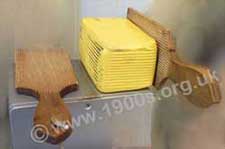
Model of wooden butter pats or paddles, showing how grocers used them to pat butter into the required size and shape for sale
I loved to watch my mother's face when Mr Brown gave her a taste of the butter on the end of the pat to see if it was too salty (a common practice in those days). Her lips would go and round and up and down, and I thought it must have been lovely to be able to do that.
Serving and packaging butter
The butter was wrapped in the sheet of greaseproof paper that it had been weighed on. Then it was put in a white paper bag for the journey home. In hot weather, this had to be a quick as possible because butter melted easily. Once home, it went into the food safe.
Note from the webmaster
Rationing
My mother wrote nothing about food rationing when she was a child, but after finding a ration-card for the period in my father's effects, I made it my business to find out - see rationing in WW1.
In the 1930s there was another provisions shop in the area.
More about the shop photo
*Photo courtesy of Hal Whiteman who has provided the following information:
Bullocks General Provisions store on the corner of Silver Street and Haselbury Road at 145 Silver Street. The shop belonged to his great-grandparents, Alfred and Catherine Bullock. Sadly though it burned down in the late early 1900s.The family, who lived upstairs, had to flee the fire across the tin rooftop. The shop was rebuilt, but with no insurance, Hal's great-grandparents were no longer involved.
(The Bullock family came to London from Bristol in the 1870s, Alfred walking the whole way to save money. After the store burned down he returned to his original trade, which was French polisher. Hal's grandparents both attended Silver Street School in the early1900s. There may be a photo of him there - but we have no names, a common regret.)
| sources | webmaster | contact |
Text and images are copyright
If you can add anything to this page or provide a photo, please contact me.

