 potteries
as
industries the Cole
Pottery
Tottenham pottery
working
practices pottery
house
1910s-1950s Sid Cole
pottery
owner E.G.Cole
pottery
owner J.R.Cole
pottery
manager John Cole
pottery
founder Daniel Cole
potter,
seaman Cole
ancestry Pettit
Pottery,
Walthamstow Tile
kilns Arkley
pottery Bristol
potteries Cox-Reedman
Australian
brickworks J C Reedman,
Australian
sportsman Reedman ancestry Distant
cousins
in the USA Early English brickworks

Life in the Pottery house
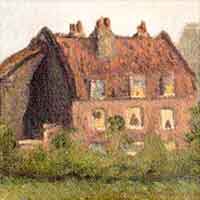
This page gives two extensive descriptions of the pottery house, the first from around the 1910s and the second from the 1950s.
____
edited by the webmaster from people who lived there
The Pottery House, Tentdale c1910s from FEC
I knew the Cole Pottery as a child when my grandfather James Reedman Cole lived there as the live-in pottery manager. This must have been around 1910. My grandfather lived with my grandmother and their large family in the pottery house which was called Tentdale. My younger brother, Ted, and I used to stay at the house most weekends and in school holidays doing odd jobs. Looking back, I think we must have helped a lot, although it never felt like that because we loved being there. It was a house of plenty and a significant contrast to where my brothers and I lived with my parents in our small terraced house.
It took about half an hour to walk there from our home in Edmonton, but we thought nothing of it. It was a pleasant walk, and the pottery was in a rural setting.
The approach to the house
There were two entrances. One was on the left, looking from the road, and was primarily for the pottery site. The other on the right went straight to the house.
There was a small garden in the front of the pottery house. Up the wall grew a white clematis that I loved and have continued to love ever since. One thing that fascinated me was a toad that lived under some bricks. When he came out he didn't move; only his throat pulsated.
There was a heavy front door which was never used and there were venetian blinds up at all the windows.
The hall
The front door opened onto a large hall with a beautifully polished floor.
At the bottom of the stairs in the hall was a small alcove in which my grandfather kept his boots cleaned and well-polished ready for church on Sunday - All Hallows, Tottenham.
The bathroom
Strange to say, the first room off the hall was the bathroom. To have a bath you had to carry in buckets of hot water.
The parlours
On the other side of the hall were the two parlours. Over one door hung what I would think were buffalo's horns. An oil lamp hung from the ceiling. There was also a large photo of my Aunt May, one of the daughters who after her marriage had made her home in Australia. Later that photo was joined by a photo of one of the younger daughters, my Aunt Grace, who also made her home in Australia after her marriage.
The back parlour was where consultations took place between my grandfather and E.G. Cole, his brother, the pottery owner. If E.G., as he was called, was coming in that day, he would arrive for breakfast. There was no conversation. He would just grunt, "Good Morning".
As soon as the two men walked in, the breakfast was taken into the parlour on a large dish. While the men were at breakfast, we had to stay in the kitchen. Only afterwards did we have our own breakfast.
The kitchen
The kitchen was large and in no way modern. You went straight into it from the porch in the side door. The first thing that met your eyes was a large wardrobe with a lot of things on top, like tennis rackets.
In the centre of the kitchen was a long whitewood table, kept scrubbed by my aunt Em. There was also a large kitchen range with a picture above it called 'The Traveller's Return', the sofa that my grandfather would lie down on for ten minutes after dinner before going back to work, a side table with a bench alongside with a wooden knife box on it, a small dresser with a telephone on top, along with a kitchen clock that my grandmother would shake when it stopped. When it stopped I would be sent along to the office to find out the time. Clocks were expensive and there were no others in the house. My grandfather and E.G. had pocket watches.
An aside - about getting the time for my grandmother from the pottery office. Two men worked in the office, Mr Wyatt and Mr Mutton [James Jeffery Mutton]. It was always to Mr Mutton that I went. He was a gentlemanly person. When I told him that my grandmother would like the right time, he would smile, take out his gold watch from his waistcoat pocket, hesitate and say "It is two minutes past eleven", or whatever, but that "if your grandmother wants to catch a train, it could be a minute either way".
Back to the kitchen: On Saturday mornings, Aunt Em would clear out the outside food safe. This was a large wooden cupboard with the front part made of galvanised mesh to let in the air. The food kept very well in it.
While Aunt Em did the clearing, my grandmother would generally still be sitting at breakfast. She was a very relaxed person whereas Aunt Em was energetic. The conversation was always much the same between the two rooms. To my grandmother: "Do you want the kipper? … How about the bits of cheese?" The answers always seemed to be no, she never did. Remember, this was a house of plenty. One of my other aunts would fry the pieces of cheese up and have them for breakfast.
The bread was kept in an earthenware crock in the kitchen.
Breakfast in the back parlour
Breakfast was quite a big event. It was organised by my grandmother and Aunt Em. The fire in the back parlour was lit, the table laid and the breakfast cooked. No bowl of cornflakes and orange juice. The pottery house was a place of plenty. There were things such as sausages, eggs and bacon tomatoes and lamb chops.
One thing I particularly enjoyed at the pottery breakfast was porridge because it was made with milk. I loved the smell when it was cooking. Although at home we children always had porridge, it was made differently. It was rather coarse and had lots of husks in it that I always put round the edge of my plate, which made my mother cross. Her porridge was made with water, then put on a large bowl-like plate. She would put brown sugar on, then pour cold milk on. It made me think of a moat from my history book. Not a word was said of this, and I knew that my mother’s financial circumstances were different from my grandmother's. This makes me think of one of my mother's sayings, which I only really understood when I was grown-up: "You have to cut your garment according to your cloth."
The outhouse
The kitchen led out on to what was called the outhouse. There were no windows there. It was a place where things were dumped and where the washing was done. The roof was pantiles and at one corner grew houseleeks.
The stairs
From the hall came the staircase with four flights of eight steps. There were three bedrooms at the end of two flights. The other two flights were curtained off with red velvet.
Bedrooms and other rooms
The other rooms were bedrooms and muck rooms. These had the smell of apples being stored. There was an old bicycle frame with no wheels that we would sit on and pretend we were riding. Of course we were told not to go there.
The back garden
The outhouse led onto the back garden. Here was a large orange blossom tree that overhung an old well that was covered over. There was also a garden shed, flower beds and a chicken run.
Sometimes my brother Ted would have the job of digging the chicken run over and would unearth such things as pie dishes left there by my grandmother when the she had taken something out to the chickens. In those days you fed chickens on something you called mash. My grandmother's had bacon in hers. When she sent me to get eggs, I never liked it. I always thought that the chickens would fly at me, but although they looked at me with their beady eyes, they always kept away.
From the garden you could see stacks of pots. Some had a mauve-blue look which was because they had been baked too long.
contributed by Edward George Cole II, my mother's brother and my uncle
For all the time I remember, Tentdale was on the pottery site, and was, I imagine, there before the pottery. It was fair sized with a large block at the back which was hardly visible from the road. It was situated in a rural setting, which made it an ideal venue for a walk or visit, particularly as there were various members of the large Ellis family (my grandfather's wife's family) living within the area.
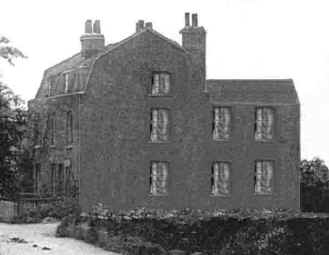
[The size of the house is evident from the following sketch by David Marden. The block at the back is just visible from some of the original photos and drawing if you know what you are looking for, but is effectively invisible from the road.]
____
Now for recollections from about 40 years later. My mother would have wept. Thank goodness she never saw it.
The Pottery House c1950s from David Marden
My family moved into the pottery house (now called Wayside Cottages) sometime in the early 1950s, possibly soon after I started school in 1953. My father (Peter Marden) had taken a job at the pottery and the flat went with it.
In those days, the house had been converted into four self-contained flats. We were in No.2 (upstairs) on the side of the house that, I understand, had been used by pottery workers as far back as the time of James Reedman Cole. We were on the eastern side of the house, ie the-right-hand side, as seen from the front of the house.
There was a date etched into the gable on the side where we lived). I seem to remember in the 1950s thinking to myself that this place will soon be 150 years old. Then I read the press cutting which quoted Alderman Cole as saying "Our place was built in 1805". So I think that the date could have been 1805. [This would have been before Cole ownership of the site.]
In my time, the left-hand doorway was subsequently sealed off and replaced by another on the western side of the building, giving access from the pottery yard.
Inside the house
Once inside the front door, a flight of stairs took us up to the first landing where we had two bedrooms, a living room, toilet, and kitchen. For some strange reason I remember the bath being in the kitchen at the very rear of the flat.
There was a second flight of stairs leading to the top floor. At the base of this was our gas meter that took only the old large copper pennies. A shillings-worth would last several days. At the top of this flight there were two more rooms used for storage. One belonged to the tenant below us and was always locked. The other was ours and had a window that overlooked the main road outside and across to the Wood Green Town Football Club ground opposite.
The flat, indeed the entire building, had no electricity, but was run entirely on gas, which I was informed was generated from a small plant outside, (though I cannot confirm this). We had gas lamps, a gas cooker, and a gas iron. The lamps were fitted with mantles that were only obtainable locally from a general store in Compton Crescent. The iron was a fearsome contraption that was connected by a rubber tube to a tap on the living room hearth. It had an internal gas ring that exploded upon lighting and played roaring flames onto the inside of the sole plate. There was no fine tuning with this - I remember most of our clothes were either wrinkled or scorched. Our 'entertainment' was a portable radio that took its energy from a pair of accumulators - acid filled glass batteries that were regularly topped up at the garage down the road.
Life at Wayside Cottages
Television
Living at Wayside Cottages really singled us out in the local community. No electricity meant no television, so while the rest of the population tuned into the hit programmes of the day, we were limited to the Home, Light and Third Services of the radio. Still, I managed to keep abreast of things and save face with my schoolmates by regular visits to my aunt’s house in Devonshire Hill Lane. Their TV was almost as tall as I was – and it had a 14 inch screen!
Watching football
I would spend alternate winter Saturdays gazing out from the spare room window at the top of the house. This afforded me a free view of Wood Green Town’s football matches, though much of the pitch was obscured by a rickety wooden grandstand that appeared to have been fighting the elements for many years. There was also a long single storey building that was the social club where my parents would spend their weekend evenings, and I was introduced to the delights of 'Housey Housey' and live skiffle. I was allowed to accompany them provided I behaved myself – usually for about 10 minutes before I disappeared outside with the other kids.
Gas lights
After the evening’s entertainment we were usually accompanied home by a family friend named Charlie. He was a tall, gangly young man, and seemed very excitable following a few pints. His regular 'party piece' was to accidentally brush his head against the living room gas mantle, showering the floor with glowing fragments and sometimes setting his hair alight.
My mother (Bet) worked part time at the nearby Direct Mineral Water Supply Company which manufactured soft drinks. They would probably be referred to as 'mixers' these days. Occasionally, workers were allowed to take home products that did not meet the required standard and failed the quality control of the day. I was never impressed by the bottles of pale, sugary water, or bitter, cloudy sludge that found their way to our kitchen.
Other tenants
I was never sure what happened to Mrs Cramp's son who eventually disappeared from the scene, but she, herself, gradually succumbed to dementia and started to act very strangely. She began to bake mince pies in great quantities - and at all hours. Sometimes we could smell the cooking in the middle of the night. Often she would catch me on the way to school and invite me into her living room, an eerie dark place due to the heavy curtains. All around were dozens of knickknacks and chalk ornaments, occupying every available space on shelves, tables and sideboards. She would tell me in hushed tones that she had a special treat for me - a batch of freshly baked mince pies that I could share with my schoolmates. She would open up one of many large square tins and load half a dozen pies into a paper bag, then send me on my way. This happened for several months on an almost daily basis until we finally moved away in late 1957.
The end of the pottery house
Shortly after 1957, the pottery closed. The house survived for a while longer, but I don't know anything about the demolition.
| sources | webmaster | contact |
Text and images are copyright
If you can add anything to this page or provide a photo, please contact me.

