 potteries
as
industries the Cole
Pottery
Tottenham pottery
working
practices pottery
house
1910s-1950s Sid Cole
pottery
owner E.G.Cole
pottery
owner J.R.Cole
pottery
manager John Cole
pottery
founder Daniel Cole
potter,
seaman Cole
ancestry Pettit
Pottery,
Walthamstow Tile
kilns Arkley
pottery Bristol
potteries Cox-Reedman
Australian
brickworks J C Reedman,
Australian
sportsman Reedman ancestry Distant
cousins
in the USA Early English brickworks

Bristol potteries and the Cole family
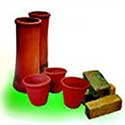
Members of the Cole family worked in pottery in and around Bristol from early times - see the page on Taking the Cole line back. But this page starts with John Cole (1776-1835) as it marks a pivotal point in the family when, in 1805, John received a considerable inheritance which enabled him to set up for himself in Bristol. He shared this inheritance with his brother, Daniel Cole (c1772-1840) of the London potteries.
____
by Bruce Bennett, a Cole descendant, from family recollections and research
The Bristol potters appear to have primarily produced what is known as stoneware. The terms stone and stoneware as applied to pottery are explained on the pottery-industry page.
John Cole 1776-1835
John's place in Cole ancestry is shown in the following descendancy chart which starts with himself and his brother Daniel with whom he shared his inheritance and whose own descendants are shown from the Daniel Cole (c1772-1840) page.
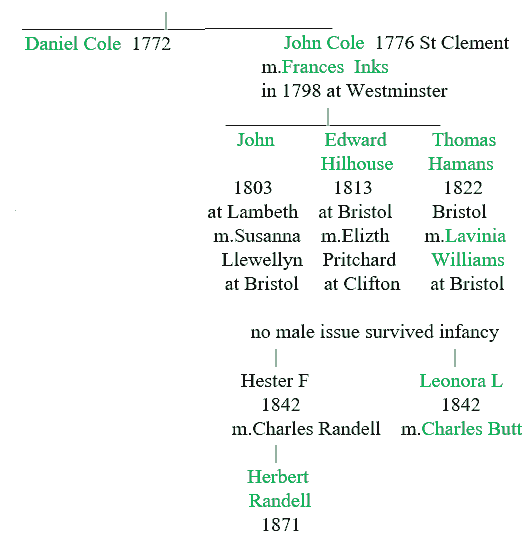
Descendancy chart from John Cole 1776-1835 with individuals involved in pottery shown in green
All the children of John Cole and Frances are listed below:
- Elizabeth Cole 28 Aug 1799 or 24 June 1800 St Mary, Lambeth, married John Cussell, butcher
- Emily as Emela bap 13 Sept 1801 Lambeth
- John Cole 25 Sept 1803 St Mary, Lambeth, married Susanna Llewellin in 6 June 1825 at Bristol
- Emily 9 July 1806, bap 31 July 1830
- Edward Hillhouse Cole 10 Dec 1813 Bristol, married Elizabeth Pritchard on 9 Jan 1833
- Frances Cole 1819, daughter of John Cole potter, married Thomas Probert of Temple-street, mariner
- Thomas Hamans Cole 25 Feb 1821 Bristol, married Lavinia Ann Williams
- George Cole 1823, baker, son of John Cole potter of St Philip, married Ann Llewellyn
John was baptized 9 June 1776 at St Clement Danes in London, second son of Daniel Cole (1738 -1789).
He married Frances Inks [sic] at St Martins in the Fields, Westminster, London on 29 October 1798. Frances had been born at the Lying-In Hospital Holborn in Aug 1776, daughter of Edward Hinks coachman and Sarah.
His descendant and family historian, Freda Pope1 next picked him up in Bristol in 1807 where he was a potter, and he and Frances took on an apprenticeship. By this time, he had benefited from his uncle's 1805 legacy.
There are numerous references to John's business activities and partnerships in Bristol after 1807, including as follows.
In 1815 John dissolved a partnership with John Hilhouse Wilcox (one time mayor of Bristol) and Thomas Hamans Cook, after whom John appears to have named his youngest son Thomas Hamans Cole. The partners had been stoneware potters and manufacturers of clay tobacco pipes in Cheese Lane, St Philips Bristol.
Next, in 1815 and 1816, John Cole worked as a brown stone potter with John Spokes at Cole and Spokes in Avon-street. Cheese Lane is an extension of Avon Street.
In 1819 John Hilhouse Wilcox proprietor, John Cole's former partner, sold several lots in Cheese Lane, St Philip and St Jacob, adjoining and connected to the Floating Harbour. Lot 4 consisted of the cone of a glass-house, within which were erected two large stone-ware kilns, turning and drying rooms, with every other requisite for carrying on the trade of a stone ware potter to any extent. It is likely this was where John worked as a partner of Hill and Cook before 1815, and then of John Spokes in 1815 and 1816. John appears to have continued there as a potter until 1830.
On 21 Jan 1830 John sold the Cheese Lane pottery by auction: 'Lot 2. A Small and Convenient Stone and Brown Ware Pottery, with a Yard, two Kilns, small Dwelling house, and other suitable buildings, now in the occupation of Mr John Coles, as yearly tenant … The Lots … are situated near the Bridge over the Feeder, at the bottom of Cheese Lane … and are within a short distance of the New Cattle Market'.
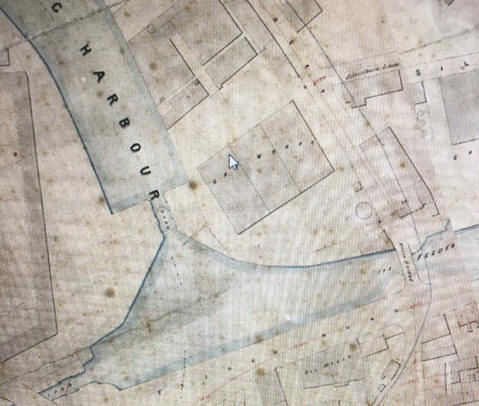
Detail of Ashmead Map of 1874 showing the kiln (circle) at the Avon-street end of Cheese Lane. These two maps of the same area show surprisingly different structures.
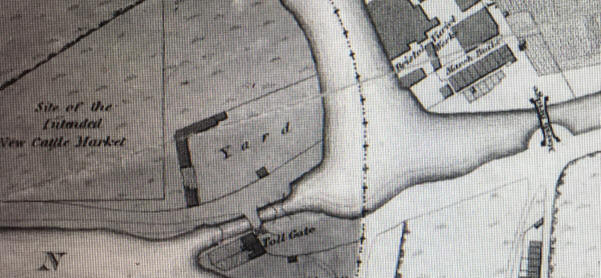
Detail from 1881 Ordinance Survey. The pottery was located “near the Bridge over the Feeder, at the bottom of Cheese Lane within a short distance of the New Cattle Market” next to a larger 2 acre, brick yard and kiln, drying sheds… in 1830. In the 1841 census Frances lived in the Marsh buildings, just near the Marsh Bridge. The Bristol Vitriol Works
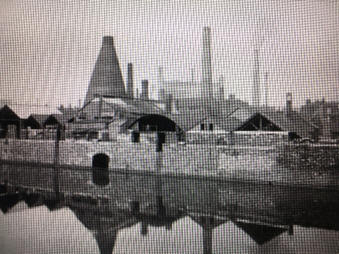
Photo: Avon street wharf 1922 [Bristol Archives] possibly the glass kiln housing the two pottery kilns.
About 1830, John moved to The Albert Pottery in St Phillip Marsh making brown stone and red wares.
While returning with his wife from visiting friends at Winterbourne, John fell out of his gig while trying to rescue his dog who had jumped out and was trodden on by the horse. He was taken to the Masons Arms, Stapleton, Bristol and died there overnight from head injuries on 26 June 1835.
John was succeeded by his widow Frances Cole from 1836 to 1855. Frances was born in London about 1785, and was 55 in the 1841 census, a pottery owner living at No 4 Marsh Buildings, St Phillip and St Jacob with Fanny 22 and Elizabeth 9. This was just a few doors from her fugitive sister-in-law Ann Marie Moss (sic, alias Tarsey nee Cole) and family. In 1851 Frances Cole 65 widow potter lived at 1 Cole Lane with her daughter Frances Fowler 33. Frances Cole died 7 August 1855 at St Philip's Marsh aged 80.
We have found where the Bristol clay came from. 'By order of the assignees of Joseph Pomphrey Austin, papermaker, a bankrupt, To be sold Lot 2 all that brickyard with the kilns and other erections thereon, together with 3 acres of meadow land, in the parish of St Philip and St Jacob, near the Great Western and Bristol and Exeter Railways, and the Coalpit Heath Railways and the river Avon, now in the several occupations of Thomas Wakefield, Thomas Bennett, Frances Cole, Samuel Spokes and Thomas West. There is an inexhaustible supply of excellent brick and tile clay, under the whole of Lot 2.
Three of the sons of John and Frances became potters - see below.
John Cole 1803-1859
John Cole was born on 25 Sept 1803 St Mary, Lambeth, the eldest son of John Cole and Frances.
He was apprenticed to his parents as a stone potter on 25 July 1815.
On 6 June 1825 he married Susanna Llewellin at Bristol and had seven children baptised at St Phillip and St Jacob’s, Bristol.
After this John seems to be manufacturing stone bottles in Red Hill, and exporting to the Channel Islands. This was in Coles pottery or Albert Pottery from about 1830 up to 1870 but thereafter known as the Albert Pottery.
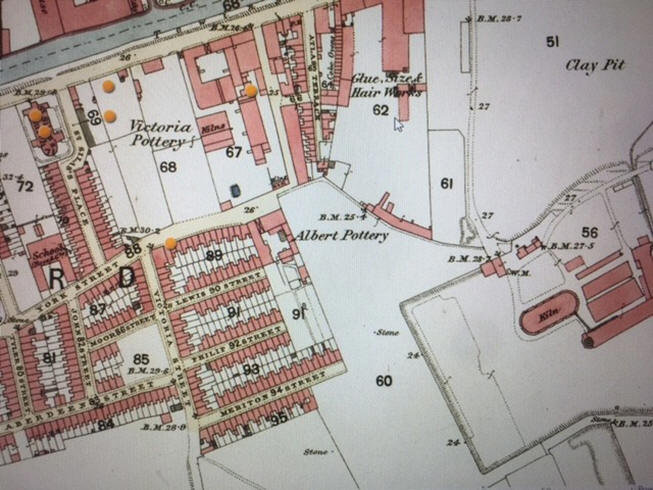
The Albert Pottery in St Philip’s Marsh. The adjoining Victoria Pottery ran from 1866 to 1905. York street became Victoria street and extended to Atlas street. There is still a Cole Road curving along the opposite/railway side of the big clay pit. In 1851 Frances Cole lived at 1 Cole Lane.
The distance between Cheese Lane and Albert Potteries is about 2km.
In 1841 John Cole 35, potter, lived at Avon Place, Marsh, St. Philip and St. Jacob, with Susannah 35, Elizabeth 10, Susannah 8, Merack 6 and Caraline 1. In 1851 John Cole 48, potter, born at Lambeth, London, was living at 9 Oil Mill Place, St. Phillip and St. Jacob, Bristol, with Susan 49, Susan 18, Maria 16, Clara 10 and Ester 8, all five born in Bristol.
In 1859, 'A potter named John Cole, who was from the parish of St Philip’s, Bristol, and worked for Mr James, Piligwenily, felt ill a few days since, and went to the Vulcan beer house, where he was placed in bed. Next morning he was found dead upon the floor. Verdict 'Found Dead'. The Pill Pottery in Pillgwenlly, Newport made mainly bricks and tiles and some glazed red earthenware figures.
Immediately after John’s death, his employer advertised the job as 'Stoneware throwers, wanted immediately, a small ware thrower, apply H James, Pottery, Newport'.
John’s grandson Herbert Charles Randell born at Bristol in 1871, was a potter in 1911 and 1921 living in Bridgwater. Herbert died 20 May 1938 at Bridgwater.
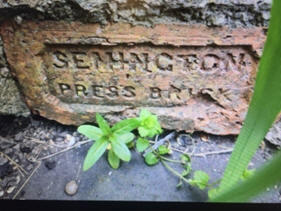
Brick made at the Pill Pottery and brickworks in Pillgwenlly, Newport, where John Cole worked. Slipware pottery was produced in the Pillgwenlly district of Newport, Monmouthshire in the 19th century. The factory predominantly made bricks and tiles, but lions seem to have formed the greater part of its other production of figures and models.
Edward Hillhouse Cole 1813-1859
Edward Hillhouse Cole was on born 10 Dec 1813 Bristol, baptised at Pembrey, Carmarthen on 1 June 1834, another son of John Cole potter and Frances of St Philips, Bristol [PR Carmarthen].
Between 1837 and 1846, Edward Hillhouse Cole took out five insurance policies on different properties. He is described as a potter and retailer of beer, although no policy mentions a pottery. He had a pub in the Dings, Bristol called The Prince of Wales. The Dings, a notorious area of poverty and degradation in the St Philip's area of Bristol, between Temple Meads and Barton Hill, was one of the worst slums.
In In 1830 Edward Hilhouse Cole and John Cole junior, potters, both voted from St Philip's Marsh. John Cole junior must be the (John Cole 1803 -1859), brother of Edward.
Edward and Elizabeth appear on the 1841 census both aged about 25. He was listed as a potter of St Philip and St Jacob.
In 1851 Edward, age 37 was a potter and kept a beer house in York Street St Phillip and St Jacob. He was living there with his wife Elizabeth and one servant.
Edward Hillhouse Cole, now listed as a builder, died in 4 April 1859 at Barton Vale, Bristol, aged 45, leaving probate to widow Elizabeth.
Thomas Hamans Cole 1821-1867
Thomas Hamans Cole was baptized 25 Feb 1821 in Bristol, another son of John Cole potter and Frances.
He married Lavinia Ann Williams in 1840 at Christchurch, Bristol.
In 1845 he was a journeyman [travelling salesman] potter of Wilkins Cottages, Dings, St Phillip and Jacob, but in 1848 was insolvent.
In 1851 at 29 he was a potter living at St Phillips Marsh with his wife Lavinia age 26.
He took over the Albert Pottery, St.Phillip’s from his mother Lavinia in 1856 until 1868.
In 1857 he 'returns his sincere thanks to his friends and the public for the many favours they have bestowed upon him for the last two years, and begs to inform them that, in addition to all kinds of brown ware, he has entered upon the improved stone, which he can supply cheaper than any firm in the West of England.'2
In 1861 he was a master potter employing three boys and seven men, living at St Phillip and St Jacobs.
In 1862 he advertised 'Wanted a man who perfectly understands the glazing and burning of red ware, apply to T. Cole, Albert Pottery, St Philip’s Marsh.'
Fire was a dreaded risk at any pottery, and in 1864 'Fire. Yesterday morning, at half-past ten, a fire broke out at Albert Pottery, St. Philips Marsh, which threatened to be very serious, on account of the scarcity of the company’s water, had it not been discovered in time. Through the kindness of neighbours in fetching water from the river. It was soon got under control. Fortunately, Mr. Cole was insured.'
The following inscription is on Thomas's grave: 'Thomas Cole master potter of the Albert Pottery died 19 Oct 1867 aged 46, deeply lamented, leaving probate to Lavinia Ann.' The grave is in undergrowth so I have not seen the inscription and I don't know how Freda got it. A search of the grave records show that Lavinia was also buried there.
Lavinia took over the pottery and advertised in 1867 promising business as usual.
Lavinia Ann Cole widow of Mr Thomas Cole, of Albert Pottery, St Phillips, was the daughter of Frederick John Williams. She married again Joseph Rowland Hands on 2 Oct 1869 at St Barbabas, Bristol.
In 1871 Ann L Cole 46, born in Bath, was a potter employing 6 men at Albert Potteries, living with daughter Rosina Davis 27 and son-in-law Charles Davis 40 clerk in the pottery.
Joseph and Lavinia Hands ran the St Philip’s Pottery from 1869 to 1871 when Lavinia died. Thomas and Lavinia were the last of the Cole potters in the Bristol area.
Joseph Hands ran the St Philip’s Pottery alone from 1871 to 1873. In 1872 he advertised for 'To builders - Albert Pottery, Marsh Bridge, St Philips, for chimney pots, cheap for cash.'
By 1873 Joseph had married again in Liverpool where he remained until his death in 1912.
In 1902 Joseph Rowland Hands of Liverpool, patented improvements in tobacco pipes.
An unnamed redware pottery was offered for sale in May 1873 and again in May 1874 and August 1878, and was probably the St Philip’s Pottery. The Pottery was then run by John Forward Moorse.
Brick made at the Pill Pottery and brickworks in Pillgwenlly, Newport, where John Cole worked. Slipware pottery was produced in the Pillgwenlly district of Newport, Monmouthshire in the 19th century. Lions seem to have formed the greater part of the figure and model production at a factory that made predominantly bricks and tiles
John Forward Moorse was described as the manager of the St Philip’s Pottery, from 1875 to 1908, but he was almost certain became the proprietor: Albert Pottery Company, York Street, makers of all kinds of flower and garden pots from 1883 to 1906.
After John Forward Moorse's death in 1908 the Pottery was run by his son, Walter John Moorse, assisted by his sister, Ada. In 1933 it features 'Flower pots, all sizes in stock, wholesale or retail. Established 1801. Apply the Albert Pottery Co.'
In 1934 Walter John Moorse was the proprietor of the Albert Pottery Co, St Phillips Marsh.
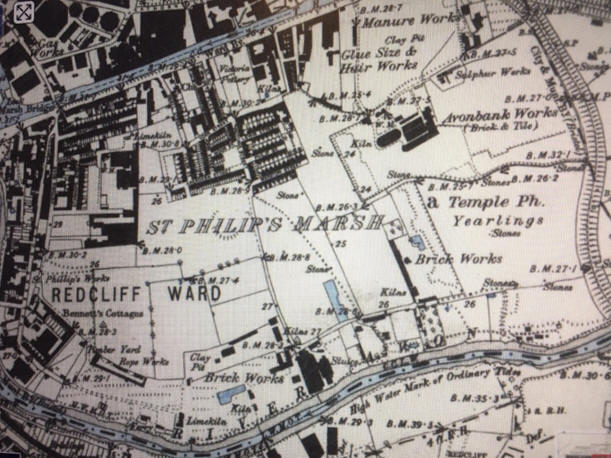
1881 Ordnance survey St Philips Marsh. Avonban brick and tile kiln upper and Avonbank Brickworks lower. The kiln of the original pottery can still be seen in the top left corner, just above the Marsh Bridge
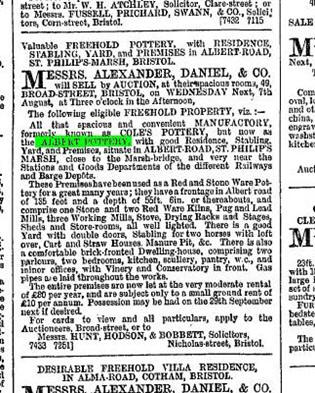
Sales advertisement 6 August 1878 in The Bristol Mercury.
References
1 Freda94 on RootsChat and subsequent emails from 2015 to 2018 from Petrina Pope
2 Bristol Mercury, 22 Aug 1857
| sources | webmaster | contact |
Text and images are copyright
If you can add anything to this page or provide a photo, please contact me.

