 potteries
as
industries the Cole
Pottery
Tottenham pottery
working
practices pottery
house
1910s-1950s Sid Cole
pottery
owner E.G.Cole
pottery
owner J.R.Cole
pottery
manager John Cole
pottery
founder Daniel Cole
potter,
seaman Cole
ancestry Pettit
Pottery,
Walthamstow Tile
kilns Arkley
pottery Bristol
potteries Cox-Reedman
Australian
brickworks JC Reedman
Australian
sportsman Reedman ancestry distant
USA
cousins early
English
brickworks

The Cox and Reedman brickworks
in South Australia

This page starts with an illustrated article on brickmaking in South Australia written by a Cole descendant, John Cole Reedman II. The page goes on to include the genealogical data of the female Cole family who emigrated from England to Australia, bearing their husbands' surnames: Cox and Dean. Reedman is on another page.
____
by Australian Cole descendants, John Cole Reedman II, Christine Scotland and Bruce Bennett
During the 19th century, members of the wider Cole family emigrated to Australia, taking their brickmaking and pottery skills with them. The following article is on the history of brickmaking in South Australia. The Cox Brothers' establishment at St. Peters, was approximately 5 kms from where Henry Cox and Edward John Reedman had their brickworks in Gilberton. As both Henry and Edward had worked in the Cox Brothers. yard at St. Peters for several years, we can assume that they used the same process in their own yard.
The article is courtesy of John Cole Reedman II. At the time he contributed it, its source was unknown and he was no longer contactable. The source has now been identified by Christine Scotland as in The South Australian Register of 1859. Probably John Cole Reedman II inherited the original cuttings and based his article on them.
Brickmaking in South Australia
contributed by John Cole Reedman II, undated
As brickmaking is one of the oldest trades in the world, our readers will no doubt be interested to know that this branch of industry is carried out with the same vigour now in the young country of South Australia, as it was thousands of years ago in ancient Egypt. Indeed the difficulties of the trade at the present day may be said to have greatly diminished, for although our manufacturers have still "to make bricks without straw" it is for the very good reason, that they have found more lasting materials suited to the purpose, and that they can now do better without straw than with it. In order however to give the reader an idea of the brick making business as at present conducted, and to enable him to judge the progress which it has made in this colony, we subjoin a description of our most extensive, and one our longest established yards, the particulars of which will of course to a great extent apply to other establishments in the neighbourhood of Adelaide.
The brickyards of Messrs Cox Bros. of Norwood, are situated on 7½ acres of ground, which lie between the north end of Sydenham Road and Osmond Terrace. Here the whole process of converting natural soil of the ground into hard bricks has been for the last 10 years actively carried on, so that many of the best buildings in Adelaide may be said to have been dug out of Norwood — a city sprung from its own suburbs. On entering Messrs Cox yard, the first thing that arrests your attention is a yawning chasm, in the midst of which, the first process of brickmaking is going on. In this valley which is 20 feet in depth, and half an acre in extent, churches, chapels and dwelling houses beyond number have no doubt taken their origin, and fresh material for other structures is still being raised from the same spot. This material in the first place is mixed with a due proportion of wood or coal ashes, and the mixture having been saturated with water, is shovelled into the 'pug mill' — a machine worked by a horse, and the effect of whose action it is to thoroughly knead the soil and ashes together, and turn them out from an aperture near the ground in the form of a thick paste. When this is done, the first step in making of a brick is accomplished, and this step is a very important one, for by the process of burning bricks adapted in this yard, unless the same proportion of ashes is always mixed with the earth, the bricks are liable to be over burnt and injured. This will be explained more fully when the kilns are spoken of, but the mixing operation belongs to this, the first stage of the work, and so great is the care exercised in the process that every brick made is said to have as nearly as possible the same quantity of ash in it. To show this, a brick or two not yet dried were broken, and the black ashes were seen scattered equally through each, like plums in a wel-regulated Christmas pudding.
But before leaving the pug mill and following the mixture up to the moulding sheds the question must naturally occur, what is to be done with the huge excavations out of which Adelaide is now getting most of its long streets of houses, when they are no longer convenient for brickmaking. On Messrs Cox's ground there is about an acre of this excavation altogether, and from its situation, as well as from the fact that the soil and water are both excellent, it is not difficult to imagine that some years hence the grounds that now form a brickyard may be famous tea gardens — the Rosherville of South Australia. At present these artificial valleys, in one of the which are Messrs Cox's stables, are delightfully cool, and in their shaded corners vegetables are found to grow with a luxuriance generally unknown on the plains.
We must return however, from the tea gardens to the brickyards. The process of moulding bricks is a very simple one, but a great deal of dexterity is required in shifting them about whilst in a soft state. From the sheds the bricks are carried, completely made so far as their share [sic - shape?] is concerned, to the drying yards, where they are placed on boards, and exposed to the sun and air. There they remain at this period of the year about eight or nine days, during which time it is necessary to protect them both from rain and hot winds. The next and final process which the bricks have to go through is that of being burnt, and this operation is performed in a somewhat peculiar manner. Instead of there being a kiln with a large wood fire blazing in it whilst the bricks are drying, they are simply made into a great stack, there being a small hole about the size of an ordinary fire place left at some part of the stack near the ground. In this hole a fire is lit, and is allowed to burn for one day, when the opening is closed up and the bricks left to carry on their own burning. This, on account of the ashes contained in them, they do by conveying the fire from one to another, and in a very short time the stack becomes too hot to be touched. Of course the sel-burning process thus followed would not answer with bricks made without ashes, but with that ingredient in them, so readily do they burn that a fresh stack piled by the side of the first heated would gradually receive sufficient warmth to become thoroughly dried without the assistance of any additional fire.
The means of this one establishment for supplying the colony with bricks will be indicated by the following facts. On the 7½ acre of land are two pug mills and four moulding sheds, and the drying ground enough for 150,000 bricks at once. The number of hands employed on the average throughout the year is twenty, and the number of horses six. To keep these in full operation the quantity of work passing through the yard may be judged by the following particulars. The materials generally on hand as stock are two hundred chaldrons of firing stuff mixed up, sufficient for 100,000 bricks, and bricks ready for sale 300,000. Whilst, with regard to the capacity of the ground for future supplies it is estimated that the land not used would give enough stuff for 100,000 bricks per week over a period of 10 years. For the carrying on of this trade, there are of course but few covered buildings required, as all the operations of brickmaking take place in the open air. Messrs Cox Bros. however are well provided with fuel sheds and stabling, the former being 50 feet long by 20 feet wide, and the later which is well pitch paved with hard bricks, being adapted to accommodate seven horses, beside have excellent store room attached. Another point which is worth noticing in connection with these yards is that all hands employed there are with one or two exceptions staunch tea totallers, and as the trade is one of the hardest and dustiest to be met with, the testimony of these brickmakers in favour of water as the most refreshing drink for general purposes deserves to carry some weight with it.
The next largest brickyard in the colony are those of Mr Coombs and Mr Dungey at Bowden, and Mr Westrop of Stepney. It is impossible however to give any particulars of interest about one establishment of this kind which do no apply generally to others. Brickmaking everywhere is pretty alike, and the chief difference between manufactures in this country is that whilst some burn their bricks in a regular kiln, others follow this plan described above, of making them of such material as will enable them to burn themselves.
According to Bruce Bennett, the above article is a direct transcript of 'The Manufactures of South Australia, No. 8 Brickmaking' which appeared in the South Australian Register newspaper of 15 Dec 1859
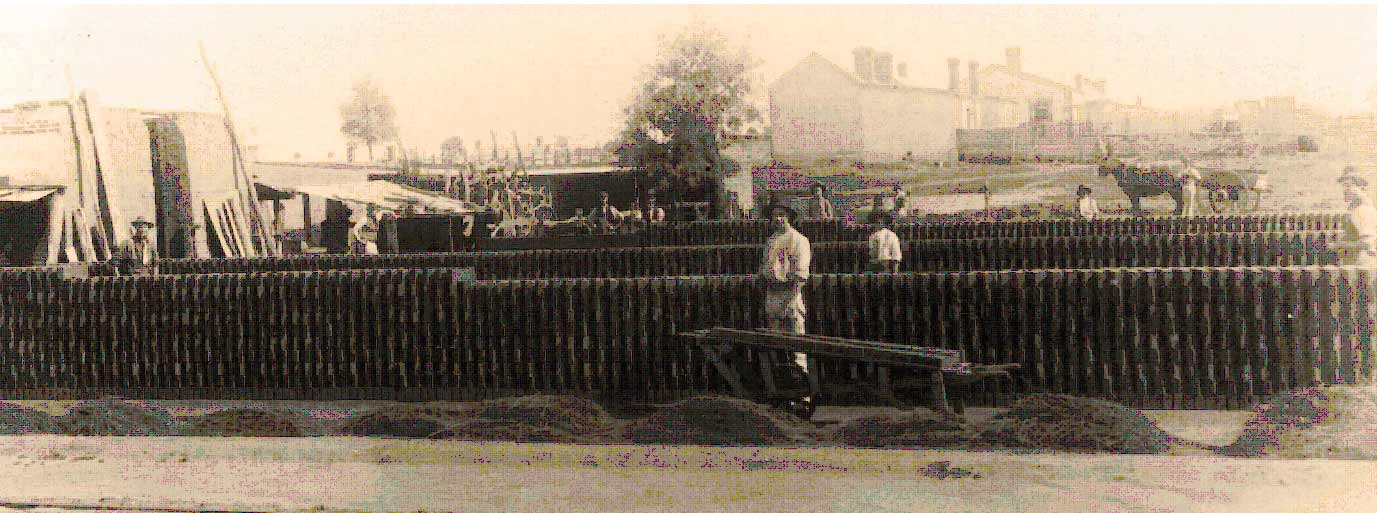
Early brickworks in Southern Australia, known as the Cox-Reedman brickworks, where the bricks were sun dried.
The Dean/Cox/Cole connection
contributed by Christine Scotland
The Dean/Cox/Cole connection in England
Sarah Louisa Dean (c1831/1832-12 Aug 1879) and Charlotte Elizabeth Dean (1838-22 Nov 1935) were daughters of Catherine Cole (1802-1865), who was the daughter of Daniel Cole. The sisters married two brothers, both on the same day, 3 September 1854, at the Parish Church in West Hackney (one of the nearest towns to the rural Tile Kilns). Sarah Dean married Henry Cox and Charlotte Dean married William Cox.
Some years later on 30 March 1856, there was to be yet another Cox-Dean marriage. Emma Cox, the sister of Henry and William, married Daniel James Dean, the son of Catherine Cole and the brother of Sarah and Charlotte. Consequently three siblings from one family married three siblings form another family. Is this a record!?
According to the marriage certificates, the father of the Cox siblings was James Cox, a labourer (for William and Henry and a brickmaker for Emma). No addresses were documented and it took a while to locate him in the censuses because his name was transcribed in 1851 as Coe and in 1841 some of the children were listed as names not known. The censuses gave James' birth year as 1781 in Hackney (i.e. relatively close to the Tile Kilns). This was enough information for his father to be identified from the IGI which showed that James was the son of Joseph Cox (mother's name not given), baptised in Hackney on 6 May 1781.
James appears to have had a large family, many of whom, according to the custom of the day, left the family home while they were still quite young, thus preventing confident identification from the censuses. According to the available data, James' wife was a Susan or Susanna born 1799 in Vange, Essex, and they had the following children:
- Elizabeth Cox, born about 1826. She married William Harris, a stonemason. In 1881, her mother Susan(na) was living with her family
- Unnamed son, born about 1826. Because of ages being rounded down to 5 year bands for individuals of 15 years or over, Elizabeth and the unknown son were not necessarily twins.
- William Cox, born 21 October 1830 in Hackney and baptised aged 23 with his younger brother Henry on 29 June 1854 at St John the Evangelist, Limehouse, London. The adult baptism suggests that parents, James and Susan, may not have been particularly religious and that the brothers were urged to be baptised before their marriages to the Dean sisters.
- Henry Cox, born 14 March 1832 and baptised with his elder brother William (see above).
- Emma Cox, born 1836. She married Daniel James Dean, son of Catherine Cole) and the couple settled in Tottenham where James was a carman at the Cole Pottery.
- Henrietta Cox, born about 1836.
- Jane Charlotte Cox, born 1844. She married Henry Gardener in Islington on 15 July 1866.
In 1841 the family was living in the railway company cottages in Widford, Essex and James was a brickmaker. In 1851 they were at 3 Norfolk Court Islington and James was a labourer. Brickmaking is very hard work because of the speed that brickmakers have to work in order to produce the quotas, and it is not surprising that James reverted to being a simple labourer in later life. The children listed were sons William 21 and Henry 19 both labourers born at Grays in Essex, daughter Emma 16 needleworker born in Islington and daughter Jane 7 born Islington.
The Dean/Cox connection in Australia
Sarah and Charlotte and Henry and William emigrated together on the Coromandel, which left Southampton on or around 12 Sep 1854. They arrived in Port Adelaide on 8 Jan 1855, well before their cousins Mary Ann (Cole) and Edward John Reedman, who left Liverpool on 10 December 1856 on the Monsoon and arrived in Adelaide on the 5 March 1857.
According to The Biography of South Australia, Henry and William were born in Middlesex, England - William c1830 and Henry c1833, which fits the census records.
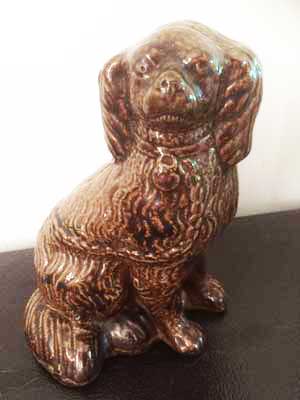
One of a set of three pottery dogs made by William Cox, the son of Henry Cox and Sarah Louisa Dean. The above and below images are courtesy of Christine Scotland.
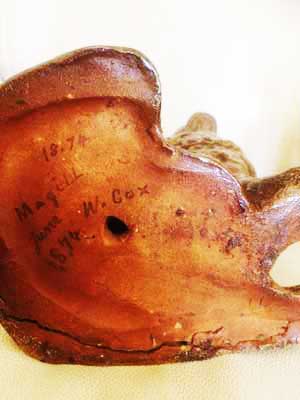
Underside of the dog, highlighted showing the maker's name, William Cox, with date 1874
William Cox and Charlotte Elizabeth Dean had the following children. It is interesting to note that the name of Charlotte's mother (born Catherine Cole) is carried on in the name of the first child while the name of Charlotte's grandfather (Daniel Cole) has been lost.
- Catherine Susan Cox, born 19 Dec 1855 Norwood. Her name perpetuated the names of both her grandmothers, Catherine Cole and Susan Cox.
- Sarah Ann 4 Sep 1857 Norwood
- Rose Ellen or Ellis Webb Cox, born 1860. There may be a family connection with a Webb line.
- Louisa Annie Cox, born 12 Oct 1862 Norwood
- Eva Jane Cox, born 14 Sep 1865, Norwood
- Lily Maria Cox, born 12 Mar 1869, Norwood
- Harry Arthur Cox, born 27 Feb 1875, Norwood. Finally a male child! His given name of Harry could have been after William's brother. So it is possible that there was an Arthur Cox somewhere
- Elsie Dean Todhunter Cox, born 28 Mar 1882, Norwood. The Todhunter name comes from William Dean's daughter Catherine Sarah who married George Todhunter on 23 Oct 1842 at Hoxton, England.
Henry Cox and Sarah Louisa Dean had the following children, and perpetuated the names of William (after Sarah's father, William Dean), Catherine (after Sarah's mother, born Catherine Cole) and Charlotte (Sarah's sister) and James (after Henry's father). The absence of the name Sarah is surprising, but may have been to avoid confusion with Charlotte's daughter Sarah.
- William James Cox, born 21 Jul 1855, Norwood. His name perpetuated the names of his uncle and grandfather.
- Henrietta Maria Cox, born 12 Aug 1856 Norwood. Henrietta Cox was one of William's sisters.
- Henry Edward Cox, born 1 Apr 1858 Norwood, named after Henry himself.
- Clara Ann Cox, born 30 Mar 1860.
- Catherine Charlotte Cox, born 1 Nov 1862 Norwood, named after Sarah's sister and grandmother.
- Annie Louisa Cox, born 21 Apr 1864 Norwood.
- Eliza Jane Cox, born 25 Dec 1865 Tanunda, named after Henry's Cox sisters.
- Alfred Ernest Cox, born 31 Oct 1867 North Adelaide. His name and that of his younger siblings might be useful sources for future research.
- Emma Susannah Cox, born 28 Jun 1869 North Adelaide.
- Rose Ellen Cox, born 13 Mar 1872 Gilbertown.
- Henry George Cox, born 29 Jan 1878 Gilbertown.
- Jessica Philadelphia Cox, born 4 Oct 1878 Gilberton.
In Australia the Coxs and the Reedmans continued the family tradition and worked together for some time as brickmakers, although interestingly The Biography of South Australia lists William as a labourer/carter. It gives no occupation for Henry.
Sarah Louisa (Dean) Cox died 12 Aug 1879 in Gilbert Town, Australia, and Charlotte Elizabeth (Dean) Cox died on 22 Nov 1935.
Reedman ancestry in bricks and pots, with the Cole and Cox connection has its own page.
| sources | webmaster | contact |
Text and images are copyright
If you can add anything to this page or provide a photo, please contact me.

