 potteries
as
industries the Cole
Pottery
Tottenham pottery
working
practices pottery
house
1910s-1950s Sid Cole
pottery
owner E.G.Cole
pottery
owner J.R.Cole
pottery
manager John Cole
pottery
founder Daniel Cole
potter,
seaman Cole
ancestry Pettit
Pottery,
Walthamstow Tile
kilns Arkley
pottery Bristol
potteries Cox-Reedman
Australian
brickworks J C Reedman,
Australian
sportsman Reedman ancestry Distant
cousins
in the USA Early English brickworks

Early brickmaking and pottery around London
Before potters and brickmakers settled in permanent accommodation with permanent kilns, they moved from place to place digging up its clay and firing it in temporary arrangements. This page explains the work in some detail and comments on the Cole potters concerned.
____
by the webmaster from research
At the end of the 18th century, London was rapidly expanding, and a great deal of building material was needed. Since there was no local stone and not yet any railways to bring stone in, and since wooden buildings had been outlawed in London since the Great Fire, bricks had to be made from local clay. Fortunately, London had suitable clay in abundance.
I believe that my Cole ancestors must have been heavily involved in the production of bricks and tiles for the London building industry at the time, although I have no actual evidence of it. This page is about what could have been their involvement in north London, then Middlesex.
Old Islington potteries/brickworks
My first step to find out more was to visit the Islington Archives. Why Islington? The Cole Potteries and the Tile Kilns were both in the general area of north London, with the earlier Tile Kilns being the further out of the two. So Islington, further out still seemed a good place to start.
I learnt from various old maps that in the period concerned (the late 1790s to early 1800s, that there were few roads in the area. Kilns of a sort were in the open fields with simple tracks running up to them. The main one was later named Tile Kilns Road and then renamed Tile Yard Road in 1897. It still exists as Tileyard Road, as documented in 'Streets with a story: the Book of Islington', E. Willats, 1987, but of course is thoroughly built-up now.
I also consulted various old books on the area, in particular William Pink's 'History of Clerkenwell' (1881, later reprinted), and 'A Victorian History of the County of Middlesex: Volume VIII' (1985).
All the books made the link between the use of bricks, the lack of natural London stone, the lack of railways and the outlawing of wood for main construction following the great fire of 1666. So the clay from clay sites around London was used to make bricks, and temporary kilns were a common sight, with their smoke and pollution dominating in every direction.
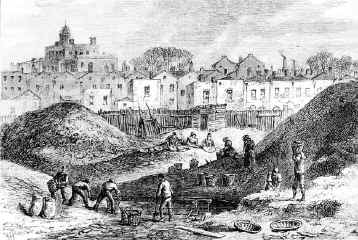
As the production of bricks moved ever outwards from the expanding London, digging clay by hand for temporary kilns
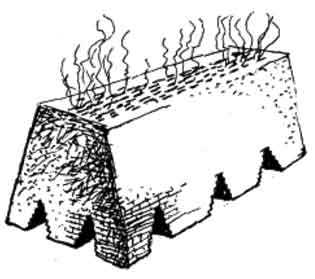
A temporary kiln built with the bricks to be fired
The archives provide no evidence of any owners or workers in these early times. 'A Victorian History' notes that in the 1770s the nearby area of Maiden Lane was made unattractive by its proximity to the Fleet River (now subterranean) and the trades that had gathered there, including a pottery. The Victorian History implies that the original Maiden Lane was quite long.
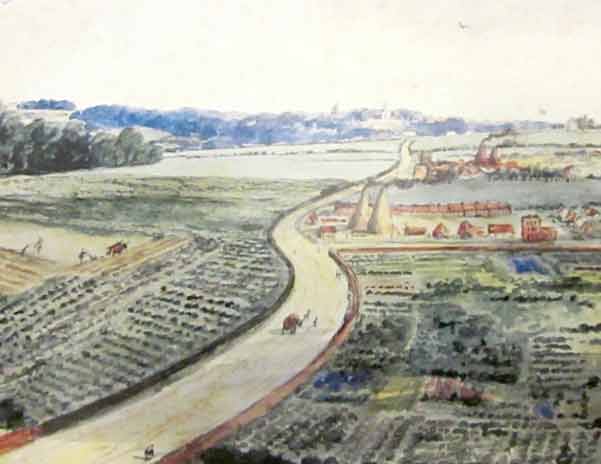
Detail of Maiden Lane (now York Way) in 1835, painting by E H Dixon. From Islington Library. Dickens walked this route in May 1836, past the tile kilns on the right and on to Copenhagen House. The nearer kilns are Randalls and the further set are Adams.
The current Maiden Lane is a very small off-shoot of the original which was renamed York Way around 1850 when the street layout altered with the coming of the railway. There was a Randall's kiln works in the area, but I haven't researched it. However, I understand from John Green that the workers' cottages, Randell's [sic] Cottages, in Maiden Row, off Maiden Lane, were built before 1841. (John Green was looking for William Brown born about 1808 in Hertfordshire and resident at the cottages in 1845. William was not there in 1841).
Old pottery works at Lambeth
There were pottery works at Lambeth on the south bank of the River Thames since Roman times and a sizeable community of potters there in Victorian times.
Although it has not been possible to trace my direct Cole ancestors to pottery work at Lambeth, this is likely to be due to the difficulty of identifying specific individuals, whose names tend to be the common ones of James, John and Charles with no identifying second given names.
There certainly was a significant Cole contingent at Lambeth during Victorian times. The 1851 census gives no less than 98 Cole individuals as having been born in Lambeth. The oldest was age 71, giving a birth date of 1782. The 1841 census would have yield more if only it did not omit places of birth. What it did show, though, was that very few Coles remained living in Lambeth at that time. In contrast to Lambeth the 1851 census showed that there were 55 Cole individuals born in Islington and 5 in Lewisham - other pottery and brick producing areas where the Coles worked. (Sadly the 71 year old Cole, although bearing the family name of James, was described as a 'gentleman' (i.e. of independent means, rather than a tile-maker or brick-maker, so no conclusions can be drawn about whether he was of 'our' Cole family.) However, our Colley family of potters who intermarried with our Coles certainly had a presence in Lambeth. We know for a fact that, sometime around the 1820s, the Colley family of potters moved north of the River Thames to the Tile Kilns in Green Lanes, Tottenham.
In the second half of the 18th century, the Lambeth potters lost out to Staffordshire potters, who developed a non porous, cream-glazed earthenware more suitable for domestic tableware. The history of pottery in Lambeth since 1815 is dominated by Doulton, although a few small potters continued there.
Incidentally there was a Daniel Cole of St Mary's, Lambeth, contemporary with 'our' Daniel Cole, who I hoped might have been a relative. His will was proved on 20th February 1839. His occupation, however, was not stated and the names of his legatees were not our family names. His wife was Jemima and family names appear to be Matthew, Daniel, Kezia, William ... but the old writing of the will is very difficult to transcribe.
Names stick across the years
Randall's kiln works gave their name to Randell's Road which is just south of Tileyard Road.
Interestingly, too, is that there is a road called Brandon Road just north of Tileyard Road. Brandon is a Cole family name. Elizabeth Brandon married E.G. Cole and the name was then perpetuated in the given name of their son, Sidney Brandon Cole. According to A History of the County of Middlesex (1985), the road was so named after a Samuel Brandon who owned land there as well as elsewhere in England. There was probably a connection between him and Elizabeth Brandon. There is a story there for anyone who wants to research it.
| sources | webmaster | contact |
Privacy Policy Cookie Policy Cookie settings
Text and images are copyright
If you can add anything to this page or provide a photo, please contact me.

