 potteries
as
industries the Cole
Pottery
Tottenham pottery
working
practices pottery
house
1910s-1950s Sid Cole
pottery
owner E.G.Cole
pottery
owner J.R.Cole
pottery
manager John Cole
pottery
founder Daniel Cole
potter,
seaman Cole
ancestry Pettit
Pottery,
Walthamstow Tile
kilns Arkley
pottery Bristol
potteries Cox-Reedman
Australian
brickworks J C Reedman,
Australian
sportsman Reedman ancestry Distant
cousins
in the USA Early English brickworks

The Tile Kilns pottery and brickmakers
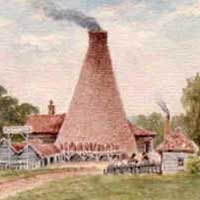
A timeline history of the Tile Kilns where various members of the Cole family learnt their pottery and brickmaking skills before setting up in the Cole Pottery in White Hart Lane, Tottenham. Photos courtesy of Bruce Castle Museum.
____
by the webmaster from family recollections and research
As London sprawled ever outwards during the eighteenth and early nineteenth centuries, the potters and brickmakers who produced the building materials moved outwards with it. For some time in the early nineteenth century, my Cole ancestors did settle as employees at an establishment known as the Tile Kilns.
The location of the Tile Kilns
A double problem faced me when I tried to find out more about the place. Both its name and its location seemed so elusive that I thought at first that I was chasing a number of different potteries and brickworks. However, through a process of gathering information and comparing possibilities, it eventually became clear that they were one and the same. The records from over the years show such continuity as to leave no doubt. The apparently different locations (of Islington, Finsbury, Stoke Newington, Tottenham and Wood Green) were, in fact, little more than labels. The pottery was in a rural setting for most of its life and either these were the nearest centres of habitation - or families chose to go back to where parents or grandparents lived for registering their civil records - or the format requirements for the records changed over the years.
Also, the place had been known by various names during its lifetime. The Coles certainly worked there, but they did not own it. Common names in the records were for the Potteries at Green Lanes, Williamson's Pottery, and of course the Tile Kilns. In those early years, 'tiles' often included bricks. You may have noticed how thin bricks are on old buildings.
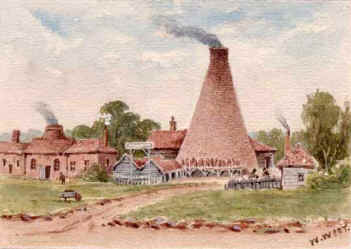
Painting of the Tile Kilns undated. The track later became Tileyard Road
On the site today is a Sainsbury's supermarket, approached from Williamson Road. You can see the location by putting N4 1UJ into a suitable modern map. The area is now called Finsbury Park and is densely built-up - but the name Williamson lives on with a nod to the one-time owner of the Tile Kilns.
A timeline history from civil records
I became interested in the Tile Kilns from the death certificate of my great great grandfather Daniel Cole which gave the Tile Kilns as where he died in 1840.
I then looked into the birth, death and marriage certificates of members of the family; census records; trade directories; maps; the Poor Law rating records and various old pictures and photographs. The secondary sources included some family notes on parts of the Colley and Pettitt families and the book The Story of Harringay Stadium and Arena (Mike Ticher, 2002, Hornsey Historical Society) For all this, Bruce Castle Museum was invaluable.
The surnames Cole, Colley, Pettit, Sharp and Dean all feature in the following civil records for the Tile Kilns.
It was not clear when the Tile Kilns began operating. The Cole family appear to have moved there from Islington some time before 1806, as their youngest recorded son was baptised in the nearby Stoke Newington. Previous children had been baptized in the parish of St Pancras, Islington.
In 1826, the pottery was trading as 'Scales Wm, brick and tile manufacturer' as given under the 'Miscellaneous' heading in Pigot's Trade Directory for 1826, 'Middlesex - Tottenham High Cross'. This is the earliest contemporary record that I have identified so far and I would not have recognised it as pertinent had I not been alerted to the owner's name of William Scales via later rating records (see below).
The baptismal record for All Hallows Church, Tottenham, shows that twins Catharine (sic) and Anne were born to Thomas Cole, labourer, at the "Tile Kilns, Tottenham" on 31 March 1828.
When a Caroline was born to Thomas Cole on 6 July 1830, the parish record for All Hallows, Tottenham, again gives the location as the "Tile Kilns".
The entry in Pigot's Trade Directory for 1828-29 also cites The Tile Kilns.
But by 1839, Pigot's Trade Directory for 1839 gives the record under "Brickmakers" as "Scales William, Wood Green ward".
The 1840 death certificate of Daniel Cole which gives his place of death merely as the "Tile Kilns, Tottenham" and states that he was foreman there at the time.
A year later, the 1841 census refers to the workers' cottages as "Tile Kilns, Green Lanes".
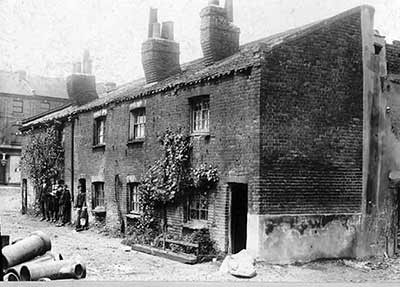
Workers' cottages attached to Williamson's Pottery
There is a rating record for 7 November 1843 which gives more information. It has an entry for "Land and Potteries, Green Lanes", followed by "Tile Kilns and Land", followed by "13 cottages compound", all owned by "N. V. Lee". The names of the occupiers of the cottages are not given individually, although there is a single entry for "Name of occupier" as "Scales William". His name does not appear in the census data for the cottages, so he probably leased or rented the cottages for the workers. (Incidentally the rateable values were respectively £120, £45 (for all 13 cottages together) and £39, and the rates paid at one shilling in the pound were respectively £6, £2/5s and £1/19s.)
In December 1850, the rating record gives the full name of the owner as 'Nathaniel Vye Lee'. The name of the occupier is still 'Scales William' but the words 'for others' also appear. The description of the property is identical to that of the 1843 record.
The 1851 census of the workers' cottages refers to them as "Tile Kilns, Green Lanes".
In October 1853, the birth certificate of E.G.Cole gives his place of birth as 'Tile Kilns, Tottenham'.
In November 1855, the rating record is identical to the earlier one.
In November 1857, the birth certificate of James Reedman Cole gives his place of birth as 'Tile Kilns, Tottenham'.
The 1861 census of the workers' cottages refers to them as 'Green Lanes Tile Kilns'.
In the January 1870 rating record, Nathaniel Vye Lee is still given as owner, but the occupier has changed to 'Scales and Company' followed by the names of the inhabitants of the cottages, one of which is empty. The property is as described in the earlier rating records except for a new entry of "Brickgrounds", also owned by Nathaniel Vye Lee. Scales and Company now also seem to occupy Common Land owned by the Parish and Manor.
The 1871 census of the workers' cottages refers to them as "The Potteries, Green Lanes, Tottenham". The names of the occupiers, now given for each cottage, is a very close match to that in the 1870 rating record but my great great grandfather John Cole is gone - although another branch of the family remains. John had in fact gone to start the potteries at Walthamstow which were to become the Pettit Potteries.
In the January 1880 rating record, the entry has become: "Land and Potteries, Tile Kilns and Land" owned by Nathaniel Vye Lee and occupied by "W. T. Williamson"; "Common Land" owned by the Parish and Manor and occupied by W. T. Williamson; "Brickground and ...?..." owned by Scales and Company and occupied by W. T. Williamson and the cottages, now 14, owned by Scales and Company and occupied by "W. T. Williamson for [the names of the workers]". This is the first mention I have found of the Williamson name in connection with what was to become a household term in the locality - ie "Williamson Pottery" or "Williamson's Potteries" or just "Williamsons".
In the 1881 census the workers cottages are listed as "The Cottages at Potteries, Green Lanes, Tottenham". Not surprisingly there is a close match between the individuals in the census and the names on the 1880 rating record.
In the 1890 rating record the property comprises: "House and Potteries, Tile Kiln Land, Common Land, Brickground, Office Buildings and fourteen houses". The occupier of all is W. T. Williamson, although the word "for" is inserted with respect to cottages (now called houses). The inhabitants are not listed by name.
The old writing is difficult to read, but the owner of the house and potteries looks like "Col Walter Raleigh Gilbert" who also owns the brickyard. The Parish and Manor still own the common land, and the office building and the houses are owned by W. T. Williamson.
Photographs from Bruce Castle Museum dated in 1897 show that the property had effectively become derelict. There were various clay items lying around which support other records that in spite of the earlier name of "Tile Kilns", tiles - as they are known today - were not the only products. The output was far more wide-ranging, and included bricks, tiles, drain pipes and chimney pots as well as horticultural pots.
The property, as listed in the 1900 rating record, is identical to that in 1890 except that "J C Hill and Co" now replaces Col Walter Raleigh Gilbert as owner of all but the offices and houses, which are owned by W. T. Williamson. J C Hill and Co also own adjacent shops. The ownership of the Common Land appears to be missing.
In spite of the apparent state of the property from the photographs of 1897, Kelly's Trade Directory for 1902 lists the firm as still trading. It appears under "Brick and Tile Merchants" as "Williamson W. T. and Sons Lim, Green Lanes, Finsbury Park N.
According to sources in Bruce Castle Museum, Williamsons Pottery closed in 1905. Also in 1905, the pottery cottages were condemned by the Medical Officer of Health as unfit for human habitation. Nevertheless, in their time, they would have been highly desirable, as only progressive establishments provided accommodation for workers and their families.
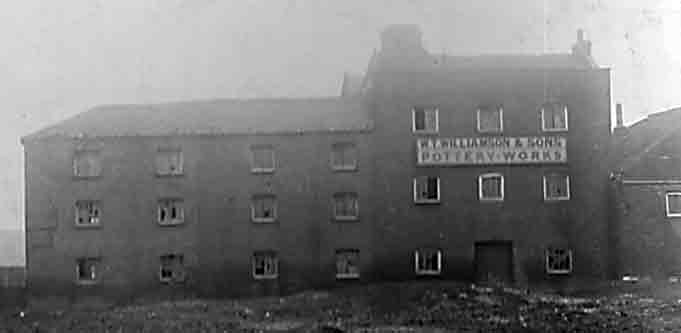
Front of Williamson's Pottery, also known as the Tile Kilns, derelict after closure
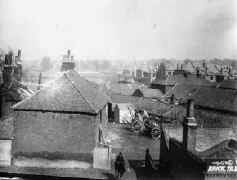
Side view of Williamson's Pottery, also known as the Tile Kilns
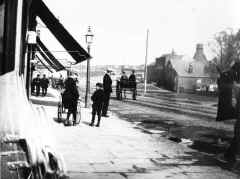
Distant view of Williamson's Pottery showing its kiln
According to the book by Mike Ticher, the site next served as a rubbish tip for a number of years. It was then developed for the Harringay Stadium, which was opened in 1927 and closed in the 1950s.
On the site today is a Sainsbury's supermarket, approached from Williamson Road. You can see the location by putting N4 1UJ into a suitable modern map. The area is now called Finsbury Park and is a built-up area - but the name Williamson lives on with a nod to the Tile Kilns.
| sources | webmaster | contact |
Text and images are copyright
If you can add anything to this page or provide a photo, please contact me.

