 candlestick
phones wind-up
phones public phones
1920s-1930s manual
telephone
exchanges area codes
and
direct dialling using a
dial phone
1940s-1950s public phones
1940s-1950s costs of calls
1940s-1950s illegal
free calls
1940s-1950s house
phones
1940s-1960s telegrams
importance
in the past telegrams
from sending
to delivery

How to use a mid-20th century dial telephone
Recollections of using dial telephones from the webmaster with original firsthand contributions from others who used them, edited together by the webmaster.
By the 1930s some UK phones had a dial that could connect directly to several areas of the UK, and by the 1960s this was the case for almost all UK phones. This page explains in detail with illustrations how to find a number, how to dial it and how to receive a call. Also discussed are the oddities of why the Q is missing on these dials and why there is no distinction between the letter O and the number 0.
Structure of mid-20th century phones
All modern UK telephones of the 1940s and 1950s Britain had a handset which rested on a cradle as shown below. The handset contained a mouthpiece at one end and an earpiece at the other. There was a dial on the base.
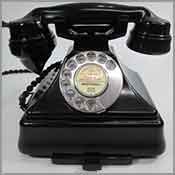
Several steps were needed in order to use these phones. They are described here in some detail although they were straightforward and second nature for us at the time.
How to find a telephone number
First, the caller needed to know the phone number of the person to be called. This was just known as the number, even though it started with a three-letter area code as explained elswhere as subscriber trunk dialling, STD.
Every household and every public phone box was provided free with several massive, heavy and unwieldy books of telephone directories. These listed telephone numbers in alphabetical order by surname of all the subscriber in that area - except those who opted to be ex-directory.
Most people kept their own record of numbers that they used frequently.
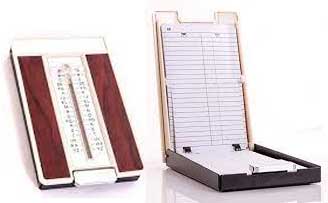
Personal telephone directory also known as an index. The central slider was moved down to the initial
letter of a person's name. Then the catch at the bottom was pressed which lifted the top to show the phone numbers
for people whose names began with that letter.
There was no way of storing a number on the phone. It had to be redialled every
time it was used.
How to make a phone call: the dialling process
To start making a call, the caller lifted the handset from its cradle and listened to hear the dial tone - also known as the dialling tone. If there was no tone, the phone either wasn't working - a not uncommon situation in and after the Second World War - or was one of the very early phones.
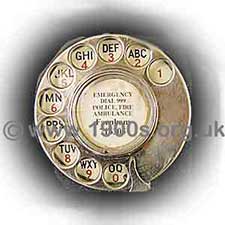
On hearing the dial tone, the caller would dial the number of the person to receive the call. The dial had ten finger holes showing both numbers and letters, as shown in the image below. The numbers were 1-9 and O and the letters were A-Y, normally shown in threes: ABC, then DEF etc. To dial someone, the caller put a finger into the dial hole that showed the letter to be dialled - it didn't matter whether it was shown first, second or third - and dragged the dial round to the 'stop'.
Detail of the dial of a 1940s phone. Photo taken in Farnham Museum.
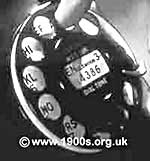
Dialling by pulling round the telephone dial with a finger in the hole above the number/letter.
On removal of the finger, the dial returned itself to its original position. As it returned, it made a series of clicking sounds: one click for the first hole, two for the second, etc. It was then ready for the next letter to be dialled - again it didn't matter where in the three letters the significant letter was - which I always felt was rather clever.
After dialling the last of the three letters of the area code, the process was repeated with the numbers part of the phone number.
The number of clicks automatically indicated the number required to the exchange. With STD, no human intervention was required.
The caller knew that the dialling had been successful because they could hear the recipient's phone ringing in their own earpiece.
Going through the operator and trunk calls
Where the phone to be connected with was not yet part of the STD system - i.e. still having an all numbers code with no letter area code - the number couldn't be dialled directly outside its local area, and the connection had to be made through the operator, the 'operator' now being the grand name for staff at the telephone exchange. Such calls were called 'long distance' or 'trunk calls'.
There were, though, other reasons for needing to talk to an operator. It was relatively common in the 1940s and 50s because something often went wrong with the call that the caller needed to be put right by the operator. To call the operator you simply dialled O.
Booking a trunk call
contributed by Neil Cryer, recollections
As a child in the 1940s I remember my parents talking about having to arrange a trunk call to a distant town. Apparently you couldn't rely on being able to do it on the spur of the moment.
Going through the operator was not necessarily quick because long distance calls had to go through several operators along a line of telephone exchanges, each one making connections by plugging in cables. Callers just had to hold on and wait. Then it would happen, and the operator would say, "You're through, caller". If you were lucky, she would then disconnect herself, but unfortunately operators were often bored or just inquisitive. So they listened into calls and users always had to assume that their calls were not private.
Trials of going through the operator
contributed by Amanda - full name supplied - a recollection
On one occasion I had to phone my boyfriend's place of work from a public phone box, going through the operator, and when she put me through, my conversation was almost drowned by the music of "I Can’t Get No Satisfaction" being played down the phone by the operator. I’m sure she thought it was very funny. I did not.
The Q, O and 0 on old telephone dials
contributed by Peter Simmons, an interested party
Most old telephone dials seem to have Q, O and 0 at the far end of the dial, i. e. the O and Q are not in alphabetical order and the zero is not in numerical order.
This is probably because the three look so similar that it avoided misdialling. In other words, if someone meant to dial O and dialled 0 by mistake, it would not matter because the same code would be sent to the exchange. It is interesting to speculate whether the order of the letters on the old dials could be the origin of zero being frequently pronounced as 'owe'.
Interestingly, an image search on old telephone dials shows that the Q was missing entirely on some dials.
Receiving a phone call
The phone rang when a caller was trying to get through to someone. To receive the call - or 'answer the phone' as it was called - you just lifted the handset from its cradle. The correct procedure was to let callers know that they had the right number. Our telephone number was Stonegrove 8105 - yes it was called a number even though it contained the area code in letters. So our family would simply say into the handset "Stonegrove 8105" and wait for the caller to respond. At that time, it was considered socially incorrect just to say, "Hello", and it would never have occurred to anyone outside a business situation to say their name instead.
Returning the handset to its cradle cut off the call and was known as 'putting the phone down'.
Embarrassing experiences of 'putting down the phone'
contributed by Jan Clifford, a recollection
As phones in homes were comparatively unusual while I was growing up, I was in employment before I needed to answer a phone call. The bell rang, so, being alone, I picked up the handpiece and gave the name of my employer, as I had heard others do. The caller asked for a person I would need to go to find. Naturally, I could not take the handpiece with me. So I put it back on its cradle. This cut off a number of calls this way. Eventually it was explained to me that I should leave the handpiece on the desk, off its cradle, to keep the connection alive.
| sources | webmaster | contact |
Text and images are copyright
If you can add anything to this page or provide a photo, please contact me.

