 Victorian
mass housing
estates a typical
house rents
and
incomes house
plans the
kitchen the
kitchen
fire the
scullery the
parlour the
bedrooms the
sash
windows the
front
approach the backyard and
garden garden pests
and
solutions the
outside
lavatory

Garden pests in Britain: then and now
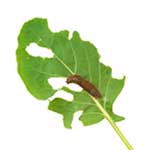
This page shows how common garden pests have changed since my mother was growing up in the early 1900s and I was growing up in the 1940s and 1950s. The page starts with slugs because the old ways have much to teach us today. It goes on to look at how the numbers and behaviours of foxes, squirrels and pigeons have changed and how this affects us humans. Finally, it examines the garden pests that continue to annoy us unabated: moles, rabbits and rats and mice, and it looks at the old treatments for these pests.
Slugs pests
Slugs and snails have probably always been among gardeners' major enemies. They can strip young seedlings overnight and leave holes in leaves, especially in damp weather, slowing growth and eventually killing young plants.
In the recent past, shops sold slug pellets which were wonderfully effective. So why not now? The answer is that they were regarded as poisonous to birds. I do not know how poisonous, but I and other gardeners do know to their cost that the replacement slug pellets simply don't work.
This is where the old ways really do come to our rescue. I read about beer traps for slugs in a Victorian gardening book, and although I would much prefer just to sprinkle effective slug pellets, that option is no longer available.
How to make beer traps to kill slugs
You need several small waterproof containers which don't have to be the same size. Presumably in the past, gardeners used glass or pottery ones, but these would have to be washed before re-use - hardly pleasant when full of dead slugs. Today we have a more pleasant option in the form of tiny, thin plastic pots that are throwaway items when we buy certain food. I have used individual cake, pudding, and or trifle containers, but there are lots of options, and you probably often buy something suitable in your weekly shop.
The containers need to be at least 15mm deep and the smaller the better, so as not to waste beer. Below is one I used recently.
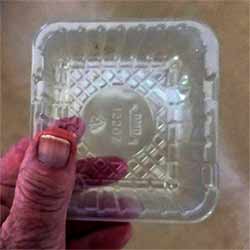
Flimsy, throw-away container bought holding a single
serving of a dessert. My hand is included for scale.
The container can be any
size or shape.
Wherever you spot severe slug damage, dig a hole close-by, just wide enough and deep enough for your container to fit inside with its top roughly level with the top of the soil.
Then half fill it with beer. The beer will froth up to the top of the pot before subsiding to a suitable depth.
Leave overnight.
When you come back in the morning to look, I think you will be amazed at how many dead slugs are in the beer. Slugs can't resist beer; they climb into it but can't get out.
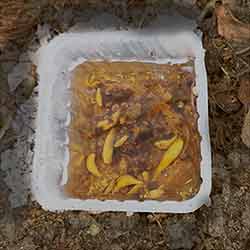
Young, dead slugs in a beer trap. They look like elongated, flat seeds.
The image shows young slugs, caught early enough to minimise excessive damage.
Slug traps seem to clear the area around them for a surprising time. I often find that one early treatment is enough.
Perhaps the traps allow time for the plants to grow tougher and less appealing. I certainly don't see so many flat slugs later in treated areas.
Fox pests
It was quite rare to see a fox when I was a child, either in gardens or when walking in open countryside.
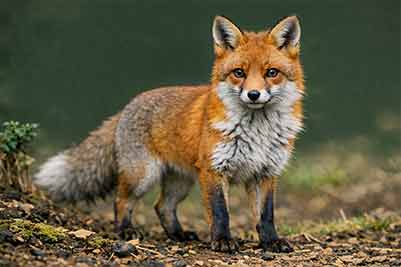
A fox
We did glimpse a fox from time to time, but it was a talking point, "Look everyone, a fox!". As soon as the fox saw us, it would stand stock still for an instant and then dart rapidly away from us or behind a bush. This was so, even if we were already quite a distance away. Foxes were naturally scared of humans.
Foxes have now changed their temperament dramatically. People laugh when I say this, but it is no joke. As I write in 2020s, foxes come into our back garden in increasing numbers. If they see us there, they still stand quite motionless, but no longer for an instant. They stay and glower directly at us, as if trying to stare us out. If we stare back, they eventually carry on calmly walking in their original direction.
If we shoo the foxes of today, they do sometimes amble away - yes, amble, not run - but if we didn't see them in time to shoo, they would come into the house if they felt like it. In fact there have been cases of this reported in the media. There have even been high profile cases of foxes biting humans inside their own homes.
It is impossible to keep the foxes out of the garden. I have seen them clamber over six-foot fences. I am told that they can climb up quite high trees, although I have never seen this. They can certainly stand on their hind legs to reach for low plums. That is my main reason for categorising them as pests.
In good weather, we now have to keep downstairs doors and windows shut unless we are nearby.
Squirrel pests, red and grey
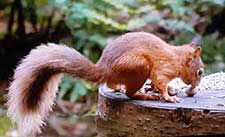
A red squirrel photographed in Scotland
In my childhood in the 1940s, it was entirely normal to see red squirrels scampering around. People liked them and as far as I know, no-one complained of them being pests. Now, they have been replaced by grey squirrels in almost all parts of the country. They cause a great deal of damage to trees, plants and gardens generally.
Back in the 1940s I never saw a grey squirrel. Yet I am told that authorities did recognise their incipient danger as pests because even at that time a shilling was paid to anyone who could confirm a killing by bringing in a grey squirrel's tail. It didn't last. Either it was too difficult to catch the squirrels or it became too expensive.
Grey squirrels strip the bark from trees to feed on sap which can make them susceptible to fungal infections. I am told that grey squirrels are directly competing with birds that rely on deciduous trees for food and nesting sites.
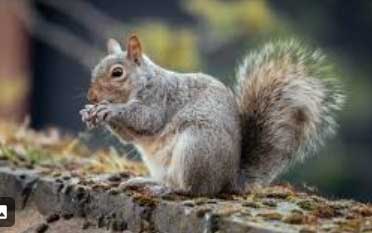
A grey squirrel which could be photographed in almost any family garden
Pigeon pests
Protecting cabbages etc from pigeons is a problem that has increased over recent years with the increasing pigeon population. In particular, they attack the young shoots of fruit trees. They just leave a carpet of them under the tree. It is not really practical for ordinary people to cover trees with netting My family did try once with a small tree, only to find that the pigeons packed through the netting, and removing the netting tore at the tree causing its own damage.
In my experience, though, pigeons actually eat young leaves of some trees. Certain plum trees seem to be their favourite in my garden. In a bad year, they leave only a few millimetres of the leaves left, understandably, making the trees too weak to bear plums.
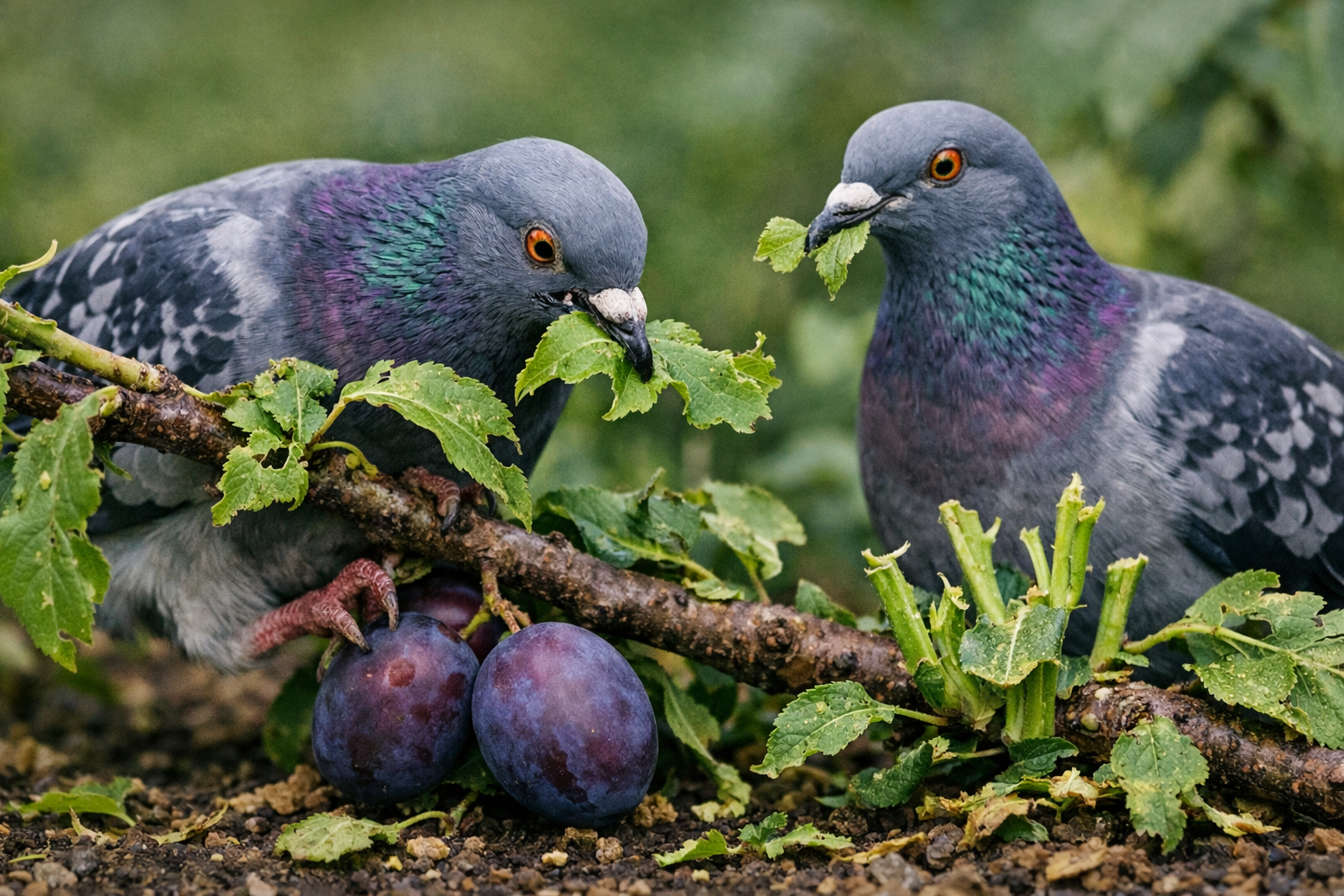
Pigeons eating plums
Moles pests
Moles were and still are significant pests in the garden if you are unlucky enough for them to make their home in your garden. They make unsightly piles of soil - called mole hills - in beds and lawns. These are the result on moles tunnelling in the ground and having to put the soil somewhere.
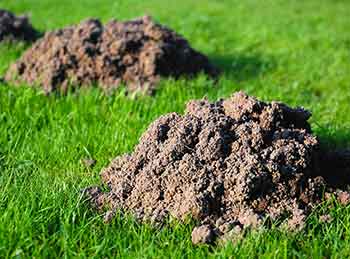
Mole hills in a garden lawn
Mole hills clearly show a mole infestation, but there is another way. If you walk over the tunnels, your weight compresses them and older people can lose their balance.
One of my relatives bought in a professional mole catcher once. He sat stock still for hours looking at the ground ready to shoot into the ground to kill the offending mole - but he was unsuccessful and still had to be paid.
The accepted way of dealing with moles involves mole traps which have to be placed in the ground blocking one or more of the tunnels. I understand that it is a messy business to locate suitable tunnels and success is by no means guaranteed. Persistence normally pays off eventually.
Rabbit pests
Wild rabbits were significant pests to farmers in the past, even though they were welcomed by shooting parties as a free source of meat.
They were and still are rare in town gardens, although they do often manage to creep into rural gardens which border onto open spaces. I have had rabbits in my garden. They eat avidly and are extremely difficult to get rid of once they have found how to get in. It is best to spot them early, chase them away and then carefully look for where they came in and block it up securely.
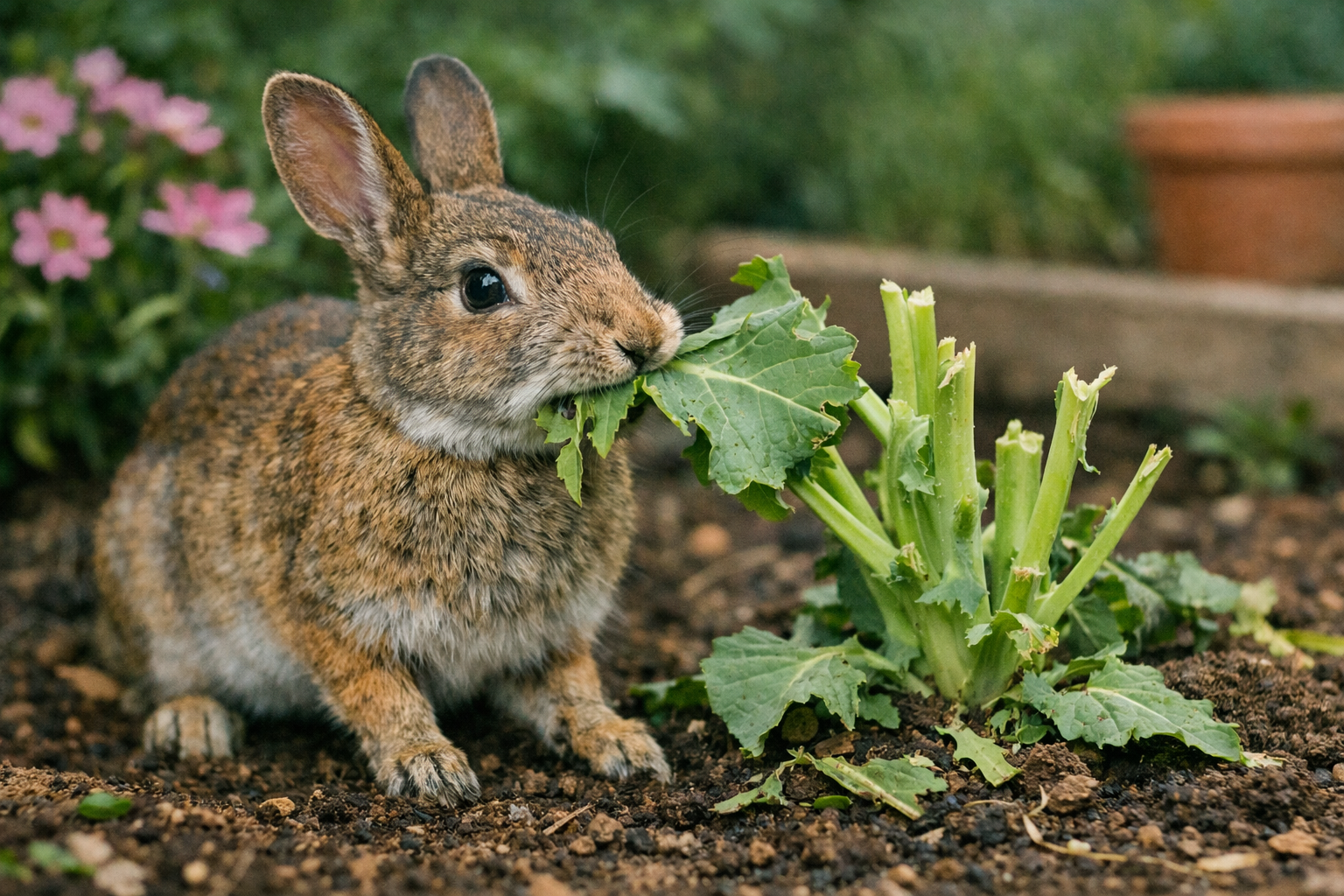
Rabbit attaching cabbages
Wild rabbits for food in wartime
contributed by Neil Cryer
On other pages, I describe how rabbits emerged as the corn was cut at harvest time, and how my young friends and I would chase them and the farmer would share them out for meat. I also describe watching my father on a shoot.
Rats and mice pests
Rats and mice have always been a nuisance, and they are today. I see them scampering around in my garden, but I never see any damage from them in the garden itself. But - and it is a very big but - they do cause significant damage when succeeding in getting at food which humans are storing.
My family have always stored our apple crop on cardboard trays on shelves in our garden shed. We check for entry points, lock windows and lock the door and leave the shed alone until we want to start the stored apples. But this year, we found the apples nibbled - and once nibbled, they go bad and we can't eat them.
So where were the mice getting in? They had actually made two large holes in the wooden floor by persistent nibbling! The floor was off the ground. To get there from outside, the mice had to manoeuvre upside down to get to where they decided to nibble their way in. We set mouse traps bated with cheese. Their design has changed little over the years. They work well and they worked for us, but the crop of apples was lost.
Worse still, a friend of mine, having come back home from a weekend away found two very large holes in her wooden larder door. The droppings inside the larder showed that the culprits were rats. I didn't like to ask about her clean-up process. Certainly I wouldn't want to eat any of the stored food, however well-wrapped it was.
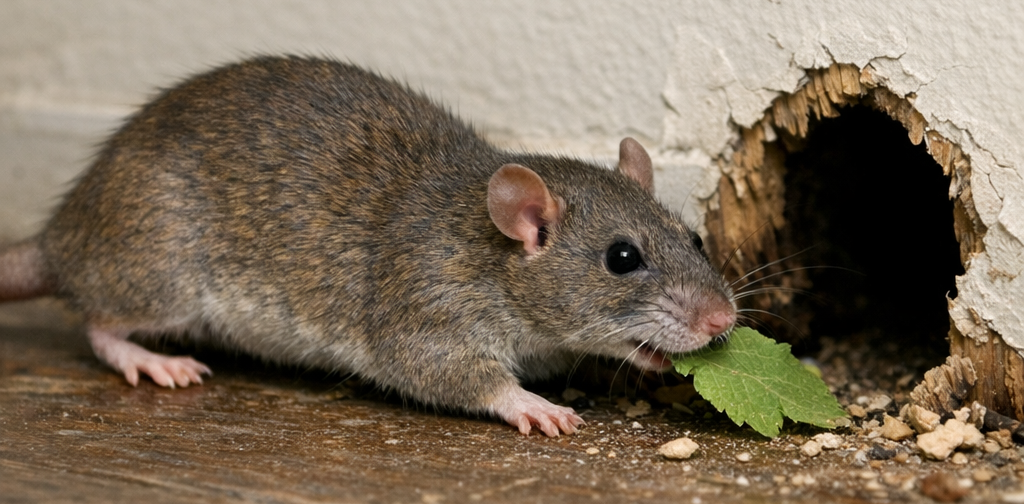
Rat or mouse hole
Conclusion
Some things haven't change over the years. Gardeners often have to admire pests' diligence one minute and try to protect the garden from them the next.
| sources | webmaster | contact |
Text and images are copyright
If you can add anything to this page or provide a photo, please contact me.

