 British farms
before
WW2 women's
work on old
farms ploughing reaping threshing bygone
harvests harvest
festivals silage in
the past silage
production
modernised haystacks blacksmiths
How and why British farms used to be different from today
What everyday work on British farms used to be like: firsthand memories, family recollections and historical explanation describe ordinary farming before mechanisation and economic need transformed the countryside.
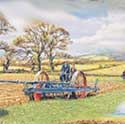
This page describes the 'mixed farming' of before and during World War Two and it explains why it had to change into what we know today.
____
Mixed farming and what it entailed
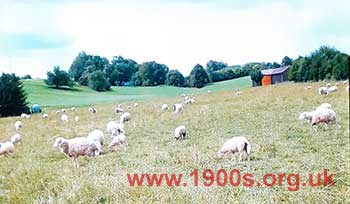
In the past, farming was almost entirely 'mixed' in that, unlike today, there was no single speciality such as, for example, just dairy farming or just pig farming. Most farms usually had a small flock of sheep, a small herd of cows, a bull, a few pigs, chickens and some crops.
The sheep
Counting sheep
Recollections from John Boulton, who grew up on a farm
Where flocks of sheep were quite large, anyone trying to count them would quickly lose count, but there was a way round this. Each area of the country had its own way method.
On farms in Lincolnshire where I grew up, it was general practice to count sheep in units of 20 called scores where one score=20. A shepherd would count up to twenty and then pick up a small stone and put it in his pocket. At the end of the count, he would just count how many stones he had in this pocket, which told him the number of scores of sheep he had.
This counting method stems back to the Celtic language with dialects tweaking how it was spoken in different parts of the country. In 1912, George Wright, of Minting, near Horncastle wrote the Lincolnshire way in my grandfather's autograph book. To us today it may look like nonsense syllables, but apparently it worked well and was chanted like a rhyme.
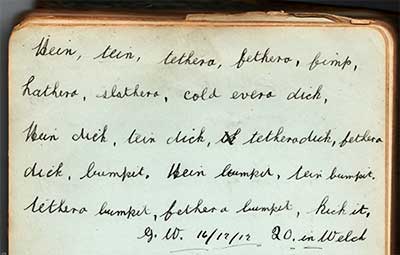
A way of counting sheep in units of 20. Apparently the writer, George Wright believed it to be Welsh, although, according to John Boulton, the origin was Celtic.
Yan, tan, tethera, pethera, pimp;
Sethera, lethera, hovera, covera, dik;
Yan-a-dik, tan-a-dik, tethera-dik, pethera-dik, bumfit;
Yan-a-bumfit, tan-a-bumfit, tethera-bumfit, pethera-bumfit, figgot.
The cows and the bull
There were usually about twenty or thirty cows to one bull.
The cows were milked twice a day in the cowshed. They were taken into the cowshed at night and led out to the fields in the daytime. The bull, though, was not allowed in the fields with the cows because he could be dangerous. He lived inside a barn He had a ring through his nose for a rope to be inserted so that he could be led out when necessary to out to service a cow. Farmers knew when a cow was ready for servicing because her milk was drying up or it was some time since she calved.
The cows were bred for meat as well as for milk.
The pigs
Pigs were kept in a fairly small confined and muddy space called a pigsty. In fact any untidy, dirty human living room was often described somewhat rudely as a 'pigsty'.
Pigs were not normally allowed out of their pigstys. I well remember walking past them as a child. The pigs were as muddy as the pigsty, not that there seemed to be any indication of ill-treatment. I understand that they would eat almost anything, including pig swill.
When the pigs were fat enough, they were taken to market or a butcher for slaughtering.
Sizes of pigs for the slaughter - and the resulting taste
Recollections from John Boulton, who grew up on a farm
In our family farm, my grandfather used to kill two pigs a year, one just before Christmas and one just after. He wouldn't kill a pig until it reached twenty-score live weight - that's 400 lbs (181 kg). That's really huge. Today pigs are slaughtered between 80 kg and 100 kg. Even the large 100 kg ones tend to be too large for the supermarkets, so are graded out for bacon. That is why pork and bacon have no taste these days.
None of the meat on our huge pigs was wasted: There were pigs fry and sausages for the farmhands as well as a giant pork pie. The remainder was salted down to preserve it. It was my job as a boy to rub the salt into the meat for bacon.
The horses
The farm's horses were the heavy sort who were there for heavy work where there were no petrol driven vehicles.
They were wonderful large and strong animals, bred specially for farm work and they could pull quite heavy loads with comparative ease and respond readily to instructions. They were widely known as 'shire' horses, 'cart' horses or 'work' horses.
The horses' work
contributed by V. John Batten from personal experience
Probably the hardest work that the farm horses had to do was to pull the heavy reaping machine. Two pairs of horses were employed wherever possible. While one pair worked, the other pair rested in the shade.
The horses were tired and hungry at the end of the working day. They would usually walk at a faster pace homeward bound than they did going to work, because, as they neared the farm their thoughts naturally turned to food and rest.
In fact 'work horse' was a common term in my childhood. If my mother felt that she had been working particularly hard with no help from other people who had been lazing around, she would come into a room and announce, "Here comes the workhorse".
At the end of a gruelling and probably boring time in the fields, the men had to tend to their horses before themselves.
The horses lived in stables when not working.
The massive size of farm horses
An original memory from Pamela Southin
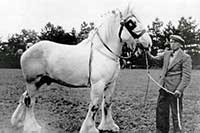
A farm horse
I remember a lovely farm horse which had furry ankles and an enormous flat back on which I said I could do ballet! I was very young at the time.
Crops
What was grown depended on the size and soil-type of the ground available. It could vary between what was essentially a kitchen garden which grew a few vegetables for family use and a few fields which were large enough to grow cereals which could be sold for profit.
There are several pages on growing and processing the wheat which was the basis of the all-essential bread: types of cereal grown; ploughing fields to rid them of weeds and prepare for sowing; cutting when ripe, known as reaping; removimg the outer husk of the grain, known as threshing; the leftovers once the grain is removed; and celebrating the completion of the work with harvest festivals.
Site and size of early farms
Early farms were relatively small compared to those of today, such that in rural areas, there seemed to be another farm every few miles in any direction. In general, the farmers rented them from fairly wealthy landowners.
Most people in Britain before the 1950s would recognise the features of a farm and farmyard because the countryside was only a short bus ride away from most towns. Double-decker buses gave excellent panoramic views of the fields, and the walks from bus stops took us into fields and through muddy farmyards.
Farmers never seemed to mind strangers walking through their fields and farm yards, provided of course that they did no wanton damage. Transmission of farm diseases like foot-and-mouth and salmonella didn't seem to be issues then.
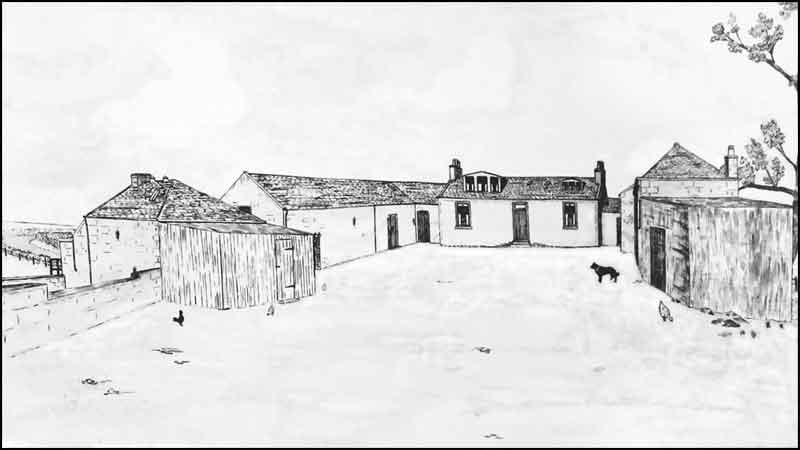
An early farmyard and farmhouse, courtesy of Bill Hogg - a drawing in his family of their old farm
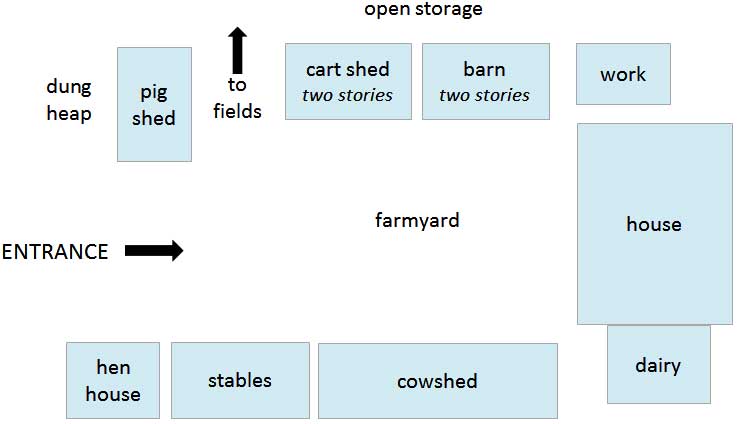
Map showing the functions of the various buildings.
Bill Hogg who supplied the drawings and provided much useful information, points out that the perspective is not entirely accurate in that the farmyard was wider and the farmhouse larger than shown in the drawing. Nevertheless the drawing gives a good indication of the almost higgledy-piggledy size and shape of the buildings as they grew up in an ad hoc manner as required.
The farmers, the farmhands and their families
The farmers who worked these small farms were known as tenant farmers because they rented their farms.
The farmer's family lived in the farmhouse, while the farmhands and their families lived in cottages some short way away.
They, their families and their farmhands had to work extremely hard for long hours because the mixed farming required so many different and essential tasks.
What changed and why: the end of mixed farming
The huge Government endeavours to keep Britain fed during World War Two and in the years afterwards meant that farming would never be the same again, because it was inefficient and output was low. Today's farms are almost always dedicated to just one type of produce and they take advantage of modern machinery and equipment - and farmers tend to be educated in the economics of farming.
| sources | webmaster | contact |
Text and images are copyright
If you can add anything to this page or provide a photo, please contact me.

