 Monday
washdays
early 20th C mangles
for squeezing
out water drying the
wash early 20th C ironing
early 20th
century the bagwash
mid 20th
century the laundrette
mid 20th
century twin-tub
washing
machines the Flatley
dryer

The laundrette: self-service coin-operated laundries: recollections
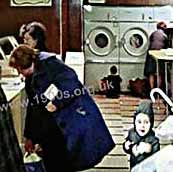
The webmaster has edited her experiences of laundrettes, 1950s-60s, into this page which reports on their popularity, the washing and drying processes, social aspects and closure.
Laundrettes were self-service laundries for washing and drying clothes using coin-operated machines.
Why laundrettes were so popular
Although twin tub washing machines had arrived in the 1950s, few ordinary people could afford them - and certainly they were well out of reach for newly married couples such as my husband and me in the early 1960s. The solution was the local laundrette.
So, like most recently married couples, we went to the local laundrette once a week taking our dirty washing with us. We walked with it, as did other people, pulling it behind us in our basket on wheels.
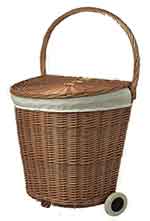
Cane basket on wheels, popular for shopping in the mid-20th Century UK and useful for carrying washing to and from a laundrette
As cars were far too expensive for the likes of us, these baskets were popular. They were made if cane, also known as wicker work. The cover protection against rain was an early plastic that discoloured and tore easily. Few people bothered with it.
Inside the laundrette
At the laundrette that I used, coin operated washing machines lined along one of the longer walls.These washing machines were all top loading.
The opposite wall was where the assistant sat at a table with scales for weighing the wash. I think it has a drawer in it for extra payments and her own personal belongings. I don't think there was a cash register, but this must have depended on the laundrette.
On the same wall were tumble driers which were front-loading and also coin operated.
In the centre was a line of seats for customers to use while waiting for the wash to finish.
What happened at a laundrette
On arrival, having ensured that we had the right coins for the machines, the assistant weighed our washing. We had to be careful not to be over the allowed weight and we had to be prepared to grovel if our washing included anything already wet which, was always heavy.
The washing powder always seemed to be supplied by the assistant at the time of weighing. This was probably to ensure that the right amount and right sort of low-lather powder was used, so to prevent stealing and suds spilling blocking the machines.
While the dirty washing was being washed and rinsed, it was a time for sitting down on the provided seats and watching other people, reading or just musing. It was quite hypnotic watching the washing going round and round.
The laundrette as a social centre
I can't remember how long a wash took, probably about half an hour. People were said to meet people and make friends while waiting in laundrettes.
Drying the laundry
We had to get up to look to see when our washing machine had stopped. Then we had to decide whether or not to use one of the tumble dryers which were on another wall. They were front loading.
There was usually a wait for a tumble dryer because there weren't many of them - and anyway they took more of our coins, and money was short for us newly weds. Usually we decided to take our wet washing home to dry with our Flatley. There were no radiators in the sort of flat that we or our contemporaries could afford at the time, on the top floor of a suburban semi.
We also of course still had to do the ironing ourselves.
Nevertheless, the laundrette was a lot better than having to do the washing the way our grandmothers did.
The closure of most laundrettes
As people became more affluent, or perhaps as domestic washing machines became cheaper, laundrettes became progressively less-used. They still remain in an updated form in specialist areas such as universities where the local population is living in some sort of temporary accommodation, but they are seldom seen today in town shopping centres.
NEXT Twin tub washing machines at home
| sources | webmaster | contact |
Text and images are copyright
If you can add anything to this page or provide a photo, please contact me.

