 Monday
washdays
early 20th C mangles
for squeezing
out water drying the
wash early 20th C ironing
early 20th
century the bagwash
mid 20th
century the laundrette
mid 20th
century twin-tub
washing
machines the Flatley
dryer

The bagwash, the forerunner of the laundrette, 1940s-1960s UK
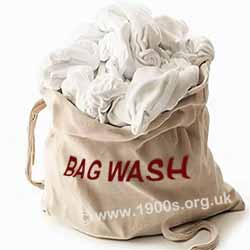
How the bagwash worked, comparisons with conventional laundries and why it ended - as told to the webmaster by older women who remembered using it.
The bagwash went some way towards freeing women from the drudgery of the Monday washdays of previous years and was the forerunner of the laundrette.
How the bagwash worked
Customers put their dirty 'whites' into a special bag, which is described below, and took it to the bagwash shop. They paid their money to the assistant and returned later to collect their washing, now clean, still in the same bag and still damp. This explains why the bagwash was also known as the 'wet wash'.
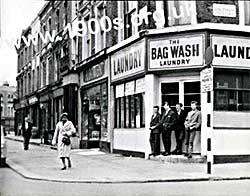
A bagwash shop courtesy of Aidan McManus
The bagwash compared with conventional laundries
Conventional laundries were available but they were too expensive for ordinary people. They handled items separately and had to mark each one to prevent loss. Marking was normally with a customer number, known as a laundry mark, attached either with tape which was sewn on or with a stamp. The ink was indelible so did not wash out. In contrast, bagwash items never got separated and almost never got lost. So they didn't need a laundry mark.
Conventional laundries returned the washing clean, ironed and aired. In contract, bagwash laundry was returned clean but crumpled, still damp and needing to be ironed and dried at home.
Conventional laundries could handle most types of fabric including colours as well as whites, whereas the bagwash only washed fairly whites.
The bagwash was the much cheaper alternative. So the bagwash was popular, particularly as it was open every day for customers to use whenever they chose.
The bagwash bag
The bagwash bag was supplied by the shop.
Some bags were like a soldier's kitbag and would hold 20 to 35 lbs of clothes. Others were like a sack, i.e. with no shape, much like sacks for potatoes. They were made of sturdy, thick cotton or linen which was permanently marked with a name or number which identified the owner. This had to be reprinted from time to time as it gradually faded with so much washing.
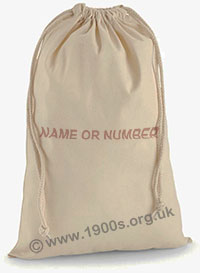
Bagwash bag or sack
The bag did up with a drawstring.
How the washing got to and from the bagwash shop
There was disagreement about how the bag reached the bagwash shop. Some people remembered that it was the task of a member of the family, often an older child, to wheel the bag in some sort of trolley, pram or push chair. They would be given a ticket which they had to produce in the afternoon to collect the clean laundry.
Other recollections were that the bag was collected and returned by van. Probably in some places both were options. It was probably a matter of how much customers were prepared to pay.
How we took the dirty washing to the bagwash shop
Name of contributor withheld
Once a week our bagwash was loaded on the pushchair and pushed up the hill to the bagwash shop where we queued up with all the other pushchairs and prams. On the way back, the youngest child in the family got to ride in the pushchair. This was in the late 1940s and early 1950s. On the way back our empty pushchair was often used to collect coke from the shop next door. So next time the youngest child sat in the push chair, they either had a damp bottom or a black one.
The washing process at the bagwash
None of the people I spoke to actually saw the washing being washed, but most of them were certain that it was washed in its bag and that washing meant boiling in soapy water, probably with soda. This is certainly reasonable because, in the days before washing machines, it was customary for women who did their own washing to boil and rinse their whites rather than actually washing them. The action of boiling with soap and soda did the cleaning. So it was assumed that the bagwash shop had something like a large copper in which it boiled a number of bags together. However, a full description came in once this page was up, from a visitor who wished to remain anonymous and had made detailed observations during personal experience of the bagwash.
Inside the bagwash boilers
Name of contributor withheld
My husband told me that he often arrived at the bagwash before the family's bags were had finished being washed, and he used to watch the machines.
The bagwash laundry used machines which looked like huge boilers - and I mean huge. There was an outer and an inner shell. The inner shell had separate segments, and each family's washing with its empty bag was tipped into a segment. When all the segments were filled, the outside shell containing the lid was locked down, then the washing was boiled, rinsed, drained and spun - all within its own segment. When the machine finished, each bag was pulled out and filled with its washing. The machine process was much like our washing machines of today, only bigger, except that the machines were segmented and took lots of bags at one go.
Apparently the returned washing smelled of bleach. So probably bleach was put into the final rinse. Maybe this was an option. I wonder if the bluebag was also used.
Still work to do back home
Drying the wash back at home
Name of contributor withheld
Our damp washing from the bagwash was hung out on lines strung across the kitchen ceiling. It was we children's job to do this, by standing on the table top. My mother would stand at the bottom handing up the next load and making sure we didn't fall off. We climbed up again later and changed the dry stuff for the next load. We did quite enjoy this but the sheets were heavy for us to manoeuvre.
The damp was so great we couldn't see across the room and the walls ran with water, but the washing did dry eventually from the heat of the cooking and with the outside door and windows open.
The ironing also took place back home.
The end of the bagwash: its disadvantages
Bagwash shops died out in favour of laundrettes for two main reasons. One was that laundrette washing machines could be set for any type of fabric whereas the bagwash only catered for whites that could be boiled. Also laundrettes had tumble dryers, whereas washing from the bagwash was always returned damp.
Around the same time, families began to buy their own electric laundry appliances for use at home.
NEXT Laundrettes
| sources | webmaster | contact |
Text and images are copyright
If you can add anything to this page or provide a photo, please contact me.

