






 postal
deliveries milk
deliveries bakery deliveries refuse collection rag and bone men insurance agents chimney sweeps ice
deliveries
knife
grinders


Refuse collection from houses
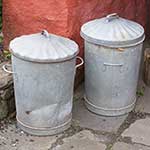
This page looks at refuse collection from the point of view of a householder in the early 20th Century, and is written from firsthand experience. It includes rubbish collection day, types of dustbin, the dustmen (bin men) and their clothes, tips and changes over the years.
____
Extracted from the memoirs of the webmaster's mother(1906-2002) and edited by the webmaster with further research
The dustbins
Every household had its own dustbin for the family's rubbish. These were all different sizes and shapes, because householders bought their own according to their needs and what was in the local shop at the time. All the dustbins were the same dark silver colour because they were galvanised to prevent them going rusty. Each dustbin had two handles at the side for lifting, and the lid had a handle in the middle - no wheels. There were of course no plastics.
Householders put their waste straight into the dustbin, sometimes, but not necessarily wrapped in newspaper.
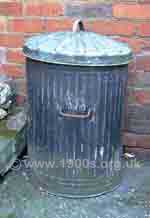
Where dustbins were kept
Dustbins were always kept as much out of sight as possible, but they had to be kept in front gardens because the only access to back gardens in our Victorian style terraced houses was through the house. (Larger houses had an alleyway going through to the back.) My father was a very particular person, and quite a handyman. So our dustbin stood on tiles with a privet hedge on one side to make it as inconspicuous as possible. In fact, it couldn't normally be seen from the street or parlour window.
Refuse collection day
Refuse collection was the responsibility of the Council.
The collection was weekly from a dust cart drawn by a horse. There were usually two men doing the collecting. They were known to us as dustmen.
On collection day, one of my parents would carry the dustbin out onto the pavement. Then, once the dustman had emptied it, they would carry it back behind its privet hedge and disinfect it with a pink powder.
The dustman's clothes
All dustmen seemed to wear the same style of clothes which were particularly suitable for the heavy, dirty work that the they had to do: flat peaked caps, dark trousers and donkey jackets.
The donkey jacket
Donkey jackets were heavy, dark coloured, of medium length and double breasted; they were made of wool and their most striking feature was that they hung down straight from the shoulders without tapering with the body. This allowed the dustmen enough width to raise their arms up to throw the contents of the dustbins into a lorry without pulling at the seams. Being dark, a good brush meant that they didn't show the dirt too badly.
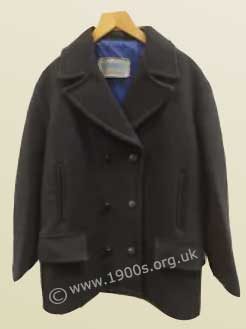
Donkey jacket with its typical loose sides and workmans soft, peaked hat.
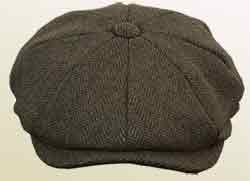
The dustman's hat
The dustman's hat was a soft, flat, peaked hat, typical of the time, suitably dark in colour.
There is a well-known song:
My old man's a dustman
And he wear's a dustman's hat ...
But there was nothing any different about a dustman's hat from any other flat, peaked workman's hat.
Tips to dustmen
The dustbins tended to get a lot of bashing. How much would depend on how the dustmen were treated. It was common practice to tip them a few coppers as a Christmas Box to keep them happy with us.
It must have been embarrassing for them, because they had to knock for it, in that dustmen normally went about their collections without having to speak to householders. One year, a dustman knocked at my mother's front door with a pencil and notebook and told her, "You owe the dustmen a Christmas Box". She was furious because tips were supposed to be given willingly - but she didn't dare show it.
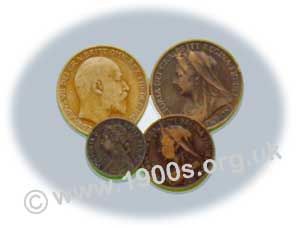
'A few coppers' - a typical Christmas Box for dustmen in the early 1900s in recognition for good service during the year. The picture shows an Edwardian penny, a Victorian penny, a Victorian halfpenny and a Victorian farthing.
What happened to the rubbish after collection?
The waste collected by the dustman was taken to some central depot from where it went into landfill.
Recycling
The idea of council-backed recycling was never considered, although recycling did happen all the time by householders, although it was never thought of by that name.
Also, the dustmen themselves picked over the rubbish and, completely legally, took whatever they had a use for.
At any time of the year, for a tip of a few coppers, dustmen would always take away larger things that we no longer needed. This was quite a source of income for them because they invariably knew how to dispose of most things profitably.
In fact, though, there seemed to be less rubbish then than today because everything that might possibly be useful was used in some way. Usually someone could make use of unwanted things, and if not, the dustman or the rag and bone man would take things away to sell on.
How refuse collection changed over the years
From the webmaster
By the time that I was a child in the 1940s and 50s, lorries had replaced the horse and cart and it was normal practice for dustmen to collect the bins from wherever the householder left them - which was from the far end of the side entrance of the 1930s suburban semis where I lived. Other than that, dustbins, dustmen's clothes, tips, collection days, etc. were just as they had been in my mother's childhood in the early years of the 20th Century.
There were still no wheely bins, no plastic bins, no separate bins for recycled waste, no plastic bags for messy waste, no high visibility vests or overalls marked with stripes and no subcontractor logos. Neither was it the responsibility of householders to carry their bins to a central collection point. All these came much later.
If you can add anything to this page or provide a photo, I would be pleased if you would contact me.
Text and images are copyright
sources: early 20th century material
sources: ww2 home front and other material
contact
the webmaster/author/researcher/editor
privacy policy

