






 pre-decimal
coins writing
pre-decimal
money pronouncing
pre-decimal
money pricing
policies bank
notes cheques
and postal
order


Pre-decimal coins in the UK, Victorian to 1971
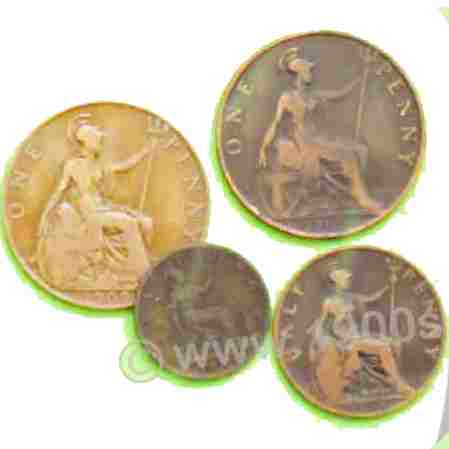
This page is about pr-decimal British coins from Victorian times until 1971 when the UK went decimal. All the pre-decimal coins are well illustrated and their equivalent values in decimal currency are given. Also included are the effects of the weights of the old coins and their silver content. A feature is that the author and the other contributors spent their early years with the old coins as their only currency and are therefore writing from personal experience.
____
By the webmaster, based on living and working with pre-decimal currency over many years, with more firsthand contributions
Before British currency went decimal, the coins of Queen Victoria's reign (1837-1901) were still in circulation alongside Edwardian ones. The last pre-decimal coins were those of King George VI and Queen Elizabeth II.
Equivalent values of base-metal coins
£1 = 240 pennies, or 480 halfpennies or 960
farthings
1 penny=2 halfpennies
1 halfpenny=2 farthings
4 farthings = 1 penny
Copper coins: pennies, halfpennies and farthings
In the early 1900s, most of the coins in everyday use were what my mother referred to as 'coppers', i.e. pennies, halfpennies and farthings. Farthings were worth a quarter of a penny.
I started collecting coins from general circulation during the few years before decimalisation. During that time, it was not unusual to see the heads of up to five different monarchs in our change.
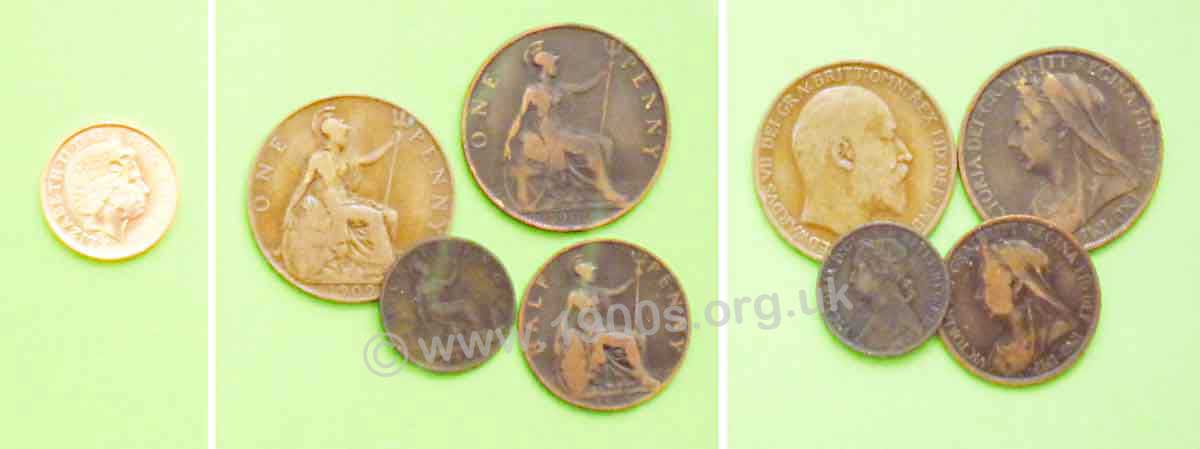
Copper coins in circulation in the early 1900s and legal currency until decimalisation in 1971.
Left: new penny, i.e. decimal currency penny for scale.
Centre: coins showing dates - Edwardian penny,
Victorian penny, Victorian halfpenny and Victorian farthing.
Right: the
same coins turned over to show the monarch's head.
There were not many Victorian coins around, but it was possible to collect some if one set one's mind to it. However, at that time, Victorian coins were over 70 years old and accordingly well-worn and a muddy brown colour, rather than the salmon pink of untarnished copper fresh from the mint. Nevertheless photographs of the old coins, even in a poor state state, do give a reasonable idea of what it was like to use them.
The weight of pre-decimal copper coins
Coppers were large and heavy compared with post-1971 decimal coins, and during the years just before decimalisation when inflation required rather a lot of coins to be carried around in order to buy anything, a general complaint was about weight. Trouser pockets quickly developed holes and purses bulged. It was certainly time for a change.
Buying power and weight of coins
In the early 20th century, the weight of the coins didn't matter much as far as carrying around was concerned because a few coppers could buy so much. My mother spoke of going shopping for her grandmother with a halfpenny to buy butter. A halfpenny was a very small amount of money by the standards of later in the century. In 1971 when the United Kingdom went decimal, it would have taken 24 such halfpennies to buy just 5p of post-decimal money. My mother's pocket money as a child was one of these halfpennies a week.
Silver coins: threepenny pieces, sixpences, shillings, florins and halfcrowns
In my mother's time, silver coins really were silver. It was considered safe to put silver threepenny bits into Christmas puddings as a treat - and this may have been true as far as the metal was concerned, but many a person jarred their teeth on them.
Silver in 'silver' coins
The omission of silver from the so-called silver coins in the 1940s started in 1947 although some of the genuinely silver coins were still in circulation even in 1967.
Ron Haller-Williams
'Silver' coins were the threepenny bit (also known as the threepenny piece and the joey); the sixpence; the shilling; the two shillings (also known as the florin) and the halfcrown. There is a page on how to pronounce this old money.
Values of pre-decimal silver coins
a threepenny bit was worth 3 pence as its name
implies
a sixpence was worth 6 pence as its name implies
a shilling was worth 12 pence; there were 20 shillings to the pound
a florin
was worth 2 shillings; there were 10 florins to the pound
a half crown was
worth 2 shillings and six pence; there were 8 half crowns to the pound
The system was known as the 'pounds, shillings and pence' system, written as £sd and pronounced LSD. The reason for this apparently strange mix of letters is explained in the LSD link.
As you can imagine, it was not quick nor straightforward for people to convert the old prices to their decimal equivalents.
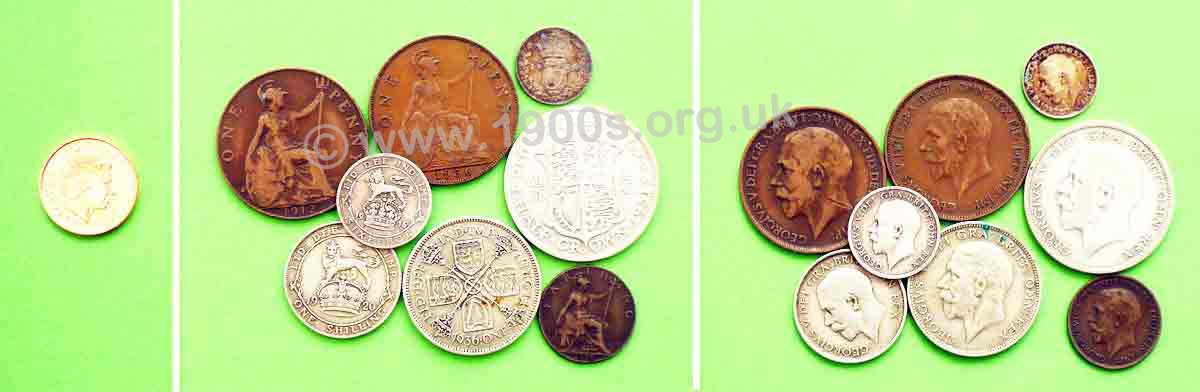
George V copper and silver coins in circulation in the early 1900s and legal currency until decimalisation in 1971.
Far left: New penny, i.e. decimal currency penny for scale.
Centre: tails of coins
- Edwardian silver threepenny bit, silver sixpence, silver shilling, silver
two shillings (a florin) and silver halfcrown. The copper coins are for
scale.
Right: the same coins turned over to show the monarch's head.
By the time I grew up in the 1940s, the practice of silver coins in Christmas puddings had discontinued, possibly because of the austerity in the war years of WW2, but also because, by then, the silver coins were made of a look-alike alloy.
You can see that calculations with pre-decimal money was not straightforward because the financial system was not based on tens. There were mechanical calculators, certainly in the 1950s and possibly before, although I never saw any of them.
Conversion of pre-decimal coins to decimal coins
Copper coins
During the transition period, the old copper coins were withdrawn and replaced with the smaller, lighter and very much brighter copper ½d and 1p coins.
Afterwards if anyone had old copper coins, they could take them to a bank for conversion. 240 old pennies would be converted to 100 new pennies.
Silver coins
Most silver coins had either already been withdrawn or were withdrawn during the transition period, but the shilling and the two shilling coins were withdrawn only gradually. So their names had to change.
An existing shilling coin had to be called 5p.
An existing two shilling coin (the florin) had to be called 10p.
In time all these coins were withdrawn from circulation but they could still be taken to a bank for conversion to the new currency. The new decimal 5p and 10p coins were originally the same size and weight as their pre-decimal equivalents, but were later replaced by smaller and lighter versions.
Pounds
Pounds already came as banknotes at the time of the conversion so there was no conversion problem.
sources: early 20th century material
sources: ww2 home front and other material
contact
the webmaster/author/researcher/editor
privacy policy

