 postal
deliveries milk
deliveries bakery
deliveries refuse
collection rag and
bone men insurance
agents chimney
sweeps ice
deliveries
knife
grinders

Rag and bone men who toured the streets buying unwanted items
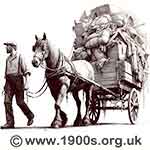
Rag and bone men traded on the streets with their horses and carts buying unwanted articles and selling them on. This page describes in more detail how they traded and why what they did was regarded as a service to the community. The page goes on to explain the origin of the 'rag and bone man' name and why the trade no longer exists.
____
First hand recollections of rag and bone men, edited by the webmaster
How rag and bone men traded
contributed by Peter Johnson, recollections
In the early years of the 20th Century, a rag and bone man would travel the streets with his horse and cart ringing a brass hand-bell to let us know he was there and shouting out "Bones!" and "Any old iron!".
He would cover a district about once a week. So anything we thought he would take was put to one side for him. These were days of extreme hardship for many people. Nothing was wasted or thrown away.
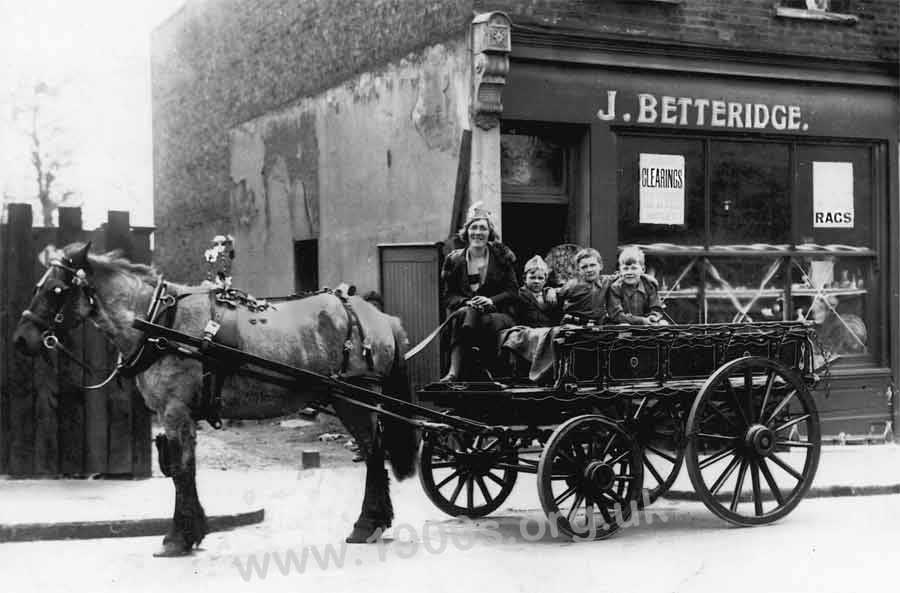
Rag and bone horse and cart outside their premises, 1930s. Photo courtesy of Thomas Franklin
He took anything that he could sell on: old metal for scrap; rabbit skins for trimmings on coats and gloves; empty glass jars for use in jam and pickled onion factories and much more. He played an important role of taking away unwanted material.
Advantages of rag and bone men over dustmen
contributed by Peter Johnson, childhood recollections
The advantage of rag and bone men over dustmen was two-fold. They would take away large items and paid us for them. The payment was not necessarily in money and never large. Sometimes it was sweets. I can even remember being paid with a goldfish and day-old chicks.
If we wanted the dustman to take away a large item that wouldn't fit in the bin, we had to tip him.
So rag and bone men were regarded as a service to the community.
The rag and bone man's horse
contributed by Peter Johnson, childhood recollections
The horse got to know the rag and bone man's route. He would stop at each house and wait to see if any householder appeared. We children would take the horse some lumps of sugar.
Over the years we got to know the man and his horse very well, Sometimes if the weather was hot, the man would hand my mother his bucket which she would fill with water. We would stand and watch as the horse gulped it down. If the man was thirsty he would dip his mug into the same bucket.
The origin of the name 'rag and bone man'
Rag and bone men specialised in 'rag' and 'bone' even though they would take anything.
Why rag
contributed by Peter Johnson, amateur historian
There was a vast market for the rags. Some of its uses included the manufacture of paper, carpet underlay, mattress stuffing, and seating in trains and buses.
The rag was any form of clothing. As this was before the days of synthetic fabric, most clothes were either cotton or wool.
Why bone
The market for the bones was for glue and fertilizer. It was burnt into a powder and sold as bone meal. The origin of the word bonfire is 'bone fire'.
The bone was animal bone. As this was before the days of plastics, most buttons on clothes were either bone or rubber. Also before World War Two most people bought meat on the bone such as a leg or shoulder of lamb, or a cut of leg of beef. The meat was roasted and fed the family for two or three days. Then the bones were boiled clean in a saucepan for soup, and then saved for the rag and bone man.
Totter: another name for the rag and bone man
contributed by Thomas Franklin, family recollection
My father was at one time a rag and bone man, and he described himself as a 'totter'.
contributed by Peter Johnson, childhood recollections
We always referred to rag and bone men as totters too. Where this name came from have no idea.
The end of the rag and bone man
contributed by Peter Johnson, childhood recollections
At the outbreak of the Second World War most of the younger rag and bone men were called up to serve in the armed forces and the older men transferred to work elsewhere for the war effort.
There was what was called the National War Effort where everybody was asked to donate glass, iron, aluminium, glass, old clothing and paper, as resources for fighting the war. We were asked to take whatever we had to a designated area at the end of the road where great heaps accumulated. This was donated for free and collected by designated contractors.
After the wars rag and bone man did re-appear briefly, mainly using vans, although some clung to their horses. One only has to watch a box set of Steptoe and Son to get a flavour of how they survived. Harold like his father had served in the army, but returned to the streets of London. Their old yards where the horses were stabled and where they stockpiled their scrap materials had been taken over for housing.
Today we have Council rubbish tips and car boot sales to take all unwanted household articles, a service that rag and bone men had provided for hundreds of years.
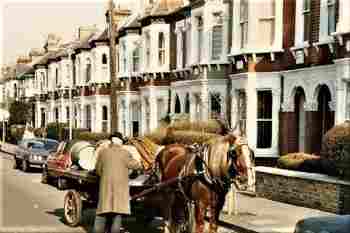
One of the last rag and bone men. Image courtesy of Ann Cator
| sources | webmaster | contact |
Text and images are copyright
If you can add anything to this page or provide a photo, please contact me.

