 postal
deliveries milk
deliveries bakery
deliveries refuse
collection rag and
bone men insurance
agents chimney
sweeps ice
deliveries
knife
grinders

Ice deliveries to shops, early 20th century UK

In Victorian times and the early 1900s there were no fridges or freezers where food could be stored. In hot weather, ice was delivered to shops by horse and cart. This page describes the horse and cart, known as the ice cart and the man who delivered the ice, known as the ice man. It also describes why children followed the ice cart with so much anticipation and where the shops kept the delivered ice.
____
Extracted from the memoirs of the webmaster's mother (1906-2002) and edited by the webmaster with further research
The need for ice delivery
When I was a child in the early 20th Century, there were no refrigerators. So shops like fishmongers and butchers had to use ice to keep their goods from going off. (The best that ordinary homes could do was to use their food safe, also known as the meat safe.)
The ice cart and the ice man
The ice was delivered to the shops in an ice cart which was easy to spot because it had ICE written in bold letters on the side. Like all the other delivery carts, it was horse-drawn. The delivery man was known as the ice man.
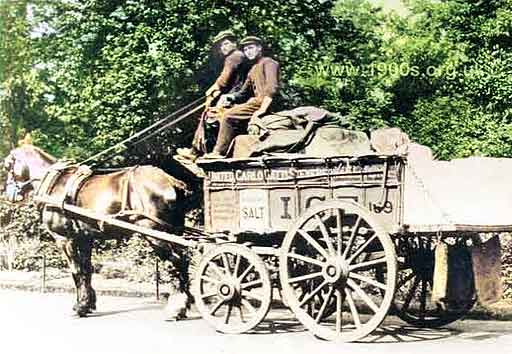
An ice cart delivering ice in the early 1900s.The letters ICE are partially hidden by the large back wheel. Photo courtesy of www.canalmuseum.org.uk
The ice was in long blocks about 2½ ft long, a foot deep and 8 inches wide. To reach the ice from the rear of the ice cart, the ice man used a long S-shaped hook to drag the blocks forward. He carried the ice into the shops using a padded sack over his shoulder for protection.
Children's enjoyment at the ice man's arrival
We children were always thrilled to see the ice cart coming along the street. The ice man had to use a lot of force to get his hook into the ice, and we would delight in picking up the bits that fell off. Goodness only knows what water source they came from, and they were probably dirty from the cart and the road - but that never worried us. We had few such treats and would pop the broken ice into our mouths regardless.
contributed by the memoirs of Francis (Frank) Read, born 1908,
courtesy of his grandson,
Tim Read
About once a week, especially in the summer, there would be a free-for-all. Talk about 'The Ice Man Cometh'. For us it was 'The Italian ice company'. Large yellow horse vans would appear wherever there was a food shop, to deliver their blocks of ice.
The swarthy aproned driver would step down from his seat, put the reins over the hook, get a large pair of tongs out, and pull out from the open van a large piece of ice. Then he would chip around it to break it into a suitable size for the shop. All us kids would be watching carefully to see where all the small pieces of ice were falling once he had got the piece to the size needed.
He'd put a sack on his shoulders, push up the block of ice onto his shoulders and take it into the shop. His disappearance would signal all of us urchins to get aboard the van and scrabble excitedly for as many pieces of ice as we could pick up.
He'd come out and all of us would get off quickly so not to be seen - but he just smiled and asked "Everybody gotta piece" and drive away. We weren't doing any harm anyway, and the ice would only turn into water.
You can guess how we looked forward to the ice man's visit on our street.
It was easy to follow the ice cart around on its deliveries because cart horses lumbered along no faster than our own walking pace.
Where shopkeepers kept their ice
Shopkeepers did not of course have fridges. They kept the ice in large walk-in cupboards, known as ice cupboards, in the main shop.
| sources | webmaster | contact |
Text and images are copyright
If you can add anything to this page or provide a photo, please contact me.

