World War Two in London suburbia: on the home
front
My perspective on WW2
World War Two poster of Winston Churchill whose name never seemed to be
far from the lips of everyone around me. Photographed in the Museum of
Nottingham Life.
I was born three months before the Second World War which started in 1939.
So I grew up knowing nothing but war. War was a way of life.
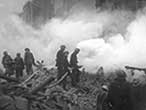
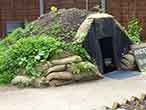
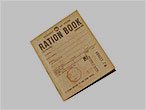
Rationing was a way of life. Bombs were a way
of life; as were air-raid shelters;
sirens wailing; searchlights piercing and
fluttering over the night sky; row upon row of 'For sale' notices against houses;
and buildings that were there when I went to sleep no longer being there the
next day. This was simply how people lived and I never questioned it. I knew
nothing else.
To get one important point clear before I start. Some people suffered dreadfully
in the war - my paternal grandparents were
bombed out, my uncle was killed on active service and my aunt was disabled
for life - and there were many more like them, but I never did suffer. I suppose
with the values of today, things can't have been anywhere near ideal, but I
didn't notice that. I was too young to understand the seriousness and reality
of what was happening around me, and I never remember feeling hungry in
spite of the rationing and
shortages. How I
was living was how everyone lived and presumably had always lived. Yet, although
I didn't understand with my emotions, I certainly did observe and remember.
In what follows I have found it impossible to separate my recollections of
the war years from the years immediately afterwards. One reason must be that
I was so young at the time, but another must be that although the general feeling
among the adults seemed to be of hope that the future would bring better things,
the austerity continued for years. So all my experiences during the 1940s
and into the 1950s seemed
to be dominated by the war or its effects.
Night time Air-raids during world war two
Air raids were - I am ashamed to say - enjoyable experiences for a very young
child. I can't remember my first one because there had always been air raids,
and it never occurred to me that I could possibly be hurt in one.
When the siren sounded to herald an air raid while I was asleep, I would
be got out of bed at any time during the night and taken downstairs with my
mother to sleep in our Morrison shelter with her and her own mother who was living with
us. My father of course wasn't there. There were very few men around at all
because they were away on war work in the forces.
A frequently heard war-time motto, 'Pray to God, we shall win in the end, when
the lights go on again all over the world, and when our lads come
marching home'.
My family home of 9 Brook Avenue, Edgware, Middlesex
in the late 1940s. I just remember the metal chains linking elegantly round
the green which ran along the middle of the road, but they were removed
for the war effort and never replaced.
During the latter years of the war, I was still up in the early evenings,
and with my young ears I often heard the wail of a distant siren before my mother
did. I always told her because it was fun to go into the shelter. It must have
been awful for her, though, tired out at the end of a long day, having to organise
her mother and me. She was very house-proud and it must also have been horrible
for her to have that Morrison shelter stuck in the front room.
Equally horrible for my mother
of course was not having my father to talk to, to ease the tension. In the early
days of the war, before he was called up into the army, he was often up all
night on fire-watching duty, but I was too young to remember that.
Sometimes when the houselights were off, I would peep through the blackout
curtains at the outside world. The searchlights flickered across the sky trying
to seek out enemy bombers to shoot down. I thought that the lights were pretty.
Yet years later when I saw laser lights as part of the Christmas decorations
in London's Oxford Street, a shiver of recollection ran down my back. So perhaps
I was more scared than I realised at the time, or maybe I had developed a better
appreciation of the dreadfulness of war.
There was a shelter at
school for use in daytime air raids.
The street peace party
Brook Avenue where I lived in Edgware had its own street party to celebrate
the end of World War Two. It was held in the garden of the flats at the start
of the road. I can remember very little of it, except that we children had to
dress up and there was precious little available to dress up with. As the photo
shows, most of us just wore home-made hats. I am third from the left in the
front row of the picture and my mother made my hat by covering a custard tin.
The brim was made of cardboard.
In the background of the picture is the shed for housing the
trains of Edgware
Tube station, a terminus.
Street Peace Party for Brook Avenue, Edgware, Middlesex
at the end of the Second World War in 1945. Names, where I remember, are
as they sounded to me at the time. Left to right:
Back row Leatrice Less, -, -, -, - , -, Sylvia
Less, -, -, -, - Middle row: James Mather, Marion Lewis, -, - Front
row: Stephen Newing, -, Pat Clarke (me), -, Bernice Coleman, Corrine Less,
-, -, -, Annette Samuels, Betty Samuels, -
The women who organised the Street Peace Party for Brook
Avenue, Edgware, Middlesex at the end of the Second World War in 1945. I
remember very few of their names. Back row 2nd from right: Mrs Newing and
on her right Mrs English (who was Scottish). Front row: Mr and Mrs Less.