






 eating
out school
dinners children's
party teas British
Restaurants
cheap meals experiences
of British
Restaurants civic
restaurants luxuries
and
treats


The British Restaurant in WW2
'British Restaurants' was not a general term for restaurants in Britain. It was the name given to dedicated restaurants set up to meet the needs of wartime on the Second World War British home front. This page describes them and gives some background to why and how they were set up, staffed and later closed.
____
By the webmaster: her early recollections and further research with contributions from others who lived at the time
Why British Restaurants were set up and what they did
In 1941, to combat the severity of rationing in World War Two, the Government set up what were known as British Restaurants. They were essentially canteens with basic nutritional meals at reasonable prices, and - most importantly - they were off-ration.
These British Restaurants were sited so that they were in fairly easy reach of communities.
British Restaurant buildings
British Restaurants were quick and cheap to set up was because existing halls were requisitioned for the purpose. Church halls and working men's clubs were typical locations because they already had basic cooking facilities and tables and chairs.
Dick Hibberd
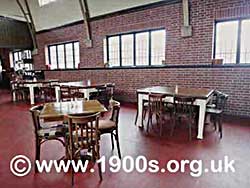
A working men's club of the sort used for British Restaurants, photographed at the Black Country Museum.
Where suitable facilities were not available, special prefabricated buildings were put up on waste ground - see the following photo.
Our British Restaurant in Edgware, north London, where I grew up was such a prefabricated building. It was painted white and was on the site of what later became the public library.
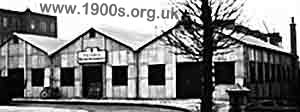
Purpose-built prefabricated British Restaurant in Hendon, courtesy of Tony Woods. Our British Restaurant in Edgware was identical except that the road ran along the long side. What always struck me was its whiteness.
The food and the price of a meal
The food in British Restaurants was designed to be both nutritious and cheap. My mother never took me to one, so I rely on others to describe their experiences of it. This is in the more general page about experiences in British Restaurants. The prices were certainly cheap and value for money.
During our school holidays we would go to a British Restaurant in the local church hall in Edmonton. We got a main course, afters, and a mug of tea, all for less than a shilling.
Peter Johnson
Staffing on British Restaurants and the WVS
One reason why British Restaurant meals could be provided relatively cheaply was that the catering, cooking and washing up, etc were all done by volunteers - normally older women who regarded their input as a contribution to the war effort. They tended to be members of the Women's Voluntary Service (WVS), a support unit for Air Raid Precautions (ARP). They had a unique uniform - see below, although in the British Restaurants, they wore their own overalls which were normally green with white scarves over their hair.
Dick Hibberd
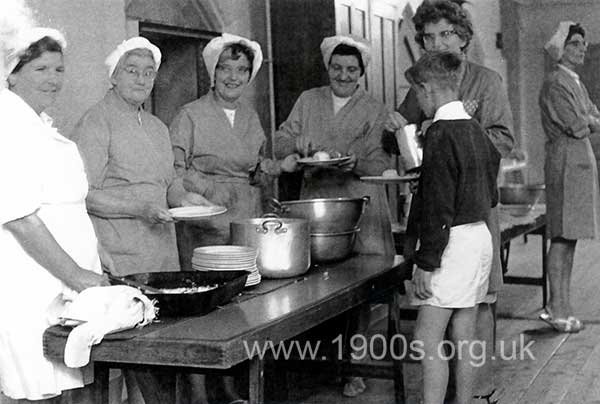
WVS women serving in a WW2 British Restaurant
Uniform of the Women's Voluntary Service (WVS)
I was told by an ex-WVS lady that WVS women had to buy their own uniforms out of their clothing ration.
WVS ladies wore the WVS uniform in dark green outside the British Restaurants. It was something like 'olive' green or perhaps 'British Racing Green'. There was a red and green emblem on the breast, and I am pretty sure, a belt of brown leather. There was also a felt hat, but I can't remember the exact style, except that it had a brim and was something like a smaller version of the Australian bush hat.
Michael Sullivan
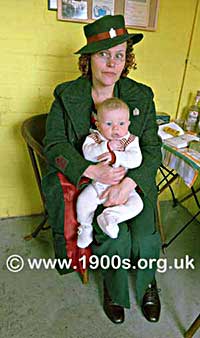
Uniform of the Women's Voluntary Service (WVS), photographed at a Brooklands 1940s Event.
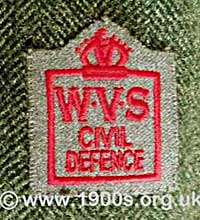
WVS uniform badge
The end of the British Restaurant
British Restaurants were renamed Civic Restaurants in 1946, after the war ended, as people wanted to forget everything connected with the war. However closed shortly afterwards in 1947.
Text and images are copyright
sources: early 20th century material
sources: ww2 home front and other material
contact
the webmaster/author/researcher/editor
privacy policy

