






 eating
out school
dinners children's
party teas British
Restaurants
cheap meals experiences
of British
Restaurants civic
restaurants luxuries
and
treats


Luxuries and treats in and after WW2 Britain
Although the Second World War and its aftermath was a time of severe rationing and shortages in Britain, some treats were available within the law due to generosity and creativity. That is the topic of this page. For people with money and influence who were prepared to bend or break the law there was the Black Market, which is on another page. Hand-me-downs are also on other pages and can be found via the search-box.
____
By the webmaster based on her early recollections with firsthand contributions from others
Treats on ration
Even foods that might today be regarded as staple became treats during the war and the years of austerity afterwards. I am sure that I must have enjoyed my treat of one egg per week - two until I was five.
There was the ration allowance of 4 oz of sweets per week. Because I was so young, my mother bought mine from the local Maynards sweet shop, and I was given them every Sunday after Sunday School. For years, they were known in my family as my 'Sunday sweets'.
We also got the ration of 2 oz of sugar a week, and I mention this specifically because it was so little that few people used it to sweeten food. (My parents used the artificial sweetener 'Saccharin' in their coffee until the day they died because it had become habit during the war.) Sugar was saved up to use with home-grown fruit to make jam - and the jam was a real treat!
Treats 'under the counter'
The shop counter
Before explaining the term 'under the counter', it is necessary to explain the word 'counter' as it doesn't exist today in the way that it used to with the growth of self-service shopping.
In the past, shops assistants were separated from customers by a long table-like barrier which was called the counter. It was low enough for shop assistants and customers to see each other and to exchange goods and money and flat enough to display goods and write out bills and receipts. Parts of underneath were used for storage and were hidden from customers and other parts were for display through glass. Customers would tell assistants what they wanted to buy, and the assistants would fetch it from shelves or cabinets their side of the counter.
Customers were never allowed behind the counter, and if assistants needed to go out to the customer's side for any reason, there was a horizontal door in the counter top which could be opened and locked shut.
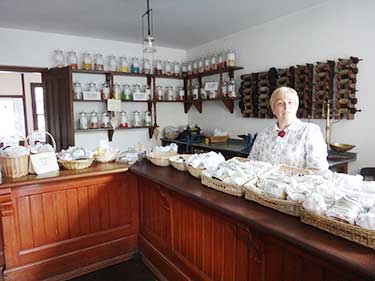
Shop counter with assistant standing behind it. Because the photo was taken at an exhibition, the counter had become a display, but I am sure you can imagine it empty.
The term 'under the counter'
'Under the counter' was a well-understood expression in wartime Britain and its aftermath. It meant that the shop really did have certain special goods, but they were hidden in the storage area under the counter and were only for customers who could do the shopkeeper a bit of good in return.
'Under the counter' was a term only used for shops selling short-supply or apparently sold-out goods to preferred customers, and it came to be used for any type of sale, not necessarily by a shop. It wasn't illegal, just unethical. Today an equivalent might be a slightly dodgy deal, off-the-books or off-the-record.
Incidentally, only much later did I learn that the obvious teachers' favourites at school, who in my view were no different from the rest of us, had parents who managed food shops. Presumably these teachers expected to be rewarded with goods from 'under the counter'.
As far as I know, my mother was never offered anything from 'under the counter' because she wasn't able to give anything in return.
On one occasion during the late forties when I was sent shopping to our local grocer, father said as I went out the door, "If they say they haven't got any, ask them if they've got any under the counter". That was exactly what I did when told there was none of the item - and they did have it and let me have it. It was condensed milk, I think. The family thought this was hilarious - as well as a comment on grocers' commercial ethics.
Malcolm Keen
Treats from overseas and from American soldiers
Very occasionally 'luxury' goods came in from overseas. It saddens me now to think of all those merchant seamen who risked their lives to bring in anything that wasn't an absolute necessity. Their ships were at constant risk of being sunk by German submarines. I wonder, now, in retrospect, whether these goods either came courtesy of American soldiers who were well-known for giving chocolate and chewing gum to children and nylon stockings to favoured young women. Or perhaps some of these luxuries were during the even worse shortages just after WW2. By then, the ships were no longer needed for the war effort and the seas were safe from German torpedoes.
Bananas: the first overseas fruit shipment to the UK after WW2
Bananas only arrived in the UK after the end of the war on 4 December 1945. The SS Tilapa from Jamaica brought in a shipment of 10 million, which were officially reserved for children under 18. Word got round and all the women queued up for them. Whether they had to prove that they were for a child, I don't know. My mother was very eager for me to try them, as I never had, but it was a strange taste to a palate unused to them, and I didn't like them. My classmates all reported the same. So I expect the adults enjoyed them instead.
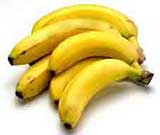
Bananas - a rare luxury in 1940s Britain
Wartime children's reactions to bananas
I was a small child when my mother managed to bring home a single banana for the family. My elder brother related to me that the occasion was ceremonial as the war really was finally coming to an end. We were each given a small and precious piece. I spat mine out in disgust!
Jan Clifford
The rarity of bananas during the war
On one occasion my friend and I were given a banana by a serviceman on leave and we wondered what to do with the skin.
We were sitting on his front garden wall at the time and a courting couple went by, strolling up the lane, arm in arm, oblivious to the rest of the world. So we threw the banana skin into the middle of the road in front of them to see what would happen. When they drew close, the man said "Mind the banana skin darling" and they stepped around it and carried on. After some five or six paces, they stopped, exclaimed together "Banana skin?!", retraced their steps and stood staring at it for quite some moments as if it had dropped from the sky. Such was the rarity of bananas in wartime.
Malcolm Head
Look-alike luxuries
My mother didn't give up telling me about how much I would like this or that food when I would eventually be able to try it. One such food was ice-cream. Once she saw a marshmallow type of cake in a wafer cone and bought it for me because it looked like an ice-cream cornet. It was horribly sickly-sweet, probably with artificial sweetener, and I didn't want that either.
I understand that some women created look-alike treats like mashed parsnips moulded to look like bananas, but my mother never did it. If she had, I probably wouldn't have liked them.
There were also the look-alike iced and decorated cakes which are on another page.
Apples and cocoa powder from Canada
Towards the end of the war there were apples and cocoa powder from Canada. They were distributed at school for children to take home. The cocoa powder needed to be sweetened. Sugar was scarce, but we did have saccharine artificial sweetener.
John Cole
Two rare treats I remember being given at school were free malt extract and cocoa powder. We were told to bring large jars to school, and my mother, realising there was something scarce being given away, found the biggest jar she had - as did other mothers. One poor lad only had a small jar so I invited him home, where my mother put some more into another jar for him. She then told me to carry it his home, so that he wouldn't have to carry two jars.
Albert Smith
I don't believe that my school ever saw any of the apples or cocoa that John Cole and Albert Smith remember - but we were not near an American military base. Yet I do remember the wonderful toffee-like malt extract that hid the taste of cod liver oil. Ours came for children from the local clinic.
Treats based on personal iniative
Some treats were on a small scale: home-made, home-grown and home-farmed. This site has numerous pages on them - see the menu index. Those who produced these used their initiative and hard work. But there were others who heard about women selling their crafts, men going out to shoot wild fame, and farmers selling off rabbits. Sometimes people got on their bikes and cycled miles to avail themselves of these treats.
Illegally acquired luxuries
Luxury goods always seemed to be readily available on the Black Market, ie illegally and at a high price. I knew that it existed but never saw any of its goods. There is more about it elsewhere on this site.
If you can add anything to this page or provide a photo, I would be pleased if you would contact me.
Text and images are copyright
sources: early 20th century material
sources: ww2 home front and other material
contact
the webmaster/author/researcher/editor
privacy policy

