





 Gov leaflet on
evacuation of
children evacuation:
why and
where an evacuee in
the house evacuee
experiences foreign
prisoners of
war mail from
servicemen
overseas fun for
children
in WW2


Fun for children on the World War Two home front
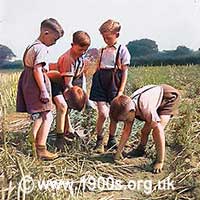
Children in World War Two managed to find fun in the ravages of the home front, and this page describes the ways that the war provided such fun. Contributions are firsthand recollections from individuals who were children at the time.
____
Main page by John Cole with additions from others, edited by the webmaster
Tanks, the British army and American soldiers
On some days in 1944 convoys of army lorries and tanks would pass my school. The convoys continued all day. At lunchtime we would spill out onto the pavement, cheering, clapping and shouting to the American trucks which were easily recognised as they had white stars on them. Our main cry was, "Got any Gum, Chum?".
Sometimes stick packs of American chewing gum would be thrown to us - rare plunder, especially for the older boys who could most easily catch them!
I, too, remember sweets also being thrown out to us from American soldiers.
Gerald Ladd
Collecting shrapnel
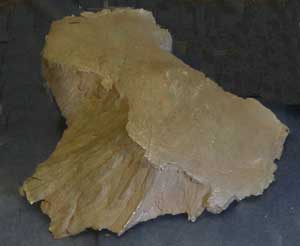
Shrapnel, photographed in Brooklands Museum.
Another prize was collecting shrapnel - splinters of shell or bomb fragments. A piece passed through our roof at home and then through the landing ceiling, and to a small boy it looked huge. It was probably about 8 inches long. This was in 1943.
When we went to school in the morning, we would collect shrapnel from the previous night's raid. It was still warm!
Gerald Ladd
Collecting chaff, nicknamed 'window'
'Chaff', nicknamed 'window' was black paper or cotton tape about half an inch wide with two metal strips, one along each edge. I don't know the origin of the name. It was scattered by bombers to confuse the ground radar and caused the radar screen to look like snow rather than giving a clear blip. It probably also gave a false indication of aircraft height and aircraft numbers. It was a much prized find for us children and very valuable in exchange and bartering!
When I went out one morning, there were rolls of silver foil all over the place. They were 'chaff' also known as 'window' that had been released in rolls from one of our planes but for some reason had failed to unroll.
Tony Shepherd
Collecting mementos from downed planes
As soon as my friends and I saw a plane come down, we cycled off towards it - but by the time we reached the crash site, the Home Guard were usually there to keep us all at bay. If the wreck was unguarded, though, the description of piranha at a joint of beef comes to mind.
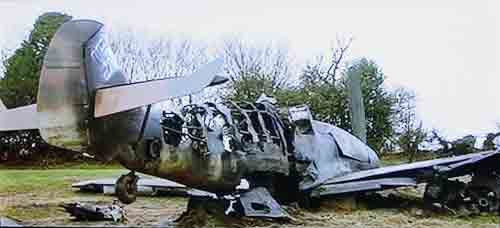
Crashed Nazi plane, a screen shot from a film, so possibly a mock-up
Sadly we were not fussy which country the plane came from, although there was greater value to shrapnel and other souvenirs from a Nazi plane.
How could we children be so heartless and uncaring? It is quite shameful. But we did care, most deeply, as many of us had our fathers, brothers, sister, and even some mothers away in the war - and fortunately, in my experience, the pilots always managed to parachute from the planes before they crashed.
As 'Winnie' [Winston Churchill] said, "Never was so much owed by so many to so few".
Dick Hibberd
Playing on the bomb sites
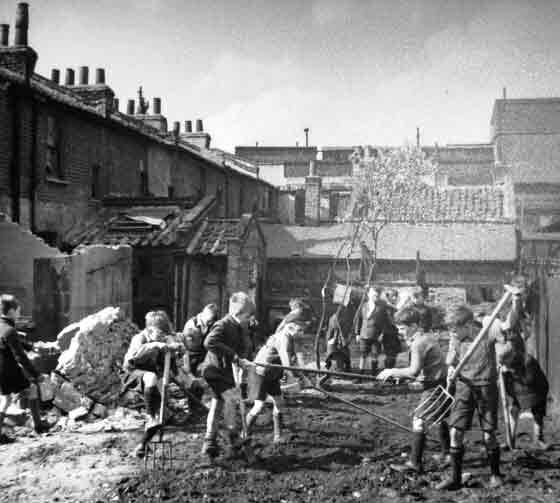
The bomb sites were children's playgrounds. We children would find all manner of things in the rubble from toy soldiers to knives. Bulbs and other plants would appear from the debris in the Spring and were collected and taken home to parents' gardens. Then, later in the year there would be apples and other fruits for the taking.
Peter Johnson
My sisters and I, along with all the other kids in the street used to play on the bomb site opposite. One day we found a large object which we sat on and banged on, using it as a drum. In a moment, we were being dragged indoors after a man passing started shouting that it was an unexploded World War Two bomb. It was! A bomb disposal squad arrived and took it away. This was as late as the 1960s! It had lain there for 20 or more years! Our escape was in the local paper, The Weekly Herald.
Pauline Bradford (formerly Pauline Mcginlay)
Watching the planes manoeuvre in the sky
I remember a doodle bug flying over our back gardens about 20 feet above the roof tops - very frightening!
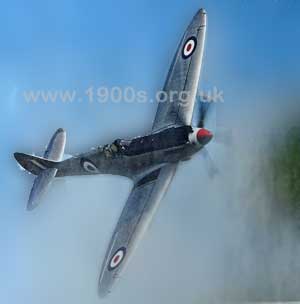
Spitfire, World War Two
Then, as I watched, one of our spitfires did a rapid climb and then went into a full dive to get enough speed to catch the doodle bug. The pilot somehow managed to get the Spitfire's wing under the doodle bug's wing and lift it onto its own wing. The Spitfire then sent the doodle bug off on a big circle to the right. Of course the bomb would eventually come back on course, but its fuel could well have been used up, hopefully forcing it down in open country.
Barrage balloons were also fun to watch, but that is on another page.
The seamier side of life
There was also the seamier side of life, which I was not supposed to know about, but couldn't help noticing or overhearing. One of our neighbours had a sister who came to live with her for a time. There were American soldiers stationed nearby, and the sister stayed out late, spoke with a drawl, had lots of cigarettes, and an endless supply of stockings. It was the talk of the neighbourhood!
If you can add anything to this page or provide a photo, I would be pleased if you would contact me.
Text and images are copyright
sources: early 20th century material
sources: ww2 home front and other material
contact
the webmaster/author/researcher/editor
privacy policy

