






 National Service
post-WW2 Army
Grenadier Gds
1952-54 Army
Royal Signals
1959-61 Army
RAMC
1960-63 Navy
1949-50
(overview) Navy
1949-50
(specifics) Airforce
(RAF)
1947-50 Airforce
(RAF)
1952-55 Airforce
(RAF)
1954-56 Airforce
(RAF)
1955-57


National Service in post-WW2 Britain
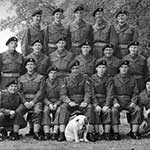
This page introduces personal recollections of National Service as it was generally understood in 1940s, 50s and 60s Britain, i.e. as a period of conscription into the armed forces for young men as a safeguard against more wars. It was essentially in three phases: basic training; job training and actual work, although there was usually some merging between them. It lasted from 1949 to 1963. All the pages in this National Service section were written by men who actually experienced it first-hand.
'National Service' as I understood it as a teenager in 1950s Britain meant that when boys were 18 years old they had to spend two years training in the armed forces. This was conscription, i.e. it was legally enforced, rather than voluntary. It was deeply resented - even though the need for it was clear, following the events of World War Two. It was seen as a serious disruption to boys' continuing education and career development and something that would be distinctly unpleasant. While I was a teenager, the hope seemed to be all around me that National Service would end before it would affect my age group. In fact it didn't, not that it affected me, as a girl.
A historical view of National Service in peace time
The origins of post-war National Service
Although to most people National Service was something that started after The Second World War, some 90% of the armed forces were National Service conscripts during the war. This meant that they were legally required to join the armed forces or undertake some form of war work - and it applied to women as well as men between the ages of 18 to 51. After the war, they were discharged from this National Service.
The idea behind post-war National Service
The basic idea behind post-war National Service was that in the event of another war young men who had undertaken it would be re-called and within days be ready to serve again. In 1939 at the beginning of World War Two we had a very small standing army and as a result it took years to build up the forces to defeat the Germans.
After the end of the Second World War, National Service as peacetime conscription was formalised in the UK by the National Service Act of 1948. From 1 January 1949, all fit young men between 17 and 21 years of age were required to serve in the armed forces for 18 months, and remain on the reserve list for four years. In October 1950, in response to the British involvement in the Korean War, the service period was extended to two years.
Peter Johnson
How and why the 1948 post-war National Service bill differed from the wartime one
Some National Service had been illegal!
The problem was that some soldiers were kept under arms for quite a while after the end of the WW2 and made to fight the communists in Malaya. One group refused, were court martialled for treason and due to be executed. However, when eventually questions were asked in Parliament, it was discovered that under the Act of Parliament that conscripted them, they were not obliged to fight at all in any conflict which did not directly threaten the security of the Kingdom. They were quietly released and shipped home.
So when the Bill setting up post-war National Service was passed, it did not contain such an exclusion clause which meant that National Servicemen could be sent to Korea and Aden and anywhere else whenever the government of the day decided it needed to interfere.
Norman Groocock
Deferral of National Service
Although all fit young men between 18 and 21 were required to do National Service, they could get this 'deferred' if they had a place for an apprenticeship or higher education. Most degree courses qualified for deferment.
In my experience, the call-up board was very helpful and did all they could to accommodate people seeking deferment. So there were men aged 21/22 and older, having been called up after their degree courses were finished, working alongside the last of the 18 year olds who had been called up direct.
John Cole
Although deferral meant that the deferred young men were excused National Service until after their further or higher education, they still had to do it. In this respect, my generation was fortunate. I left my grammar school in 1957 and for those of my contemporaries who went on to higher education, National Service had finished by the time they had completed their degrees or apprenticeships. My husband was one of those who never did National Service.
Structure of the National Service
The call-up
Before the National Service started properly for anyone, there was what was called the 'call-up' and medical with the associated administrative matters. These were handled locally. Some of the contributors gloss over it as not worth elaborating on, but for details, see Fred Peach's description of the call-up and Peter Johnson's description of the medical. The call-up was independent of the service that the national serviceman ended up in.
The National Service itself was in three main phases.
1. Basic training
The first part of National Service consisted of what was called 'basic training' which was more or less the same in principle across all the services. It is included or implied in some way on every one of the personal recollections, but there are different perspectives and emphases from each contributor. Some even omit basic training, taking it as obvious.
According to the first-hand recollections, it certainly did vary considerably in terms of how rigorous, unpleasant and unfair it was. For perhaps the worst experiences, see the basic training of John Gaisford for the army.
A feature was what was called 'square bashing'. This meant repeated marching in the approved fashion round the square, and it presumably got its name from the force with which the square had to be bashed on each step.
The low pay was widely criticised, but Dick Hibberd describes with some amusement how it was distributed. Norman Groocock tells us the amount of pay in the RAF, as does Barry Hooper, but that may not necessarily have been what it was in the all branches of the forces and it may have changed with location and time.
Basic training seems to have been designed to make servicemen obey orders instantly, irrespective of what these were and without querying them. A secondary aim, irrespective of what the future work was to be, was to instil an elementary familiarity with weapons and a certain amount battle capability.
2. Training for useful work - trade training, in-service training and on-the-job training
The second phase consisted of training was related to the useful work that each conscript was expected do during the rest of his National Service. It was called different things in different services, for example 'in-service training', 'trade training' and on-the-job training.
Depending on the service and the nature of the work, training for useful work was not a distinct from the third phase of working on-the-job.
3. On the job
Lastly came the actual on-the-job work which was conducted alongside regular experienced servicemen which meant that it still involved training. It tended to merge with the second phase because although the national serviceman was doing useful work, he was also being trained and learning new skills along the way - rather like an apprentice. Consequently he ended up with a useful trade or profession for later life.
Many a former national serviceman had cause to be grateful for the job training and experience that they received in the forces. It was by no means all about fighting. The personal experiences pages - see the menu - give more details. Two contributions from the Navy and Airforce respectively actually mention that they never went to sea or flew in an aeroplane.
The armed forces as a parallel way of life
When one enlisted in the armed forces, they pretty much provided everything one needed. So it became a completely parallel way of life to the civilian world. The idea was that a serviceman or woman would be provided with everything they might need and, if married, everything their families might need. It all came from government sources (everything from grocery stores to furniture for married quarters) and travel warrants. You could get your Heinz Baked Beans from a NAAFI* supermarket in Cyprus or Germany or Singapore, which was useful if the children wouldn't eat anything else and the local shops neither stocked British goods nor had English-speakers behind the counter.
*NAAFI stands for Navy, Army and Air Force Institutes.
Alan Bennett
The value of National Service
Resented as National Service was, most of the men I spoke to reported that it was the making of them. They may not have enjoyed it at the time, but were the better for it. They ended up fitter than they had ever been in their lives; some learnt trades that they would never have been able to afford to learn in a college or as an apprentice and all acquired skills that remained with them in later life.
The end of post-war conscription into National Service
The period of post-war conscription for national service was from 1949 to 1963. In practice, though, it ended gradually. In November 1960 the last men entered service, and call-ups formally ended on 31 December 1960. The last National Servicemen left the Armed Forces in May 1963. By this time, the two-year period had normally been shortened to 18 months.
Why the period of some men's National Service was longer than envisaged
Bob Howard explains one reason why his intake had an extended national service. Another reason is in the following box
When I was a student nurse on the base in Fayid, the young conscripted soldiers who were doing time beyond their two years were always getting drunk and fighting. Their punishment was to be locked in the guard room for a specified time which was regarded as prison. The specified time was added to their period of service - and it was a common recurrence.
Jackie Felgate
sources: early 20th century material
sources: ww2 home front and other material
contact
the webmaster/author/researcher/editor
privacy policy

