 house price
SE England
late 1930s furniture
prices costs of
floor
covering price of a
radio/wireless
in 1938 costs of
house
maintenance cost of house
insurance
1938 household
accounts
1950s/60s inflation from
annual family
expenditure monthly
expenditure
1950s

Cost of a radio, known as a wireless, in 1930s UK
In real terms, radios - called wirelesses - were very expensive and very bulky in the early years of the 20th Century. This page explains. It provides images of original invoices and receipts, and an illustration of the 1938 radio that was in the webmaster's parents' home in the 1930s and 40s.
____
By the webmaster, based original family documents and discussions with others
Why radios used to be so expensive
Before the 1950s, radios relied on what was known as valve technology. Valves were bulky and frequently 'blew'. They couldn't be mended and had to be replaced, which added to the maintenance costs of owning a radio.
Also, as there were no portable radios, these old radios had to be installed in position by a workman who had to fit an aerial in the loft or on the roof.
Receipt showing the cost of a 1930s radio
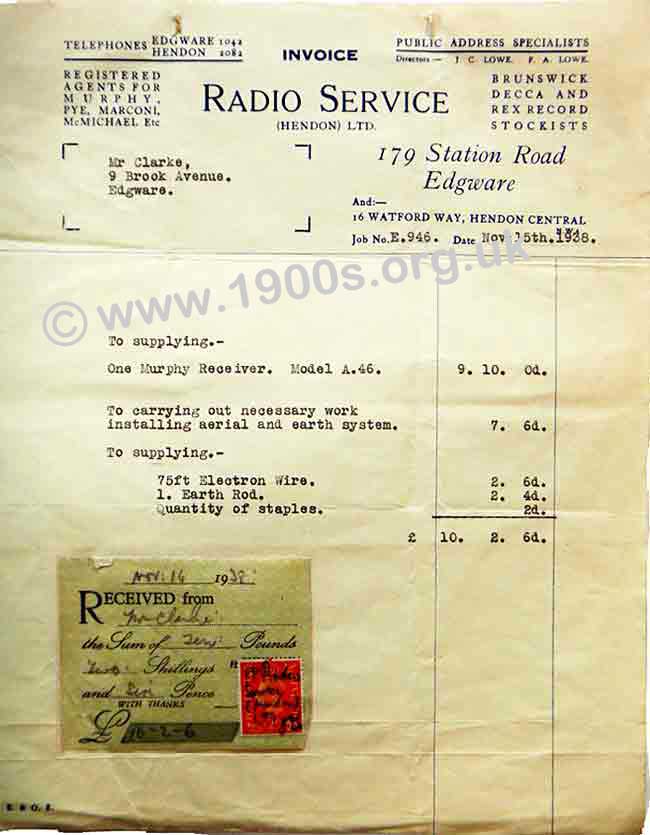
In November 1938 my parents bought a radio. The receipt, dated November 15th 1938 includes installing the aerial. This was four months after they moved in, so they were without a radio for these four months - not particularly unusual at the time. Incidentally the receipt called the radio a 'receiver'.
Receipt for radio
My parents went to a local Edgware supplier who charged them £9.10.0 for the radio itself, 7/6 for the work of installing it and aerial, and 5/- for the various bits and pieces. Below is a transcription of the receipt.
| TRANSCRIPTION OF RECEIPT | |
| Supplying: | |
| One Murphy Receiver (radio) Model A.46. | £9-10- 0 |
| Installing aerial and earth system | 7- 6 |
| Supplying: | |
| 75 feet of electron wire | 2- 6 |
| 1 earth rod | 2- 4 |
| Quantity of staples | 2 |
| TOTAL | £10-2- 6 |
Appearance of a 1930s home radio
Like most pre-war radios, this was a good quality piece of furniture in a large polished wood case and although we only ever used the two channels of the home service and the light programme, its dial showed that it was capable of receiving from much further afield.
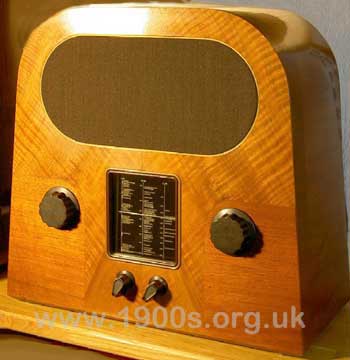
The wireless shown in the receipt
I understand that before World War Two people did listen to European programmes, but these were blocked during the war.
The receipt is on professionally printed paper and the breakdown of costs is handwritten.
Purchase tax
Note that purchase tax, also known as stamp duty, had to be paid by buying a 2d stamp and signing across it to invalidate it for other use. I am not sure why some receipts and not others seem to show this stamp. Perhaps radios were deemed a luxury. Do you know?
The range of available radios
Before and after WW2 there were a number of radios on sale for the domestic market, but I don't have any records as to their cost. If you are interested in the radios themselves, they are illustrated and described on another page.
| sources | webmaster | contact |
Text and images are copyright
If you can add anything to this page or provide a photo, please contact me.

