 house price
SE England
late 1930s furniture
prices costs of
floor
covering price of a
radio/wireless
in 1938 costs of
house
maintenance cost of house
insurance
1938 household
accounts
1950s/60s inflation from
annual family
expenditure monthly
expenditure
1950s

Costs of house maintenance in the past
The costs of house maintenance in the past is revealed in documents in this page starting from the late 1930s and refer to the maintenance of a semi-detached house on the northern edge of London's suburbia. These are original and provide tantalising insights into the costs of house maintenance around that time as well a resource for considering inflation between then and now.
____
By the webmaster, based original family documents and discussions with others
The surviving documents
All the survivng documents are in the old £-s-d currency and they all show the phone numbers of the suppliers with the old-style first three letters of the area as what was known as the area code. Where a document is typed, it is clearly from an old manual typewriter with a slightly worn ribbon and often with misplaced type heads, although always on professionally printed paper.
Cost of work on the outside a house, 1940
Painting the house was an extremely major job. There were no replacement windows with plastic frames and no plastic gutters which would not need painting.
Window frames were made of wood which needed the old paint scraped or burnt off, an undercoat and two top coats of paint against the weather. Then the putty that held the glass inside the frame normally had to be renewed and painted because it cracked ov time. Also, as paint built up with every repainting job, doors and windows tended to stick, sometimes so badly that they would not open. Dealing with this, too, was a major job.
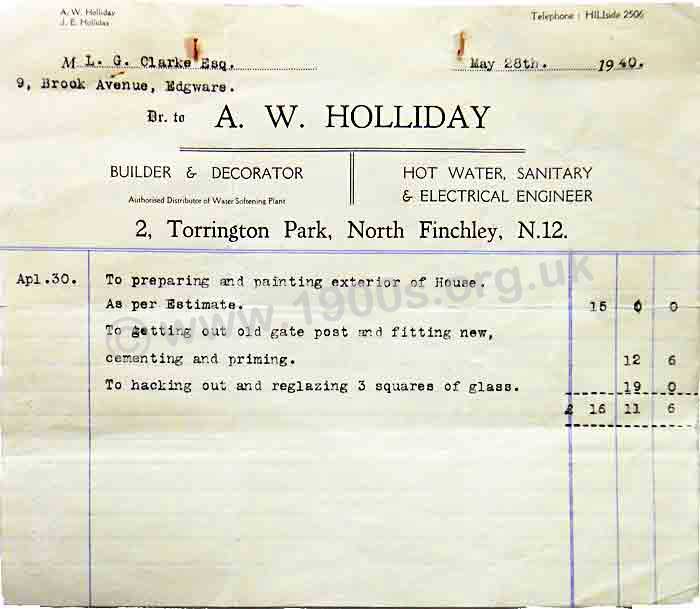
Invoice for painting the outside of the house
| TRANSCRIPTION OF INVOICE | |
| Preparing and painting exterior of house | £15- 0-0 |
| Removing old gate post and fitting new | 12-6 |
| Hacking out and re-glazing 3 squares of glass | 19-0 |
| TOTAL | £16-11-6 |
Gutters and drainpipes were made of iron which went rusty. My recollections are that the painting was much more for protection than for cosmetic purposes because there was no way of completely smoothing the rough and corroded surfaces before repainting.
So there was a lot of preparation work to be done, even before the painting, and there was a lot to paint. Even then, the bill for painting the house in May 1940 was only £16.11.6. Surprisingly my father did not choose a local contractor, but one near his work in Golders Green. Even more surprisingly, the contractor was prepared to travel from Finchley to Edgware to carry out the work.
It is interesting to speculate why my father chose to undertake such a major piece of work during wartime. I suspect that it was a now-or-never decision as men were being called up to serve in the forces.
Costs of redecorating a room, 1938
This receipt is earlier than the above one, but less major. It is for papering the walls of the two main downstairs rooms of my parent's semi-detached house. The receipt calls them the drawing room and dining room, although we always called them the front room and back room.
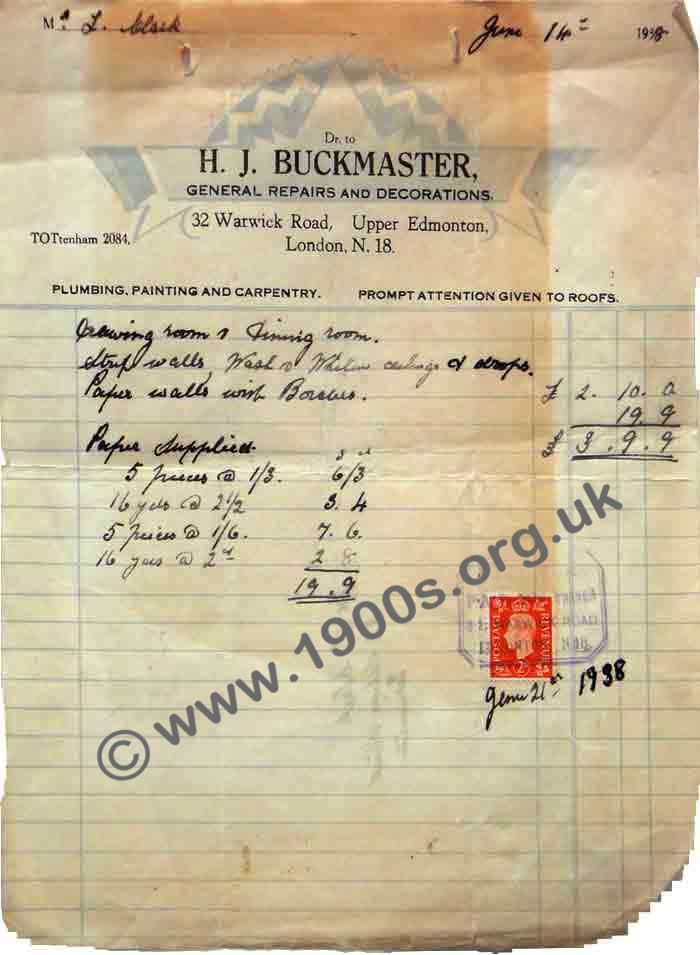
Receipt for interior decorating, 1938
| TRANSCRIPTION OF RECEIPT | |
| Preparing and papering walls | £2-10-0 |
| Paper: | |
| 5 pieces @ 1/3 | 6-3 |
| 16 yards at 2½d | 3-4 |
| 5 pieces at 1/6 | 7-6 |
| 16 yards at 2d | 2-8 |
| TOTAL | £3-9-9 |
The 'pieces' were almost certainly the decorative bands just below the picture rail.
The receipt is on professionally printed paper and the breakdown of costs is handwritten.
Note that purchase tax had to be paid by buying a 2d stamp and signing across it to invalidate it for other use. I am not sure why some receipts and not others seem to show this stamp. Do you know?
Cost of a plumber, 1939
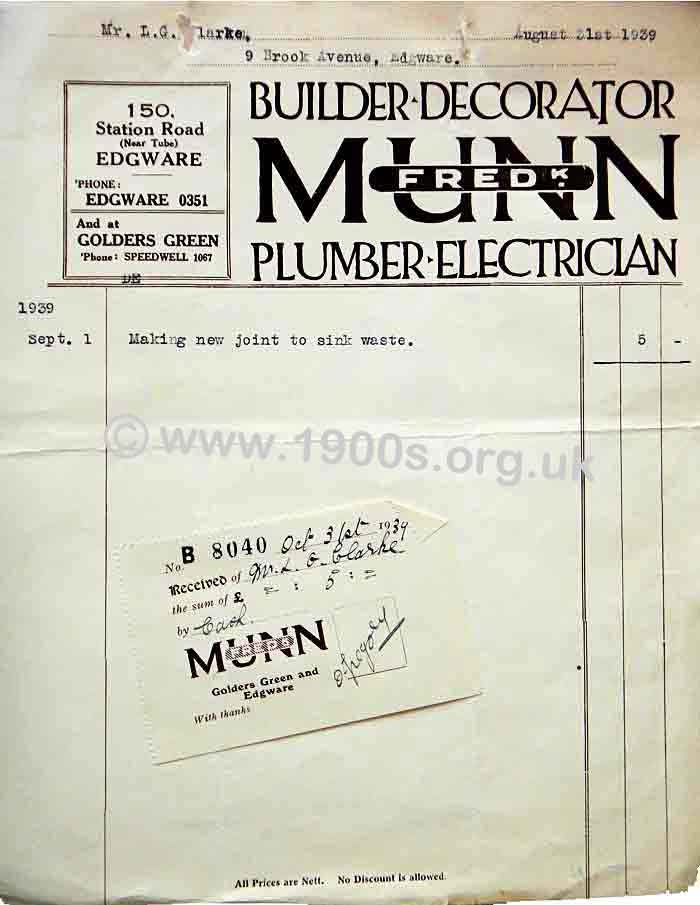
Plumbers are usually emergency call outs, and their charges reflect this, but this job seems to have been set up on August 1939 and carried out in September 1939. The Edgware plumber charged 5 shillings for coming out to the house to 'make a new joint for sink waste' - just 25p in today's money!
Although the receipt is on professionally printed paper, the typing is clearly from an old manual typewriter.
It seems that my father had finally got used to the fact that he would trust a local, Edgware plumber.
A note on inflation
The above serves to consider inflation, not to calculate it. In real terms, labour was cheap in those days, even though the work force were by no means odd-jobbers just slapping on paint. They were masters or apprentices of their trades.
| sources | webmaster | contact |
Text and images are copyright
If you can add anything to this page or provide a photo, please contact me.

