





 radios in WW2 and afterwards
radios for pop music in the 1950s
vintage
radios in WW2 and afterwards
radios for pop music in the 1950s
vintageradios gramophones and radiograms televisions
in homes recording from television libraries
pre-digital admin
in
old libraries


Radio/wireless as experienced by the UK public circa WW2
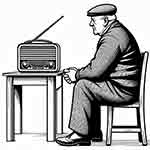
This page discusses how the public experienced sound broadcasts before, during and immediately after WW2. It describes their radios, then known the wireless; the stations available and how and why the Government limited these to just two.
____
By the webmaster: her early recollections and further research with contributions from others who lived at the time
Wireless or radio - what's in a name
When I was a child in England in the Second World War, the radio was called the 'wireless'. I don't know why the name changed over the years to 'radio', but I do know that some twenty or so years later, anyone who still used the term 'wireless' was considered very out-of-date.
Radios/wirelesses before WW2
Right across the country in the late 1920s and 1930s, there was normally just one radio/wireless in any household. Televisions were still many years away. They all fitted the same description of a polished wooden box with two, three or four knobs, a dial and a fabric covered speaker. Yet to me, as a young child, they all looked very different in size, shape and even the grain and colour of the woods. Unlike home telephones which were all identical to one another, radios clearly had a number of manufacturers, each producing their own range of radios/wirelesses.
It turned out that all these wirelesses had been bought in the relatively affluent 1930s, before the Second World War. Let's take the wireless in my childhood home as an example. It was in a large polished wooden box which could lay claim to being a piece of furniture in its own right because it was so elegantly contoured and veneered in cross-ways veneers. A photo is in the following section which considers the controls.
Controls on the 1930s radio/wireless
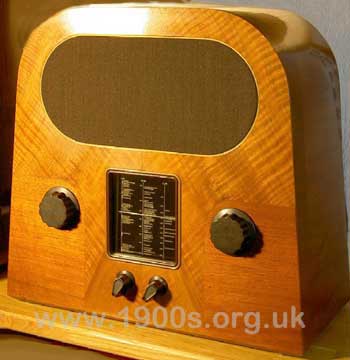
The wireless that I grew up with, a Murphy A46.
Photo courtesy of Radiomuseum.org, owner Christian ADAM France
There was a dial, two large knobs and two smaller ones. Twisting the left-hand large knob clicked the wireless on and off and further twisting adjusted the volume. The right hand knob searched the stations; the right hand smaller knob adjusted the tone (bass or treble); and the left smaller knob selected long, medium of short wave. The speaker was covered in some sort of roughish fabric.
Incidentally, as the following receipt shows, that radio cost 7/6, that is 7 shillings and 6 pence, approximately 40p in today's money. How's that for inflation!
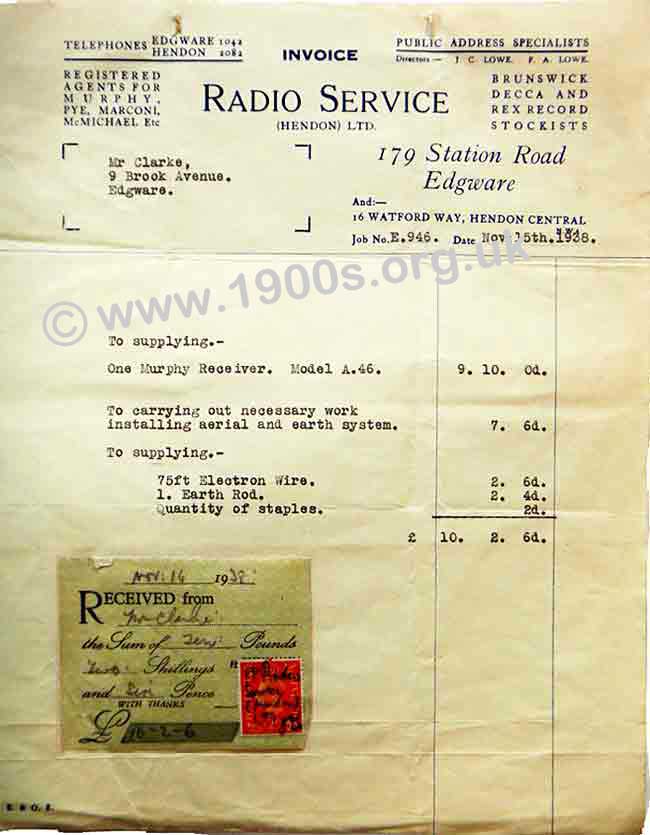
Receipt for the Murphy A46. Tap/click for a legible version
You can see how extensive the dial looked. As a child in the 1940s, this always puzzled me because we could only listen to two stations, more of which below. I since learnt that in the 1930s before the war, British people frequently listened to European radio stations, particularly for the concerts of classical music.
Radios/wirelesses for sale during WW2
Early in the war, the Nazis closed most of these European stations, making the German station, Radio Hamburg, the only European one that could be heard in Britain. They used this and more to broadcast propaganda to demoralise the British people.
Consequently, we were only allowed or expected to listen to British programmes during the war. For this reason - and probably also because of the wartime austerity - the only radios for sale were very basic indeed - and that was only if you could find one in the shops.
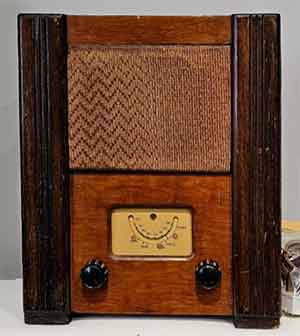
Known as the wartime civilian receiver
You can see how basic the construction is and in particular how the dial is set to limit all but Government approved stations.
No doubt, of course, much more sophisticated radios were available to the military.
The radios manufactured for the home market during the war were made to government specifications by several manufacturers. A feature was that they could not receive long wave, which meant that we in England could not listen to or be influenced by the propaganda transmitted from Germany.
David White
See his vintage radio collection
Although there were no new types of radio for the home market during the war, manufacturers apparently thought it worthwhile to keep their names in the public eye. Hence the advert in the thumbnail below left. It is somewhat wistful in the way that it speaks of 'better days'.
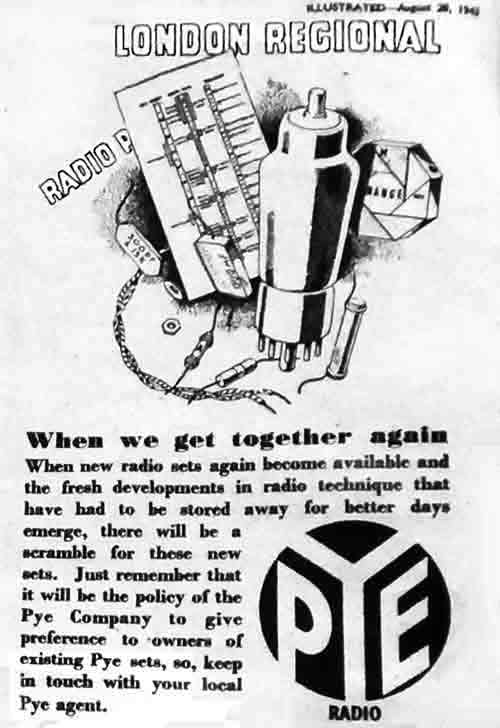
Advert in a 1943 magazine, telling readers that Pye radios will be ready when 'better days' come.
Tap/click for an image large enough to read.
Radio stations for the British public
To prevent people from listening to Nazi propaganda, the Government limited the number of available radio stations as follows. Incidentally, I don't remember the term 'channel' ever being used for a radio station. That came later with television.
The Home Service
At the beginning of the war, the Home Service was the only station allowed to broadcast. It seemed designed to inform about the progress of the war, and it gave frequent news bulletins.
The Light Programme
People became so demoralised with the lack of entertainment, that another radio station was allowed to broadcast - the Light Programme which was designed for light entertainment.
For most of the war, there were only these two stations, and in conversation they were widely known as 'sides'. People would say things like, "Which side are you going to listen to this evening?" Since only two stations were broadcast, the term was quite appropriate. Both were broadcast by the BBC, ie the British Broadcasting Corporation.
The Third Programme
Just after the war, a new station was broadcast by the BBC, known appropriately as The Third Programme. It was dedicated to what my mother called 'highbrow stuff'. It may have been popular but we never listened to it.
The wireless 'extension' status symbol
Even as the 1940s merged into the 1950s, radios must still have been rather expensive in real terms. Rather than buy a second one, the better-off families had something called 'an extension', ie a run of cable from their one radio to a speaker in another room. This meant that the radio could be listened to in either room.
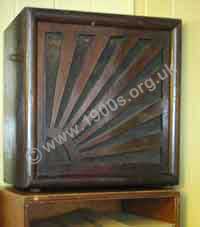
An extension speaker, photographed at a Watercress Line event
I asked my mother if we could have an extension too. Looking back, I don't think I was particularly concerned about being able to listen in a second room. Rather, it was my first awareness of the existence of a 'status symbol'. Anyway, my mother said 'no' and that we couldn't afford it - but that was her response to most requests. Money was tight.
Favourite programmes
I particularly remember Music While You Work which broadcast very lively music with a rapid beat, designed to encourage the women working in the factories to speed up their production.
My favourite programme, being still a child, was the daily Children's Hour, which my mother and I listened to over tea.
My mother and grandmother - and my father when he was home from the army - listened to the Light Programme during the evenings while I was supposed to be asleep.
The News, of course, on the Home Service, was not to be missed, because it reported on the war, but I was too young for it to mean much to me.
More programmes of interest were introduced after the war. My mother seldom missed Woman's Hour. It was broadcast just after her lunch when, presumably, women were deemed to be allowed a sit-down between the morning's and afternoon's housework.
My parents liked In Town Tonight which was broadcast on Saturday evenings and presented interviews with well-known people who happened to be in London at the time. I was not particularly interested, but in the late 1940s, as in previous years, it was accepted practice for all family members to be together in one room. So I could not help but hear what my parents were listening to, especially in winter when there was only heating in one room, with its single coal fire.
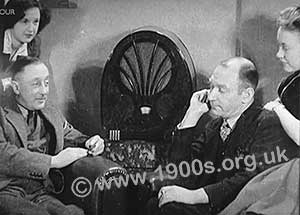
Families listen together
After the war, as a teenager, I liked the programmes in which people phoned in requests for boyfriends, husbands and relatives still serving in the forces overseas. The requests were invariably for pop music which appealed to me at that time. In particular, Europe was transmitting again, and Radio Luxemburg provided non-stop pop music requests. For some reason which I cannot now understand, I seemed perfectly able to listen to the music while doing my school homework to an acceptable standard.
Radios after the Second World War
After the Second World War, wirelesses (radios) gradually became available again, with many brand manufacturers. The more expensive ones limited their sales to selected dealers, but many other brands were more widespread, and some others were available to all shops. Top brands included Pye, Bush, Ekco and Murphy, while Philips, Ferranti, Ferguson and Ultra were more widely available.
Douglas Adam
____
You may also like the companion page on early televisions in the home
____
sources: early 20th century material
sources: ww2 home front and other material
contact
the webmaster/author/researcher/editor
privacy policy

