 British farms
before
WW2 women's
work on old
farms ploughing reaping threshing bygone
harvests harvest
festivals silage in
the past silage
production
modernised haystacks blacksmiths

Firsthand memories of harvest festivals in British churches
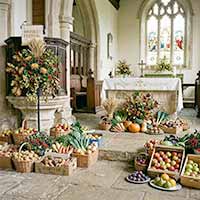
What harvest festivals were like in the past and why they were so significant. From the previously unpublished written recollections of the webmaster's mother who attended many old-style harvest festivals as a child, edited by the webmaster.
What were harvest festivals; when and where did they take place?
People wanted to give their thanks for a successful harvest because bringing it in was always a fight against the weather. Wheat ripened later in the season than today because hybrid wheat had not yet been developed, and the crop could easily get destroyed through wind and rain.
The formal thanksgivngs were known as harvest festivals and they took place in church in late October or early November by which time the harvest would normally have been gathered in.
To me, as a child in the 1900s and early 1910s, harvest festivals were a lovely time. The church would be a picture of colour with all the produce that the congregation would bring to give thanks to God for a successful harvest. These harvest gifts were encouraged to be given in advance, so that they could be used to decorate around the church. Nevertheless most people did bring them at the time There was a constant stream being brought up to the floor of the front of the church. Everyone in the congregation could watch them accumulating.
Typical harvest gifts
There would be harvest loaves on the window ledges. They could be of any shape, but the ones that particularly appealed to me were the ones shaped like sheaves of corn or platted into a flattish strip.
Blackberries and other berries which leaked their juices were in disposable containers known as 'strawberry baskets', made of thin slats of wood platted together.
In the centre of the rail would be a glass of water, as water is one of God's gifts that make the harvest possible.
On some of the window ledges, would be apples and tomatoes arranged alternately.
There would also be plenty of marrows as they made a good show, although to me they were an uninteresting watery vegetable, as my mother never stuffed them with meat or spices.
There would be sacks of potatoes, cabbages, onions, and more marrows, mostly grown by allotment holders.
There would also be an abundance of flowers, like Golden Rain, daisies and chrysanthemums.
The occasional pumpkin was always a talking point with us children, as pumpkins were not part of our normal diet. Most children had never tasted one, and knew them only from the Cinderella fairy tale where the Fairy Godmother turns a pumpkin into Cinderella's coach. For townsfolk, such as us, pumpkins were essentially ornaments for the harvest festival.
If it should be a hot day, which it often seemed to be, the smell of it all would be overpowering.
The harvest hymn
There was one obligatory hymn for harvest festivals. The first verse goes:
We plough the fields and scatter
The good seed on the land
But it is fed and watered
By God's almighty hand.
It certainly conjured up in my mind the picture of what harvest festival was all about.
What happened to the harvest gifts
It was customary for the church to give the sick of the congregation small parcels from the harvest festival gifts. The rest would go to the local hospital.
However, even in those days, my father, who worked at the hospital would say that the harvest festival gifts were not actually wanted. The hospital planned its meals in advance and in bulk and it could not function reliably from the unpredictable quantities and types of what might or might not be gifted to it. Consequently much of the food either went bad or was given to the hospital staff. Once my father was given a pumpkin from which my mother made pumpkin pie. She cut up the pumpkin into small pieces, added sugar and spices, covered it all with pastry and baked it in the oven. I can't remember whether we liked it. We probably didn't because it would have been a new taste.
Nowadays, gifts of perishable goods are discouraged at harvest festivals, which is understandable but does spell the end of a beautiful tradition. I am sure that the old people of the parish would still appreciate the small gifts even though the large organisations would not.
| sources | webmaster | contact |
Text and images are copyright
If you can add anything to this page or provide a photo, please contact me.

