 train travel
in
WW2 Britain 1st 2nd & 3rd class
trains train
tickets forces'
travel warrants train ticket
inspection station
platforms inside early
passenger trains early train
windows early train
doors early train
lavatories level
crossings

What train travel was like for passengers in 1940s wartime Britain
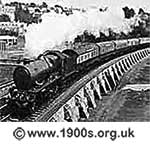
Train travel was the only realistic means of long-distance travel for ordinary people during 1940s wartime. This page elaborates and explains what it was like to travel by train at that time: the dirt, soot and over-crowding and the hypnotic effect of looking out of the train window. Specific features of train travel are on other pages - see the above menu.
____
By the webmaster based on her early recollections with additional research and firsthand contributions
Why travel by train
Trains were by far the main mode of travel for any distance in Britain during World War Two.
Very few families had cars, and even where they did, the car driver was invariably the man of the house who was away serving in the armed forces. Petrol was rationed anyway and often unavailable for anything other than essential services. So trains were the only realistic option for relatively long distance journeys.
Overcrowding and discomfort on trains
My memory is that trains were not particularly comfortable because they always seemed to be packed with army, navy and airforce personnel, often with standing room only.
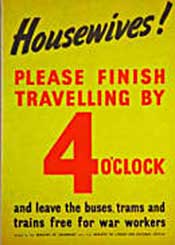
Poster urging housewives to free up trains, buses and trams for the war workers**
Also trains were dirty because the engines, being still steam engines running on coal, produced an enormous amount of soot. You could watch it in clouds wafting past. If the windows were open, it got into eyes and made clothes dirty.
Only necessary journeys
Long distance journeys were a matter of necessity or special treats for families - although not of course for forces personnel. Money and resources were in short supply, and everyone felt that they shouldn't travel without good reason.
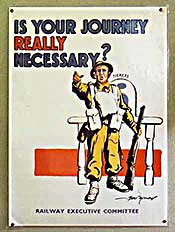
World War Two poster encouraging people to save on train journeys*
Back in the 1940s, my mother did take me with her on what we called a 'long' journey. That was to visit her friend no further than the other side of London. Also on one occasion she took me on an even longer journey to see my father who was on leave from the army. A leave of absence from the armed forces was invariably short and often measured in hours rather than days, so my parents probably thought they would have more time together if my father didn't have to do the travelling.
The hypnotic effect of looking at telephone lines out of windows
A major amusement on a train for me as a child was looking out of the window - but this was not just at the scenery. Let me explain:
At that time the wires connecting telephones to the exchange were not buried underground. They were carried up high, strung between poles known as telegraph poles. It was quite normal to see roads and railways lined with these poles each carrying many wires referred to as telephone 'lines'. The wires hung down between poles and so when watched from a train one's eyes were attracted by the smooth rythmic up and down sense of movement of the wires.
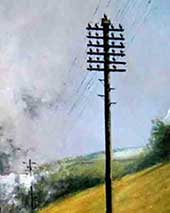
Telegraph poles strung with telephone lines along a railway in the 1940s and 1950s before the lines went underground. Detail from an old painting.
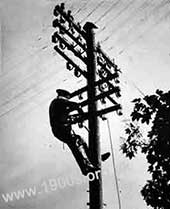
Engineer climbing a telegraph pole with special grips on his legs. Detail from a picture in Milton Keynes Telephone Museum.
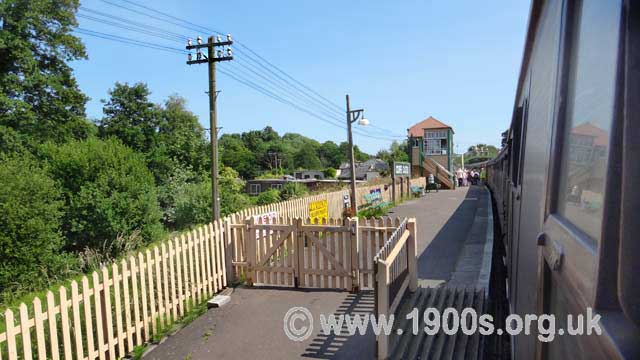
Station platform showing telegraph wires along railway lines. Photographed along the Swanage Heritage Railway.
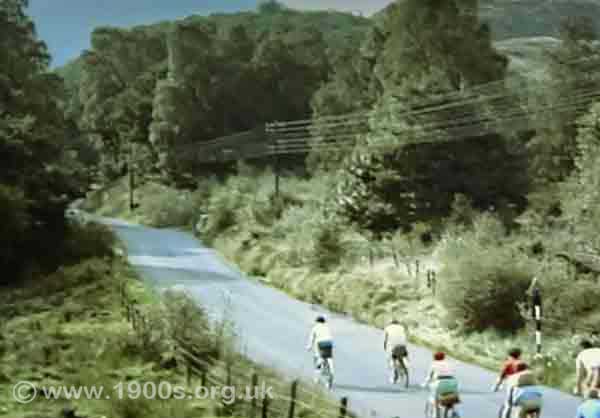
Telephone lines running along the side of a country road. Screenshot from an old film.
It became almost hypnotic to fix one's eyes on the telephone wires as the train moved. The train windows were very much narrower than those of later trains, so it was rather like viewing through a slit - albeit a wide one. So the telephone wires seemed to swing up and down as the train moved from the high points of the poles to the sagging points mid-way between.
Trains after the war
After the war and into the 1950s, little seemed to change on the railways from a passenger point of view. Britain was still recovering from the ravages of the war and there was hardly any spare money for investment.
Certainly I remember, in the late 1950s, my face being black with soot after travelling between London and Exeter in a train pulled by a steam engine and powered by burning coal. There was always a great deal of smoke from these engines. Of course my sooty face was my own fault for leaning out of the train window!
| sources | webmaster | contact |
Text and images are copyright
If you can add anything to this page or provide a photo, please contact me.

