






 mid 20th
century
cars car
indicators traffic
control petrol
filling
stations AA
roadside
support double-declutching
gears bicycles


Experiences with old British cars
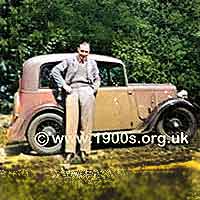
This page is about the appearance, comfort and safety of the old British family cars that started appearing on the roads after the Second World War. These cars had been in storage while petrol was reserved for war work, and were mainly from the 1930s. Some were even older, and no new family cars were being produced because the country was still recovering from the war. The focus of the page is on what was experienced as dramatically different about these old cars and car rides compared with those of today. The page is brought to life by the firsthand contributions from people who knew these cars from their own experience.
____
By the webmaster: her early recollections and further research with contributions from others who lived at the time
Appearance
Most of the cars I saw were from the 1930s, and they looked like boxes on wheels with an engine sticking out. You can see an example in the top photo.
Why the box-like appearance of old cars
The box-like appearance of old cars is explained by their having no boot until the early-mid 1930s. The spare wheel was usually mounted vertically on the outside of the body with an external folding luggage platform providing carrying space.
Douglas Adam
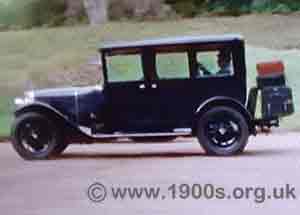
Luggage packed on the back platform of old car
The earliest cars that I noticed were probably from the 1920s or even before, but there were very few of them. There was no attempt at streamling and the seats were raised above large wheels. The entire car was open to the wind and rain.
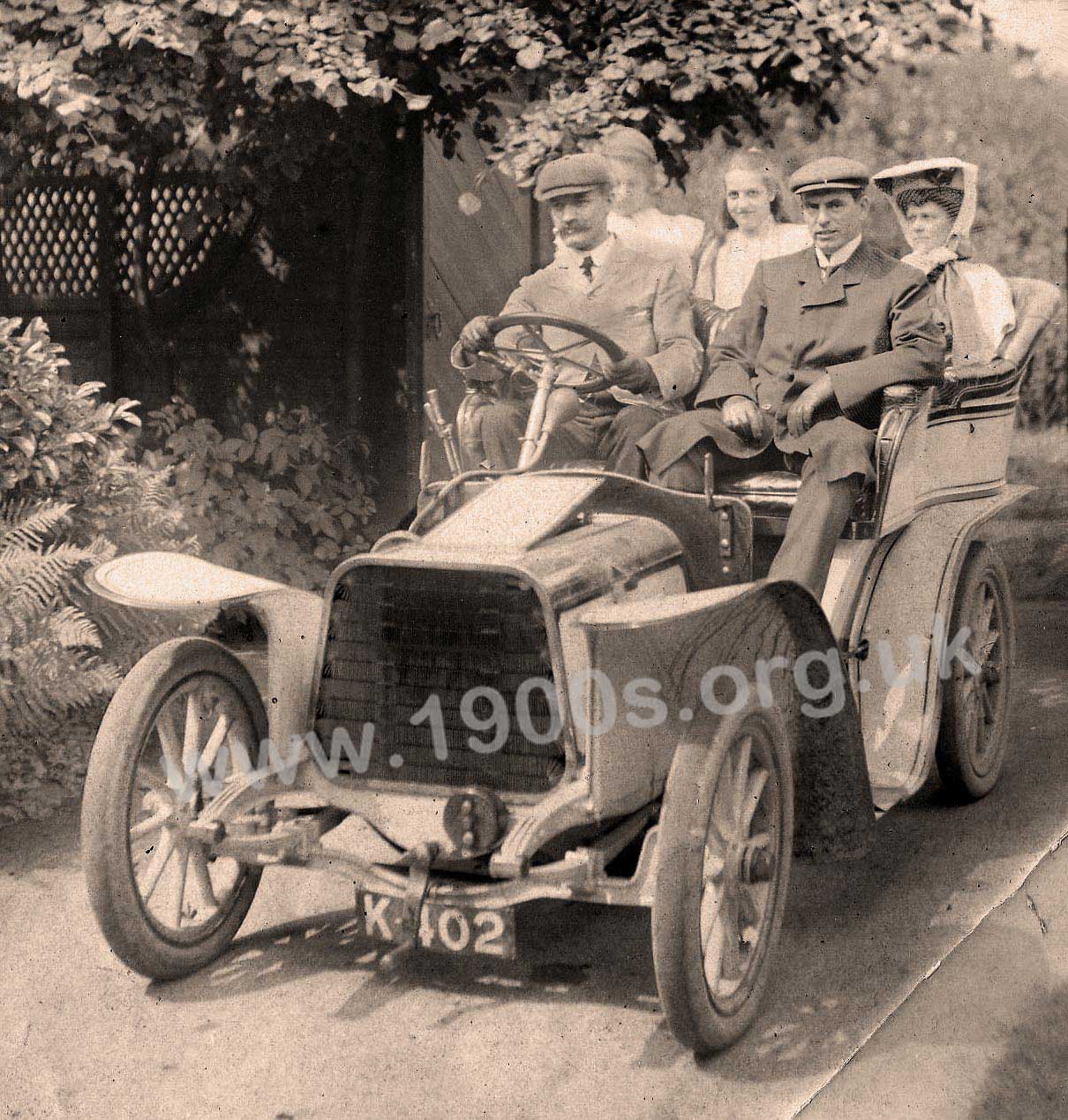
A 1920s car
Dangerous doors in older cars
Why doors were called 'Suicide doors'
Doors of some early cars were hinged at the rear which meant that if opened slightly while the car was moving, they would be forced all the way open by the pressure of the air due to the car's motion. This was the case with the rear doors of our 1935 Morris Ten and the front doors of our 1939 Riley, and was extremely dangerous. But the term 'suicide doors' may be North American.
Douglas Adam
Windows and windscreens
It was common for car windows to be made of some sort of cracking, brownish plastic, which was not really any longer properly transparent. Contributions in the following boxes elaborate.
Celluloid for old car windows
Celluloid was used for flexible car windows and I understand that early safety glass was a sandwich of glass and celluloid. The celluloid used to yellow and eventually brown over time, so was not ideally suitable, but better than shards of glass in an accident. Celluloid dates from about 1885 and until the early 1920s was one of the commonest plastics around.
Colin Williamson
The drivers must have had to drive with the windows open or with a hole pushed through them, in order to see safely - not that this would have been as dangerous as it sounds because there was so little traffic.
Front windscreens that opened
My father had a Morris 8 car in the late 1940s and its full windscreen was hinged along the top and could be opened out and held open with side brackets. I'm not sure whether it was to cool off the car after standing on a hot day or a modern form of air conditioning! I seem to remember that the windscreen wipers were attached to the top of the screen.
Mike Wheale
The opening windscreen could have been to improve visibility in the all-too-common fogs or when the windscreen got misted up or discoloured.
Neil Cryer
Yes, opening car windscreens were for fog use - as I can confirm from personal experience! What with poor wiper performance in old cars (some with only a single blade), poor headlights, or a pea-souper fog at night, front-opening windscreens were really needed!
Douglas Adam
Insects on windscreens
On any reasonably long car journey, the car windscreen would always be splattered with dead insects. This was evidence of the large number of insects in ordinary air. They were killed as moving cars drove into them. This is something that never seems to happen these days due to modern pesticides and the large-scale destruction of wildlife in recent times.
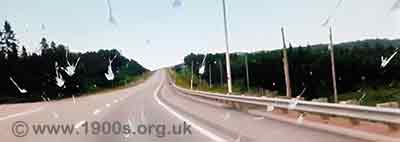
Insects on a car windscreen, normal in mid-20th century
Starting handles
The engines of these old cars needed to be started manually using what was called a 'starting handle' - see the photo. This had to be inserted into a hole at the front of the car and turned with a good 'thwack'. It often needed a number of turns.
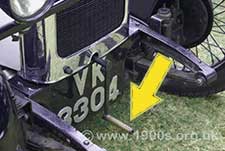
Car stating handle, photographed at Tilford Rural Life Centre
Why a starting handle was necessary
There were no multigrade oils to lubricate the engine. The engine oil was usually Castrol XL. The colder the weather, the thicker the oil became, so the low capacity lead battery struggled to turn over the engine fast enough for --- to 'catch'. The starting handle was common in post-war cars for quite some time.
Mike Wheale
How to hold the starting handle
It was important to grip the starting handle with a curved hand with the thumb on the same side as the fingers. This was because the starting handle could suddenly jerk round and cause damage.
Bill Hogg
Once the sound of the engine showed that it had started, the starting handle was removed and stored ready for starting the car next time. The starting handle was often stored in clips inside the car or clipped under the bonnet.
Running boards on old cars
Old cars had sturdy ledges on both sides running between bulky front and back wheel mudguards. They were called 'running boards', although I have never understood why. I suppose they were designed as steps for passengers getting in and out, based on the old horse-drawn coaches which were higher than cars.
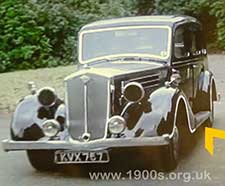
Running board on an old car
Running boards served as shelves for petrol cans, first-aid cans and holders for spare wheels. I also saw running boards used as seats when the cars were parked and as something for joy riders to stand on while cars were moving - a dangerous occupation which would probably not be allowed today.
Bonnets on older cars
The bonnets on most late 40's/early 50's cars consisted of separate halves, so that you could lift up the right-hand-side or the left-hand-side to get to the appropriate part of the engine.
Mike Wheale
Seat belt legislation: comfort and safety in older cars
There were no seat belts in older cars. Although car manufacturers did have to install them from 1965 in the UK, it was not until 1991 that the law required adults to wear them whatever them in the front as well as the back seats of a car.
Some statistics state that wearing a seat belt improves safety by 50%, but I can say from experience that seat belts would have improved comfort:
Sometime in the early 1950s I had a very long journey in an old 1930s-type car. I was appalled at how uncomfortable it was! It was winter and very cold indeed, and there was no heating. I don't think that the car had much in the way of springs, or the seats much left in the way of padding, but it certainly had no seat belts. As there were no motorways, only twisting and turning country roads, I was seriously thrown about, which was no fault of the driver. I felt sick, stiff and cold way before the end of the journey.
However some drivers were not necessarily competent. In 1935, compulsorydriving tests were introduced for all drivers and riders who started driving on or after 1 April 1934. I understand that the pass rate first time was not encouraging, but I can say from my own experience that I knew people driving around who, quite legally, had never had to pass a driving test.
Another safety factor was that it was fortunate that there was not more traffic on the roads. As the trafficator system of signalling drivers' intentions was so unreliable, cars bumping into one another would have been much more frequent than it actually was.
Also to add to the confusion at road junctions, there were no traffic lights
Licences to drive older cars
The following images show the 1939-1940 driving licence for my mother-in-law who drove ambulances during the war. Young women with no pre-school children had to go into employment, by law, during World War Two to fill the men's jobs.
Tap/click thumbnails for larger images.
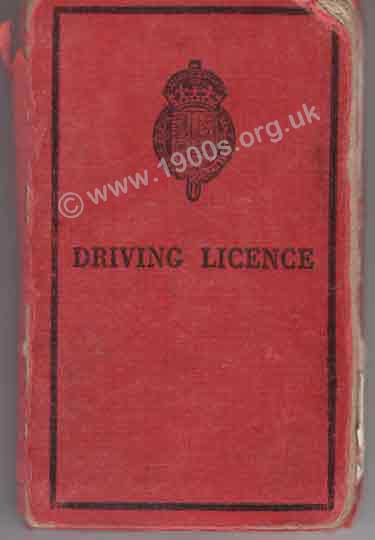
1939 driving licence, cover, courtesy of Neil Cryer
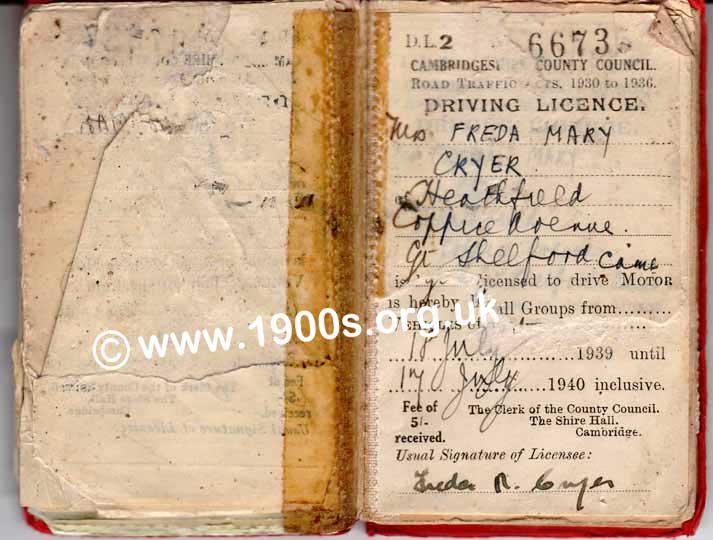
1939 driving licence, inside, courtesy of Neil Cryer
My family's first car - late 1950s
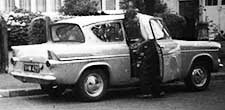
Ford Anglia family car
Like many other ordinary families, my father bought our first family car in the late 1950s. Such cars were newly manufactured, rather than second hand older ones.
Our car was a Ford Anglia which sold widely, probably because it was relatively inexpensive. To everyone used to the appearance of the old cars, Ford Anglias were dramatically different because they were contoured to look as if they were rapidly accelerating, with an inward slanting back window. Gone were the 1930s-style bulky mudguards over the wheels and running boards.
Advantages of the Ford Anglia's inward sloping back window
Although the idea of the Anglia car's forward sloping rear window never caught on for other makes, it had a wonderful advantage when it rained: the window would remain clear and would also not fog up as easily.
Norman Gibson
The following image is a car tax document for 1956. It is not for our Anglian, but does show the format of the car tax at the time. It has to be shown on the windscreen of every car on the road.
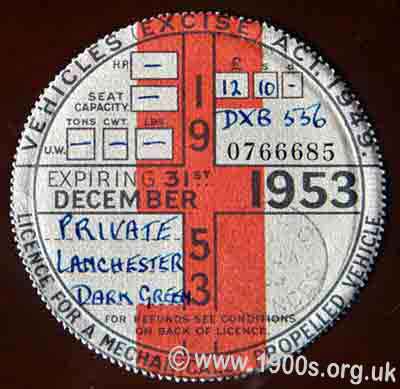
1953 car-tax disc for a dark green Lanchester family car DXB 556, courtesy of Francis Duck
My father, like most drivers, belonged to the AA (Automobile Association).
If you can add anything to this page or provide a photo, I would be pleased if you would contact me.
Text and images are copyright
sources: early 20th century material
sources: ww2 home front and other material
contact
the webmaster/author/researcher/editor
privacy policy

