 Victorian
mass housing
estates a typical
house rents
and
incomes house
plans the
kitchen the
kitchen
fire the
scullery the
parlour the
bedrooms the
sash
windows the
front
approach the backyard and
garden garden pests
and
solutions the
outside
lavatory

The kitchen in a small Victorian family home
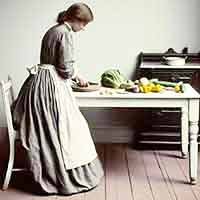
It must be stressed that the word 'kitchen' has changed its meaning over the years. In the early 1900s when the author was a child on a working class Victorian mass-housing estate, the kitchen was not where the main cooking and washing took place. That was the scullery. Victorian kitchens were where the family lived and relaxed. This page explains more about the relation between the kitchen and the scullery and goes on to describe how and why the kitchen was so cosy and comfortable in houses on Victorian mass-housing estates.
____
By the webmaster's mother (1906-2002) from personal experiences/observations, edited with further research by the webmaster
What the kitchen was used for and how it related to the scullery
The kitchen was where the family lived, ate, worked and played. So it was cosy and comfortably furnished with a kitchen fire like a small version of a kitchen range, which could be used for cooking simple meals. (The full-size kitchen range was in the scullery.)
The first sketch on the house plans page shows how the kitchen and the scullery were connected.
Only as late as the 1940s were residents starting to refer to their kitchen as the 'living room'. The 'scullery' became known as the 'kitchen', and its little alcove for washing, became the scullery.
The couch
For comfort of everyday living, there was a sofa - something that would never be found in a kitchen of today.
It was known as the couch and was well used in more ways than one. I understand that my mother used to have ten minutes well-deserved rest on it after we had gone to back to afternoon school. Women's work was really hard in those days. This couch was particularly convenient, being in the warm kitchen, because if you had had to go up into a cold bedroom for a rest, you would think twice about it.
To us children the couch was something to play on and its cushions were somewhere to put things under as a quick tidy up before my mother came into the room.
The walls and the coalhole/coal hole
The kitchen walls are worth special mention because - again - their main feature was something that would never be seen in a kitchen of today. On the hall side, against the stairs, the wall made the side of the coal hole where the coalman shot the coal when he delivered. Its door was quite attractive tongued and grooved wood. The entrance was in the scullery. This will become clearer if you look again at house plans page.
The other walls were wallpaper on plaster. As can be seen from the following photo, the fashion of the day was for rather flowery wallpaper, what might be descried today as 'busy'.
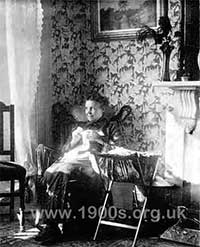
The Victorian kitchen. This photo emphasises that
the kitchen was the everyday living room
in the early 1900s. Note the rather 'fussy' patterned wallpaper.
Photo
courtesy of Don Billing.
There were numerous pictures on the walls but I only recall the water colours of lakes and mountains. They were hung from picture rails as illustrated on the parlour page.
The window
The back wall had a window which looked out onto the back yard and garden. There are four pages on these windows. The link gives the first of the four, from which the others are linked.
The window blind, like all the others at the back of the house, was linen with a deep fringe of lace made by my mother from macrame thread, crocheted. It was secured by a cord, hanging down from the centre. The knob to hold the cord was in the shape of an acorn and was called an acorn, although it was made in box wood.
The floor and its piece rug
The floor was essentially wooden planks but it was scovered with oilcloth. In fact, oilcloth was the floor covering in most of the rooms. When it got worn, the varnish chipped off to show canvas threads underneath. My mother washed her oilcloth with warm soapy water.
The stark appearance of the oil cloth was taken off by the rug in front of the kitchen fire. (There is more on the kitchen fire on its own page, but it should be noted here that is was a small-scale version of the kitchen range in the scullery, such that it could manage small-scale cooking.) The type of rug was unique to to the period, was extremely common and something that you would never see today, let alone in a kitchen. It was called a rag rug or a piece rug for reasons about to be explained.
The rag rug/piece rug
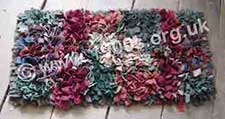
A rug, known as a 'piece rug' or a 'rag rug', common in working class homes in the early 1900s and before, and made by poking strips of hard-wearing fabric through canvas and backing with more canvas.
Rag rugs or piece rugs were made from off-cuts of hard wearing-fabric such as serge and tweed, of which there was no shortage as women always seemed to be busy mending or making garments in those days. The fabric was cut into lengths and looped through canvas, then backed with more canvas.
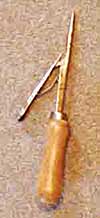
Tool for making a rag rug. It was poked through the fabric backing, locked onto a length of rag and pulled back.
Rag rugs were nice and warm to your feet and cosy. They didn't shrug off dirt the way that today's rugs seem to, but we knew no difference, although now I dread to think how dirty they must have been. Like a good many more things, though, they were put outside onto the clothes line from time to time to be given a good blow. Also when there was snow on the ground, they were dragged quickly across it - not enough to get really wet but just enough for the snow to ease off the dirt. The sun, wind and snow did much for things in those days.
The dresser and cupboard
There was a recess on either side of the fireplace. In one was a built-in cupboard and in the other was a dresser where the best dinner set was kept.
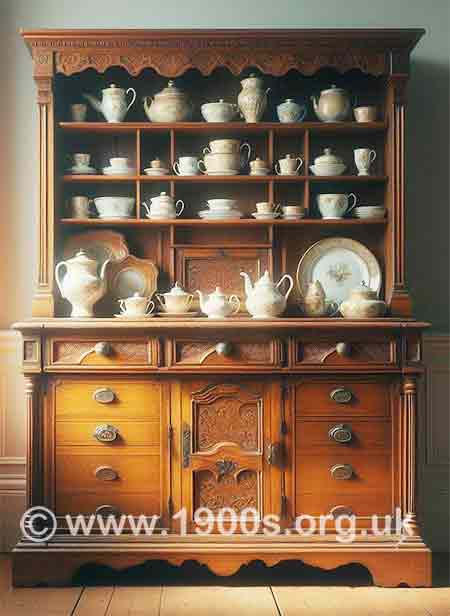
Wooden dresser similar to the ones in Victorian kitchens
Jugs and cups were hung up on hooks on the shelves. In the lower part of the dresser were two drawers and below there was a small recess which was covered by a curtain. Boots and shoes were kept there.
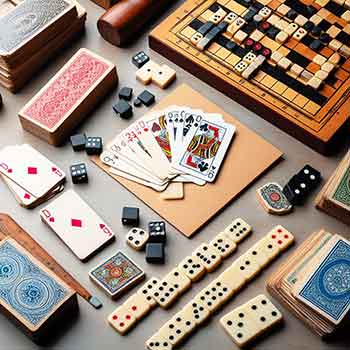
Indoor games kept in Victorian kitchens which were of course living rooms
In the drawers numerous odd things were kept. In one drawer were socks and stockings and in the other drawer were indoor games. These were very popular as there were no radios or televisions to relax with. Draughts was played on a draught board. We had two of these boards, one was made by my father from material like oilcloth and the other was a carpenter's joy and treated as such. I never knew what became of it. For us children the playing cards were mostly for playing Snap and Beat your neighbour out of doors, and of course Patience which has helped to pass away many an hour, both by children and adults.
Then there was cribbage, a card game where the scoring is kept with little coloured pegs on what was known as the 'crib board'. The pegs kept in a little compartment at the back of the board. My mother and father seemed to enjoy this game. I used to think it was an odd sort of game when I listened to them, scoring, "One for the knob, two for a flush", etc.
Another game that was kept in the drawer was Dominos. I didn't mind this as there was no skill, just luck.
The table and chairs
There was a table under the window with Windsor chairs round it. Windsor chairs were standard in most homes. Typically, the seats were usually carved into a shallow dish or saddle shape for comfort and the backs were bent spindles.
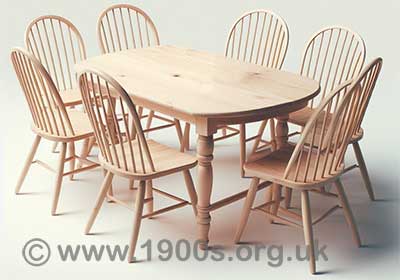
Set of early 20th century Windsor chairs and
table, similar to what is described here.
The wood was 'whitewood', ie plain,
unstained and unvarnished wood that could be scrubbed frequently, usually a type
of fir. Lots of things were made of whitewood. They were things that had to be scrubbed regularly to keep the dirt out of the grain, for example the breadboard, the lid of the
copper, the
cutlery box and
cabbage squeezer to name just a few.
The sewing machine
My mother's sewing machine must not be forgotten because it was kept in the kitchen and in constant use - never, though at evening times as it annoyed the man of the house - he who had to be obeyed - my father. It worked with a foot pedal, known as a treadle. There were no electric sewing machines.
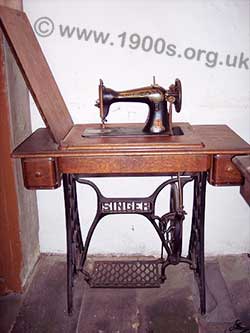
Treadle sewing machine
| sources | webmaster | contact |
Text and images are copyright
If you can add anything to this page or provide a photo, please contact me.

