






 coal and its
importance
in the past the coal
yard/depot coal and coke
prices 1938/39 preparations
for a delivery
early 20th C arrival of a
coal delivery
early 20th C coal delivery
mid 20th century coalmen's
work coalmen's
appearance


The appearance of the coalman who used to deliver coal
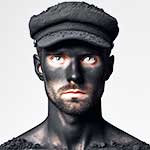
This page gives descriptions of coalmen who used to deliver sacks of coal to houses when Britain was dependent on coal for fuel. It describes how the coalmen were mired in black coal-dust and how their clothes differed in different parts of the country. The page even comments on their smell.
____
By the webmaster based on childhood recollections, firsthand contributions and discussions with older people
Coalmen's ingrained blackness from the coal dust
No-one could fail to recognise the old-style coalman who delivered coal up until the mid 20th century. Even if you came across him without the sack of coal on his back, you could not mistake him. He was black - not by race, just black, black all over: his skin was black; his clothes were black and his hair was black. The blackness of a coalman had to be seen to be believed. It was gritty and uneven, and in spite of this description, you probably can't really imagine what he looked like without seeing him for yourself. There was just one part of him that didn't look black - round his eyes were white rings where he rubbed them to get rid of the coal dust in them. Most of the photos on the web don't show the extreme extent of the blackness and were presumably specially posed.
I came across a coalman close-to only once when I was a young child at my parent's home. I came out of our front room and there he was, presumably waiting for his tip. I was shocked, and he could see that I was.The whites of his eyes seemed to stand out from his face. He said and did nothing, but I couldn't help but notice the look of resignation on his face. His experience of shocking a child would not have been uncommon.
The scariness of coalmen to young children
To my sister and me, coalmen seemed scary because they were 'as black as the ace of spades' from all the coal dust, but often with paler rings round their eyes where they had tried to rub the coal dust away.
David Perfect
At the weekend we children thought we had two fathers - a dusty black coalman Dad throughout the week and a clean washed off-duty Dad at the weekend!
Valerie Fife
The dress code for coalmen
Contributors describe coalmen's clothes in the following coloured boxes, and their descriptions are exactly as I remember seeing them. I have checked with a number of people who remember coal deliveries and - so far - everyone in the south east of England and as far north as Cambridge remembers the same.
In the south east of England and possibly elsewhere
When the coalman came to our house to deliver coal, his face, hands and clothes would be black with coal dust.
He didn't have a uniform, but wore a leather hat with a flat leather flap down the back to protect his neck, back and shoulders as he carried the sacks.
He also wore narrow straps just below his knees, possibly to prevent the coal dust getting up his legs, but I'm not really sure why. The trousers always seemed to be corduroy but that may have been chance.
The webmaster’s mother, 1906-2002
Although 'coalies' - as we called them - did not have a uniform, they did have a dress code because they were dealing with the public and uniformity was quite essential.
The backing hat - i.e. the long leather-backed hats
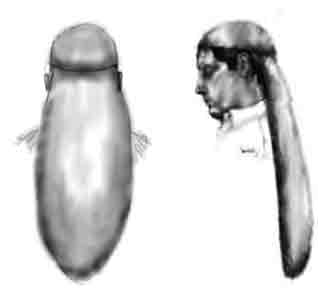
Back and side view of a coalman's backing hat, based on a sketch by former London coalman, Terry Martinelli.
The piece of leather at the back of a hats was mainly used for protection by the loaders and delivery men who carried the sacks of coal on their shoulders and backs. It was called a 'backing hat' and protected the head, neck and back. It was made from an old trilby hat, the front rim of which was cut away. Stitched to it, using hemp or jute twine, was an old piece of thick leather from an old sewer boot, split up the seam. It was generally made by retired coalmen for some pocket money.
White coats and smocks
White coats - 'backing jackets' as we called them - were for car men, i.e. the men who drove the carts, and white smocks were for the depot manager. These were traditionally worn from the 1st May, the start of summer prices which, incidentally, were less than those in winter.
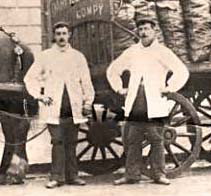
The white coats and 'spankers' worn by managers and drivers
The spankers, i.e. the straps round the trouser legs
The straps around the trouser legs were called 'spankers', the use of which I am not too sure. It was possibly to stop dust rising up the legs in hot dry weather or wet conditions. Or maybe it was to stop vermin from flying up legs, particularly with people who worked in grain stores. However my theory could be just fashion and dress code.
Bob Warr (ex-London coalman)
whose father, grandfather, great grandfather and uncles
were mostly coalmen
Elsewhere in the country
However, some contributions show that coalmen elsewhere in the country had a variety of protective clothing. Read on ...
As a child in Yorkshire, I remember coalmen making deliveries wearing thick leather sleeveless jackets to give protection to their shoulders and backs when carrying bags of coal. No neck protection, though.
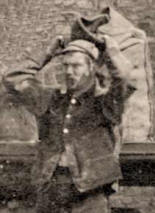
A coalman's hat and sleeveless leather jacket.
Moyra Hill
In Poulton-le-Fylde in Lancashire where I lived as a child in the 1930s and 1940s, the coalmen always wore a sort of 'leather shield' as protection. I can best describe it as like the back half of a tabard. It had straps over the shoulders and round the chest to hold it in place. One of my grandsons thinks it may have been called a 'back skin'. Can anyone shed more light on its name?
They wore their own hats and there was nothing organised to protect their necks.
Frances Reynolds
My father and his fellow coalmen never had the protective head, neck and upper back gear which seems to have been common further south.
He had some protection on his back which was a piece of waterproof black leather or leatherette fabric stitched onto the upper back of his donkey jacket (a medium-length workwear jacket, typically made of unlined black or dark blue thick woollen fabric, with the shoulders back and front reinforced and protected from rain with leather panels.) The waterproof backing did repel the rain initially, but it would deteriorate due to wear and tear of the heavy coal bags. So he would arrive home with his back soaking wet from the holes in the back of the jacket. Although its fabric was a thick black industrial woollen material which was warm, it was not suitable for wet weather conditions.
My father wore a leather topped cap, similar to New York policemen in the 1960s, but there was no covering of his neck.
Valerie Fife
The smell of the coalman
My grandfather used to work in the coal yards at Upper Holloway, in north London where he unloaded the coal trucks and loaded the lorries. What I remember particularly is the smell of the coal when he came back home in his working clothes. There was a nightly ritual of him standing at the sink in the kitchen for a thorough wash. Afterwards my nan would dish up his dinner.
David Houghton
If you can add anything to this page or provide a photo, I would be pleased if you would contact me.
Text and images are copyright
sources: early 20th century material
sources: ww2 home front and other material
contact
the webmaster/author/researcher/editor
privacy policy

