Join me in the 1900s logo
from the webmaster

Living with Victorian and Edwardian sash windows

Based on childhood recollections of working class family life in north London in Edwardian times.

Victorian and Edwardian houses are still giving good service today, but few have their original windows. Most have been fitted with replacement UPVC windows designed to look like the originals.

My mother's written recollections of life in her childhood in the early 1900s mention sash windows. So I wanted to learn more about what they were and what it was like to live with them.


What sash windows are

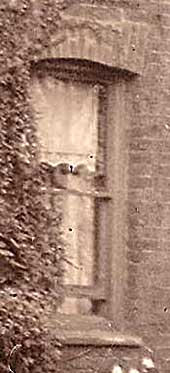
Sash window pre 1900

Detail from an early 1900s photo showing an original sash window. It is slightly open with its lower section slid up inside its upper one. In Victorian and Edwardian times the frames were made of wood.
old sash window, the worse for wear

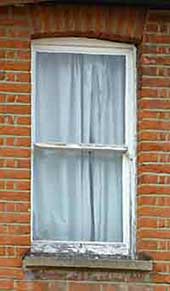
Modern photo of a Victorian sash window. The flaking paintwork illustrates how the wooden frames need to be painted regularly to stay in good condition.
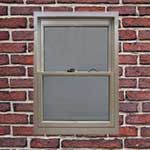
replacement sash window with UPVC frames

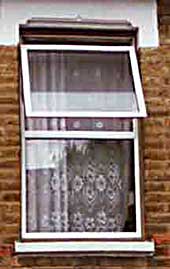
Modern photo of a replacement window. There are several styles which preserve the two-section appearance of Victorian and Edwardian sash windows. This one opens by tilting rather than sliding. When closed the cross bar appears thicker than in the Victorian or Edwardian counterparts.

A 'sash window' is a window in two sections which opens by sliding one or both of the sections up or down over the other. Little effort is required because of an ingenious system of pulleys and counterbalancing weights which keep the window open or closed in any position. Each section is known as a 'sash'. The outer one is the top one.

I understand that sash windows were in use as early as the 17th century, and they were commonplace before the onset of the commercial use of plastics in the middle of the 20th century. In their heyday sash windows always had wooden frames.

to top of page

How sash windows work

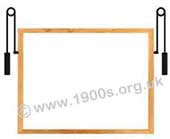
The principle of how sash windows open and close easily and stay in position

The principle of how sash windows open and close easily and stay in position with a system of pulleys and counterbalancing weights. Schematic and not to scale.
'Horns' on the upper section of sash windows

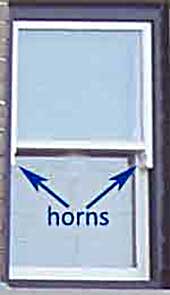
The 'horns' on either side of the upper sash window. They prevent the sections from sliding down so far behind the lower sash that it can't be reached. You have to look carefully to see them in the above 'original' photographs. (There were similar horns inside on the lower sash section - see the photo below.)

Each window section (ie the upper and the lower sash) is hung on cords which pass over pulleys and connect to weights which are concealed inside the window frame. The weights counterbalance the weight of the sash so that it can be raised and lowered with little or no effort and then stays in whatever position it is left in.

There are projections called 'horns' on either side of the upper sash window. They prevent it from sliding down so far behind the lower sash that it can't be reached.

to top of page

Living with original sash windows

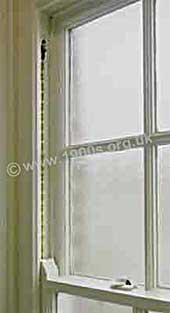
Old sash window from inside showing the sash chain that replaced the sash cord in better-off households and the sash window locking mechanism

Sash windows in the better-off houses and public buildings tended to have chains instead of cords. This photo taken from inside, shows not only a chain but also the sash window locking mechanism and the internal horns on the top of the lower window section.

As the frames of the Victorian and Edwardian sash windows were made of wood, they expanded in damp weather unless they were painted regularly. Painting was quite a palaver because some part of the window and its the wall frame which held it was always inaccessible, and care needed to be taken when painting close to the edges near the channels. In practice some paint invariably spilled into the channels, and layers of set paint built up over time. Consequently, the windows tended to stick, and as often as not they simply would not open. I never lived with them, but I do remember as a child visiting houses which had them and being told, "That window doesn't open".

It was also near impossible to get a neat painted edge on the glass. The panes of glass were fixed into their wooden frames with putty, a pliable waterproof material based on linseed oil. It set hard on exposure to the air as the linseed oil evaporated and seeped into the wood. As it set, it contracted and small cracks developed which became deeper over time. Eventually pieces broke off. Painting over the putty while painting the wooden window frame prolonged its life, but in time the edge that met the glass became bumpy and jagged.

Lower corner of an original sash window showing how

Lower corner of an original sash window showing how the putty fixing the glass into the wooden frame has shrunk and cracked, so letting in rain and preventing a neat painted line.

While preparing this page, I spoke to people who remembered living as children with Victorian and Edwardian sash windows. By then of course the windows were already many years old. So perhaps it is not surprising that they were regarded as ill-fitting, draughty, and rattling in the wind.

There is a page on my mother's recollections of her mother cleaning sash windows in the early 1900s.

to top of page

Replacing broken sash window cords

Sash cord breakages were uncommon, but had to be treated with care, because once one cord had gone all the weight of the window was taken by the remaining cord, which skewed the window sideways and jammed it. The remaining cord could then also break under the extra strain, bringing the whole window crashing down. This is something my mother is on record as remembering. My husband too has a recollection of it: His landlord was opening a sash window when both cords broke. The lower sash which had been raised came crashing down trapping his fingers. The window was very heavy without its counterbalancing weights and someone had to fetch a poker to lever it up so that he could get his fingers out. His fingers were painful for some time afterwards, but fortunately were not broken.

Removing the beading from the edge of the frame

Removing the beading from the edge of the frame. Photo courtesy of  Sash Repairs.


Swinging the sash window out on its remaining cord.

Swinging the sash window out on its remaining cord. Photo courtesy of  Sash Repairs.

Richard Cole tells me that mending broken sash cords was a performance. A beading, which was invariably stuck in place with paint, had to be prised off from the edge of the frame, so that the window could be swung out on its one remaining cord. Then the edge of the frame could be removed, revealing the channel which held the counterweight. The weight had to be attached to a new cord which had to be threaded through the pulley at the top of the frame, and the other end had to be re-attached to the window, making sure that the cord was the correct length: long enough that the window could be fully lowered, but not so long that the counterweight lay on the bottom of its box before the window was fully raised. Then the edge of the frame had to be replaced; the window had to put back into position, and so did the beading. Nail holes needed to be refilled, and some paint touching up was invariably also needed.

This website Join me in the 1900s is also known as Join me in the 1900's and is © Pat Cryer.

to top of page

MORE ON VICTORIAN/ EDWARDIAN TERRACED HOUSING
............................
the housing estate
............................
room plans
............................
the front garden
............................
the parlour
............................
the kitchen
............................
the scullery
............................
the bedrooms
............................
the back yard & garden
............................
the flush lavatory
............................
computer models / reconstructions
............................
chamber pots
............................
sash windows
............................
washing facilities
............................
cooking & heating: the kitchen range
............................
hot water: the copper
............................
lighting: gas lamps
............................
mice
............................
rubbish disposal
............................


SEE ALSO:
............................
older properties
............................
1940s & 50s properties
............................