






 Victorian
mass housing
estates a typical
house rents
and
incomes house
plans the
kitchen the
kitchen
fire the
scullery the
parlour the
bedrooms the
sash
windows the
front
approach the backyard and
garden the
outside
lavatory


The toilet/lavatory in estates of working class Victorian houses
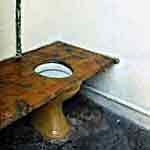
In Victorian and Edwardian times, there was mass building throughout the UK of homes for the working classes - all built to the same basic Victorian house design. A feature was the plumbed-in flush lavatory, widely known today as the Victorian toilet, the Victorian terrace toilet or the outside loo, a major improvement over the older outside privies. This page describes the various features of these toilets and what it was like to live with them.
____
By the webmaster's mother (1906-2002) with firsthand contributions from others, edited with further research by the webmaster
The toilet/lavatory in estates of working class Victorian houses
Although the toilet was built into the back wall of the scullery of the terraced houses, there was no way into it from indoors. It was only accessible from outside in the back yard, as shown in the floor plan of these houses. This was probably to prevent smells in living areas.
There were chamber pots for use in the night and in bad weather; and elderly and sick people used commodes. Neverthless can you imagine what it was like in the normal way to have to go outside every time you wanted to go to the lavatory or to have to empty chamber pots in the morning?
The toilet building
As previously stated, the toilet was built onto the outside wall of the scullery. The other walls were brick-built. It was just one storey with a slate roof construction. The inside walls were plastered.
The door consisted of tongue and groove lengths of wood about four inches wide. There was a space 6-8 inches top and bottom which meant that the room was open to the elements and thus well ventilated - albeit cold and draughty in most weathers. The door opened and closed with a farmhouse-style up-down latch with a slide bolt inside for privacy.
Cliff Raven, resident of a Victorian estate
The flush, the water cistern and plumbing
These toilets flushed! This was a special feature and very modern indeed at the time for ordinary people as it meant that we didn't have to empty the waste ourselves, as with the old outdoor privies. The flush operated by pulling the chain shown in the picture which released water from where it was held up in the cistern.
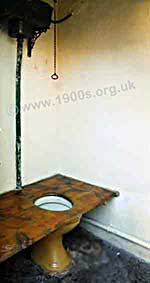
The cistern and flush in the toilet of an everyday Victorian style house*
The water cistern was made of cast iron and was attached to the wall, supported by iron angle brackets situated about eight feet from ground. Its water was plumbed into the main house supply and fed to the flush pan through a lead pipe about 2½ inches in diameter. In fact, all flush toilets need to be plumbed into the house supply and therefore need to be part of a building with its own plumbing.
The operation of the toilet was efficient, and the only repairs needed would be new chain pulls, ball valves or water feed washers.
Low level flushes were decades away.
The U-trap and the sewer
There must have been a U-trap somewhere just underground because there was no smell. The main sewer ran along the length of the whole road, along the backs of the houses in line with the toilet outlets. There was the occasional manhole along that line.
John Cole
The toilet seat
On our estate, the bowl of the lavatory was set into a wooden box-like container which went the width of the cubicle. The lavatory seat consisted of planks of white wood with an appropriately sized hole to sit over. The planks went across the whole width of the room as shown in the above photo and my mother scrubbed them every weekend.
Newspaper as toilet paper
There was no toilet paper as such. I don't think it existed, as I never saw any. Everyone used newspaper cut into approximately six inches squares, pierced though with a meat skewer, threaded with string and hung on a hook. It was accepted common practice to read from these pieces while sitting in the toilet. No-one thought about germs.
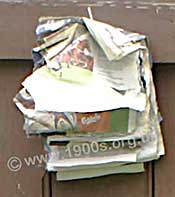
Squares of newspaper on a string, to serve as toilet paper**. In practice, the old newspapers would not have had any colour, being solely black print on white.
Newspapers were common in all but the poorest of homes. There was no radio or television so newspapers and the cinema were how we got our news. In fact, if we hadn't had newspapers we wouldn't have had toilet paper.
Pull-chain flush toilets in wealthy houses
In the houses of the very wealthy, the toilets were indoors, the china bowls were richly and colourfully decorated inside and out in the style of the old guest toilet jugs, and the seats were fitted, polished wood. I have only seen these in museums where they strike me as over-cluttered.
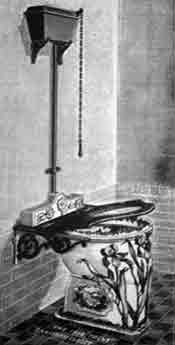
A pull-chain flush toilet in in a wealthy house*** Note the decorated china pan and the fitted wooden seat
Origin of the flush toilet
Thomas Crapper is widely regarded as the inventor of the flush toilet, although, according to Wikipedia, this is untrue as he was actually a leading manufacturer. His surname is said to be the origin of the word 'crap', meaning something entirely worthless, presumably like the contents of a toilet pan.
If you can add anything to this page or provide a photo, I would be pleased if you would contact me.
Text and images are copyright
*Photographed by the webmaster in a private house
**Photographed by the webmaster in Fagans Museum of Welsh Life
***Photographed by the webmaster from a picture in Blaise Castle Museum
sources: early 20th century material
sources: ww2 home front and other material
contact
the webmaster/author/researcher/editor
privacy policy

