 older
olderrural housing open-fires
for
cooking oil-lamps
for
lighting the
outdoor
privy chamber
pots and
commodes mice
in houses recycling
rubbish
disposal student
accommodation
1950s

The outdoor privy lavatory
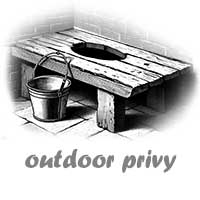
A privy was an outdoor building with no plumbing set up as a lavatory or toilet. In the past, older properties in rural areas had no indoor modern conveniences, so privies were common. It was quite normal for people to go outside to visit the lavatory. This page reports on all that you are likely to want to know about outdoor privies in the past and is well-illustrated.
____
By the webmaster based on the memoirs of FEC (1906-2002) and discussions with older people, particularly Bill Hogg, Anne Davey and Phyllis Durbidge (born Phyllis Money), with additional research
The location of a privy
Privies were used in all weathers, rain or shine. So they had to be near enough to the house or cottage to be reached quicky in bad weather. Yet they had to be far enough away to keep the smell away from the living quarters. If the weather really was too appalling to venture outside, chamber pots and commodes had to suffice indoors. Chamber pots were always used at night anyway, rather than having to go any distance outside in the dark. It is difficult for us today to imagine what the smell must have been like.
All cultures seem to have euphemisms for going to the toilet. I used to hear older people talking about 'going outside'; everyone knew that they meant visiting the privy.
The privy building
Some privies were wooden huts and some were brick-built. Only the brick-built ones seem to have survived today for photographs.
The roofs sloped to let the rain drain off, and the doors had ventilation in them, above eye level, to keep the air as fresh as possible. The simplest form of this was a door that was shorter than its door frame, open to the elements at the top and sometimes at the bottom, although this made for cold feet.
I am told from firsthand recollections that some poorer people in rural Ireland did not even have a building. They just went outside and leant against a tree. It seems likely that this practice was widespread everywhere in labourers' families in the past; it just did not and does not get reported. In fact, the person who told me, clearly regretted that he had, as he clamped up afterwards.
The lavatory seat
The lavatory seat was always made of wooden slats with a hole to sit over. Some families had two or more holes of different sizes to accommodate children. Sometimes there was a board behind to lean on, so that users could sit more comfortably.
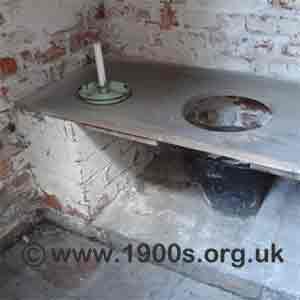
Inside a privy showing the hole in the wooden plank seat and the bucket underneath. Note the candle for use in poor light.
Lavatory paper/toilet paper
Toilet paper/lavatory paper was newspaper, cut into squares, pierced with a skewer and hung on the wall with string, as was still usual the lavatories of the Victorian mass-built estates.
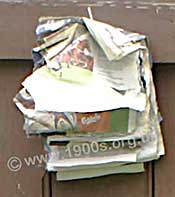
Squares of newspaper on a string, to serve as toilet paper. In practice, the old newspapers would not have had any colour, being just black print on white.
Privacy and the privy lock
People were not as concerned about privacy then as now, but there were privy locks and latches. They were designed so that the door could be shut from either side, to prevent damage from the wind and rain while also providing privacy while in use. One type is shown below. Some privies probably had bolt latches on both sides of the door
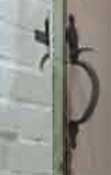
Privy latch to open or close the door from inside and out
The privy bucket
There seem to have been various ways of disposing of the products of a visit to a privy. In small families, the privy bucket was the most common. There were several of them so that as one was full, it was replaced by another.
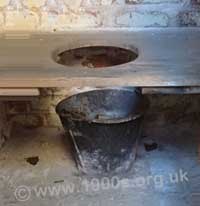
Privy bucket under the seat to catch the products of a visit
The bucket in use was placed under the hole in the seat as shown in the photographs. It collected the results of the visit and was portable for ease of emptying. Either its contents would be taken as far away as possible and dug into the ground or covered in some way as part of a compost heap, or the bucket would be left somewhere convenient for the night soil man to collect - see below. These buckets were aluminium. There were no plastics and wooden buckets would have been too difficult to clean.
The privy drainage pit
The principle of another disposal method is shown in the following diagram.
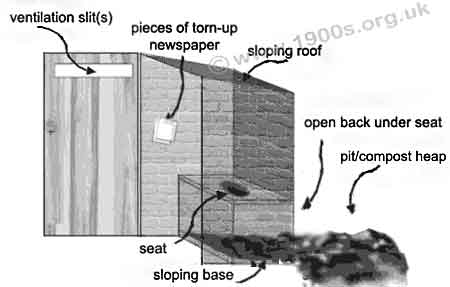
The principle of drainage into a privy pit. The area under the seat was open at the back and there was a sloping base to let the results of visits drain out into a pit behind. Based on a rough sketch with explanation by Bill Hogg.
The area under the seat was open at the back and there was a sloping floor to let urine drain out into a pit behind. Presumably one person's urine helped to wash out the previous person's faeces, although the occasional bucket of water probably helped. The pit could be used as a compost heap for any rubbish that would rot down. This 'enhanced' compost heap was said to be a great soil improver for the garden. If or when the pit was full, it had to be dug out. If required, there were contractors who would do this.
Odour prevention
There was no water flush, so a privy could be a very smelly place. It was kept fresh by sprinkling the products of a visit with whatever was readily available and would serve the purpose. Ash was an effective common commodity at the time because open coal fires and cooking ranges were the only forms of heating. Sawdust was also used, as was plain garden soil. Water would have filled up the bucket too quickly, but I was told that it was sometimes used for the pit privy.
I was told that some pit privies had a lever system which 'flushed' somewhat like modern lavatories but with the ash or sawdust - but by all accounts they never really worked effectively.
The night soil man
The 'night soil man' could be engaged to take the waste away. He would come round by horse and cart, normally at night so that he did not disturb the occupants of the house or cottage.
contributed by Joan Grange
My aunt told me that she once saw the night soil man's cart coming and warned her friend that they should cross the road. Apparently the pong hit them soon afterwards anyway, and it was atrocious!
The coming of mains drainage
contributed by Alan Talbot, family recollections
Mains drainage did not come to some rural areas until the 1950s or even after that. It should not necessarily imply, though, indoor toilets/lavatories. The residents of the Victorian mass-built housing had flush lavatories on mains drainage, but still had to go outside to use them.
Where my family lived in South Lincolnshire, mains drainage did not arrive until in the 1990s!
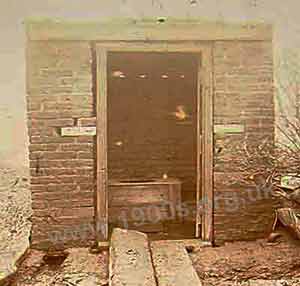
Privy at the Tottenham Tile Kilns from a photo taken in 1897. Similar outdoor privies were still in use in the first part of the twentieth century.
| sources | webmaster | contact |
Text and images are copyright
If you can add anything to this page or provide a photo, please contact me.

