





 older
olderrural housing open-fires
for
cooking oil-lamps
for
lighting the
outdoor
privy chamber
pots and
commodes mice
in houses recycling
rubbish
disposal student
accommodation
1950s


Open fire cooking in old unmodernised houses
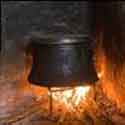
Old houses that did not have a kitchen range or kitchen fire cooked on an open fire in a large fireplace with a wrought iron arrangement which could affect the temperature of the cooking and keep a kettle of water on the boil. This page describes and explains the arrangement, but first comments on the fuel and the sorts of meals that were suitable for open-fire cooking.
____
By the webmaster based on the memoirs of FEC (1906-2002), discussions with older people and additional research
It is difficult for us today to imagine how poor people used to live in the early 20th Century and before. For example, my mother told me that one of her grandmothers lived in little more than a hovel. There was no gas or electricity; candles, coal and paraffin oil had to be bought and dry wood collected from woodland. Cooking was on an open fire.
Coal versus wood for a fire in a grate
People who could afford it would buy coal to burn in their fires because it burnt at a higher temperature and for longer than wood. However, families living in old, rural, unmodernised houses were usually poor, and wood was readily available as fire wood, free of charge in the open countryside. So many a fire would use wood.
Meals for open fire cooking
Open fire cooking is most suitable for meals that require long slow cooking at a fairly low temperature. The people who lived in these old cottages tended to be poor. So their food was probably mainly stews of seasonal vegetables, with the occasional home-reared chicken or trapped wild rabbit.
The simple and obvious way to adjust the heat for cooking
Building up a fire with more wood or coal is the obvious way of increasing its heat, whereas limiting the air supply with a covering of loose fuel is the way of reducing the heat. This latter process was described as 'banking up the fire'. People normally did it to save fuel just before going to bed at night when they no longer needed a warm sitting area. In the morning there was usually enough heat inside the fire for it to burst back into flames given a good poke with a poker to let the air in.
However this method was not sensitive enough for cooking.
The device to give a finer control over adjusting the heat for cooking
The heat from an open fire under cooking pots could be adjusted quite quickly with a cast iron bar or arm arrangement attached with heavy hinges to the fireplace. It is shown in the following image, but there were usually more than one such arm at different heights.
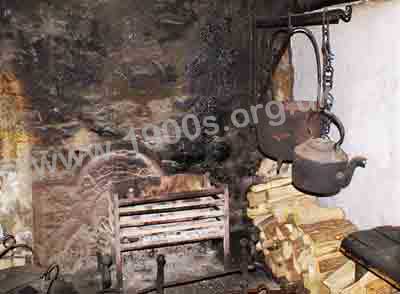
A cast iron arrangement for heating cooking pots over an open fire
Note the width of the fire place which had an equally wide chimney, the sort that children
chimney sweeps were expected to climb up to remove collected soot
One or more cooking pots or kettles were hung onto an arm which was swung round, either to over the fire to heat up quickly or somewhere near the fire to keep warm. The choice of the arm to use depended on how far above the fire the cooking pot needed to be placed, which in turn depended on how strongly the fire was burning. Alternatively the height above the fire - and hence the cooking temperature - could be adjusted by the altering the lengths of the suspension chains.
The arms could be swung back from the fire for loading and unloading the pots.
There were various versions of the device, but the principle was the same.
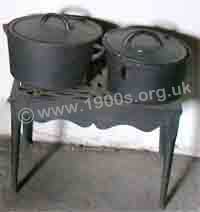
Trivet for protecting the surface below hot pots
Photographed at St Fagans National Museum of Wales
If you can add anything to this page or provide a photo, I would be pleased if you would contact me.
Text and images are copyright
sources: early 20th century material
sources: ww2 home front and other material
contact
the webmaster/author/researcher/editor
privacy policy

