 older
olderrural housing open-fires
for
cooking oil-lamps
for
lighting the
outdoor
privy chamber
pots and
commodes mice
in houses recycling
rubbish
disposal student
accommodation
1950s

Chamber pots and commodes: alternatives to a lavatory
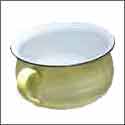
Chamber pots and commodes were used indoors in the past when a visit to the outside lavatory was too cold or wet to attempt, particularly at night. This page describes them with the help of illustrations and explains the procedure for using and cleaning them.
____
By the webmaster based on discussions with older people and additional research
What chamber pots were and why they were used
Chamber posts were like the babies' potties of today but larger and more substantial, because they were for adult use. They were made of china or enamel and could be quite decorative.
In the Victorian style terraces where I grew up in the early 1900s, we considered ourselves fortunate to have a built-in flush lavatory, even though it meant having to go outside into the back garden to get to it. This was not something anyone would relish at night or in bad weather.
So not surprising chamber pots - also written as chamberpots - were a part of everyday life for adults as well as babies and children.
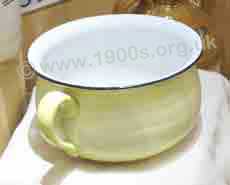
A basic enamel chamber pot photographed at Milestones Museum in Basingstoke.
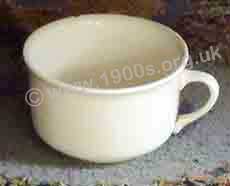
A basic china chamber pot photographed at the Museum of Nottingham Life.
Chamber pots were normally kept under beds in bedrooms.
Limiting the smell from chamber pots
contributed by Darren Kitson, recollections
Chamber pots, once used, were sometimes covered with newspaper or with an otherwise discarded piece of cloth - i.e. if they were covered at all. In fact they seldom were covered for urine, only for faeces.
Using and emptying chamber pots
contributed by Darren Kitson
When and how chamber pots were emptied depended upon the routine of each individual household. Sometimes the chamber pots would be collected, emptied, washed and replaced, by the first adult to rise in the morning; perhaps, the man of the house up early for shift work. Or the task would fall to the woman of the house either before the children got up or after they had gone to school. In my experience, chamber pots tended not to be emptied in front of children.
Emptying chamber pots was so much a part of ordinary life in the past that no-one thought much about it. When I used to visit an elderly relative, she brought her chamber pot downstairs in the morning, uncovered and took it through to the outside lavatory without batting an eyelid. She kept another chamberpot in the room for visitors and did not bat an eyelid either when they brought down their pots for emptying.
Chamber pots as part of matching wash sets
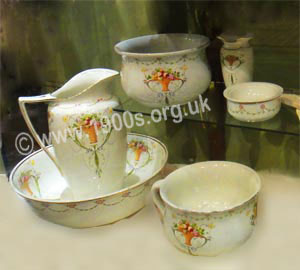
Decorative china chamber pot as part of an upmarket wash set: wash bowl, hot water jug, slop bowl, soap dish and shaving jug, photographed at Milestones Museum.
There is a page on this website about using washbowls and washing generally where there were no bathrooms of the sort that we would recognise today.
Commodes
Commodes were (and still are) essentially removeable chamber pots fitted into chairs.
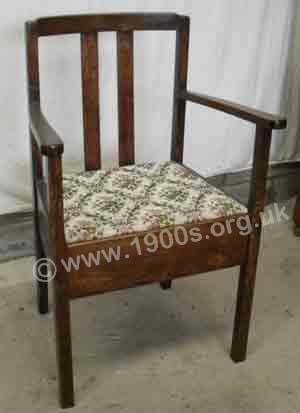
Commode, closed
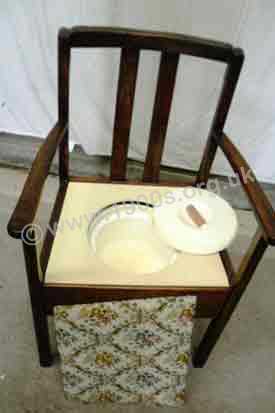
Commode, open for use
In Victorian and Edwardian households, commodes must have been necessary for the older members of the family. My mother's grandmother, who ended up living with the family on their Victorian terraced estate was 92 when she died, and at that age would doubtless have wanted a toilet in the night. She could hardly have been expected to handle a chamber pot or go outside to a lavatory.
In those times 'family' commodes could be very attractive pieces of furniture, and it would have been quite difficult to tell that they were not ordinary chairs. They had removable padded cushion-style lids which not only improved appearances but must also have kept down the smell.
Nowadays commodes are mainly found in care homes.
| sources | webmaster | contact |
Text and images are copyright
If you can add anything to this page or provide a photo, please contact me.

