





 writing paper
and envelopes
1940s50s holiday mail
1940s50s economy
1940s50s fountain
pens postage
stamps
1900s-50s postage
rates
1930-40s postal
collections
1940s-50s postal
deliveries
1900s-50s bureaus portable
writing
desks contents of
writing desk
1930s50s


Old-style fountain pens for writing
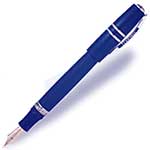
Fountain pens are pens which store ink. They were common before the arrival of ball-point pens. This page explains how they were filled and explores their advantages and disadvantages over the simple dipping pens. It also considers them and their appearance as status symbols.
____
By the webmaster, based on firsthand recollections and discussions with older people
While I was growing up, almost everyone wrote with pen and ink. This was for writing letters, invoices, bills, accounts, in fact anything that was written by hand.
By the 1950s I, like most children, had graduated from a pen which had to be dipped into ink to a pen which stored ink. These were known as fountain pens.
How to fill a fountain pen
Fountain pens had a rubber balloon-like reservoir inside the body of the pen which stored the ink - see the photos. This reservoir had to be squeezed and let go to suck up the ink through the nib from an ink bottle. A lever on the side of the pen did the squeezing (Much later, ink cartridges were the norm, which dispensed with the messy business of having to fill the pen.)
The following images are courtesy of Heritage Vintage Pens who sell and repair such pens.

Old fountain pen with its top screwed on for carrying around. Note the lever at the side.

Old fountain pen ready for use, with its top unscrewed and pushed onto the back of the pen. This not only held it tidily, it also lengthened the pen making its balance better for writing.

Inside the fountain pen, showing the rubber ink reservoir - for illustrative purposes only as the pen could be filled with ink from the lever at its side without opening it up. You may be able to see it in the second of the above three photos.
When the pen was empty of ink, it was filled by dipping the nib into a bottle of ink and repeatedly using a finger nail to pull out and let go the lever on the side. This accordingly squashed and released the reservoir, drawing ink up into it. It was full when the process no longer generated bubbles in the ink bottle. The ink was delivered down a channel which opened up as the nib pressed onto the paper.
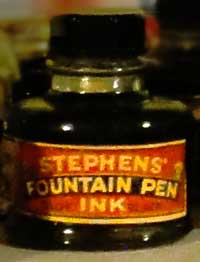
Ink bottle containing black ink. Photographed in Milton Keynes Museum
Advantages and disadvantages of fountain pens over dipping pens
Fountain pens had the advantage over the older dipping pens because they didn't have to be repeatedly dipped into ink. The flow of ink was smooth and continuous which made the writing appear much neater.
However fountain pens did tend to leak - and ink stained fingers and clothes. Also, like with all pens, we had to let the ink dry on a page before turning it over or folding it. Blotting paper was available but never seemed to be on hand when needed in ordinary homes. Better-off homes and businesses had all these things ready laid out on desks, often in matching sets.
Styles of fountain pens
A range of fountain pens were sold with different width nibs and with different body colours and decorations. Some were quite expensive and seemed to be status symbols. Like many status symbols, they were often sold in plush padded boxes and with matching propelling pencils - a common fall-back birthday or Christmas present. (Silver propelling pencils also seemed to be status symbols, but I never saw any that weren't tarnished and dirty-looking. They didn't appeal to me at all.)

Business man's breast pocket with a range of fountain pens and propelling pencils clipped inside and a white pocket handkerchief - all the unspoken 'uniform' of his work. Screenshot from an old film.
Personal fountain pens
Everyone seemed to be very fussy about no-one else using their fountain pens because the pressure of a different hand was supposed to spoil the nib for the original user. I don't know how true this was, but it seemed to maintain the image of a status symbol.
If you can add anything to this page or provide a photo, I would be pleased if you would contact me.
Text and images are copyright
sources: early 20th century material
sources: ww2 home front and other material
contact
the webmaster/author/researcher/editor
privacy policy

