






 writing paper
and envelopes
1940s50s holiday mail
1940s50s economy
1940s50s fountain
pens postage
stamps
1900s-50s postage
rates
1930-40s postal
collections
1940s-50s postal
deliveries
1900s-50s bureaus portable
writing
desks contents of
writing desk
1930s50s


The portable writing desk: common before the mid-20th century
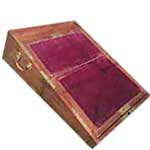
The portable writing desk was a clever device that sat on any flat surface but could be lifted and taken to anywhere convenient. This page described how it could be transformed from a large reasonably flat wooded box into a suitably sloping writing surface with compartments for all sorts of writing equipment. It had a key, and in its box form it could be locked closed for security.
____
By the webmaster, based on close examination of an actual portable writing desk and discussions with older people
While I was growing up in 1940s and 1950s Britain, most communication was by post - snail mail as it came to be called decades later. People (mostly men, who were at the time considered more suited to tackling business and financial matters) had a 'desk' in which they stored their writing materials and which provided a surface for writing.
While I was growing up, new desks were of the bureau type, but older men still used either special custom-made portable boxes or - if they had the space - office style desks.
Appearance of a Victorian/Edwardian portable writing desk
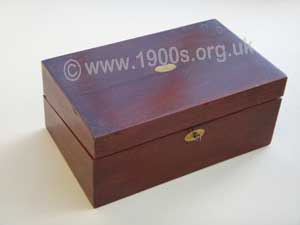
The portable desk, closed - a polished box of dark wood which locks with a key
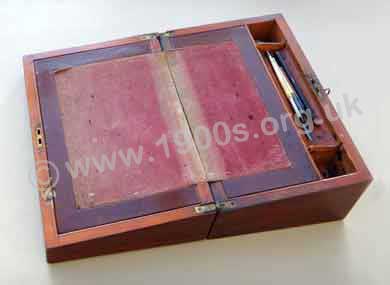
The portable desk, open, showing a sloping writing surface and various storage compartments
My grandfather's portable desk was probably new in Victorian or Edwardian times, and I am fortunate to have it in my possession.
The desk can serve as a model for other such desks in ordinary working class households, although more expensive desks would have had more compartments and been more decorative.
Writing surface of a Victorian/Edwardian portable writing desk
When opened, the lid of the desk forms a smooth and slightly tilted writing surface with the part of the lower half of the desk. Although this is difficult to explain in words, it is clear from the photo.
Both parts of the writing surface lift off to give storage spaces underneath.
The surfaces are covered in a coloured fabric, sadly now badly faded.
At the back of the desk, (as seen by the user), are holders for pens, ink and small items of stationery.
The compartments of the desk
The photo shows the pen compartment and two other compartments for odds and ends. The pen compartment has a curved lower surface so that the pens can be picked up and removed and replaced more easily.
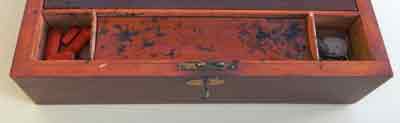
The pen compartment which has a curved bottom surface so that the pens can be removed and replaced more easily.
Note the ink stains from constant use.
If you can add anything to this page or provide a photo, I would be pleased if you would contact me.
Text and images are copyright
sources: early 20th century material
sources: ww2 home front and other material
contact
the webmaster/author/researcher/editor
privacy policy

