 writing paper
and envelopes
1940s50s holiday mail
1940s50s economy
1940s50s fountain
pens postage
stamps
1900s-50s postage
rates
1930-40s postal
collections
1940s-50s postal
deliveries
1900s-50s bureaus portable
writing
desks contents of
writing desk
1930s50s

The bureau: a piece of furniture, a storage unit and a desk
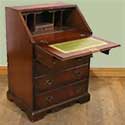
The bureau was a standard piece of furniture in early-mid 20th Century UK homes. This page describes and explains its convenient and clever design that enabled it to serve as a piece of furniture, a storage unit for stationery and a writing desk.
____
By the webmaster, based on firsthand observations and discussions with older people
The purpose of the bureau
Because there was so much letter-writing while I was growing up in 1940s and 1950s Britain, every home had somewhere to store their stationery, important documents and letters and postcards received from friends and family. Older people still used their old portable desks, but younger households turned to a more modern solution - modern that is for the 1940s and 1950s. It was the bureau.
How a bureau doubled as a desk
The bureau was a largish piece of furniture with a slanting lid which folded down to make a flat writing surface at a height suitable for writing when a chair was drawn up under it. The following photos show a bureau with its lid closed and another one with its lid open, showing everything that might be expected for a viable desk for storing miscellaneous items.
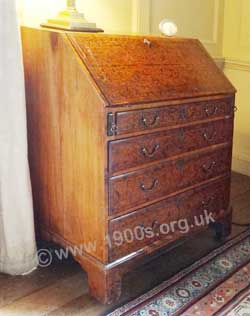
A closed bureau. Note its sloping lid that opened as a flat writing surface. Photographed in Dinefwr Park House.
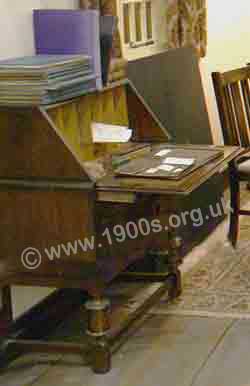
An open bureau - showing the writing surface and storage compartments. Photographed in Milestones Museum, Basingstoke.
The bureau as a storage unit
Inside the sloping lid were compartments for filing papers and storing odds and ends like ink, pens (dipping pens and fountain pens) and paper clips. When shut, it could be locked with a key for security.
The bottom half of the bureau was cupboards, bookshelves or drawers. My parents' bureau had shelves on which they stored a complete set of inherited encyclopaedia.
Bureaus like all furniture at the time were made of dark wood.
It was a sign of the times that bureaus belonged to the men of the house, although there must have been exceptions.
| sources | webmaster | contact |
Text and images are copyright
If you can add anything to this page or provide a photo, please contact me.

