






 the
the'right' time timers clocks pocket
watches wrist
watches balance
scales for
weighing spring
scales for
weighing


The spring scale or spring balance for weighing
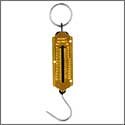
Spring balances work by extending or compressing a spring attached to a scale. By the 1950s, most British shops had gone over to these scales where feasible. This page shows examples of spring scales and they may surprise you because the spring in the majority is hidden. The page also explains the advantages of spring scales over the balance type.
____
By the webmaster based on experience, visits to museums and discussions with museum staff
How spring scales work
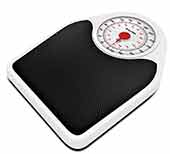
When something pushes down on a spring, the spring is depressed and when something pulls down on a spring, it is extended. Spring scales work by measuring how far a spring is depressed or extended on a scale which has been previously calibrated using known standard weights. Two examples today include luggage weighers that extend a spring and bathroom scales which compress a spring. The strength and resistance of the spring is chosen by manufacturers to suit what is to be weighed.
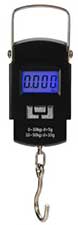
Left: modern luggage weigher, based on extending a spring.
Above: bathroom scales
based on compressing a spring.
The luggage weigher has a digital display whereas the bathroom scales have an analogue display.
Today, most spring scales use an digital displays; analogue displays would be regarded as old-fashioned, although they are usually preferred for clocks and watches.
Advantages of spring scales over balance scales
Shopkeepers were quick to spot the significant advantages of spring scales and were starting use them to replace balance scales when I was shopping as a child in the 1940s and 50s. However the old style balance scales were still used for heavy goods like potatoes and builders' materials. Main advantages of spring scales were as follows:
- Spring scales gave an immediate display of weight on their scales, so were quicker to use, as there was no trial and error to get a balance of fiddling about with weights.
- Spring scales were more sensitive and accurate for small weights.
The Imperial System of Weights
16 drams = 1 ounce (oz)
16 ounces (oz) = 1 pound
(lb)
14 pounds = 1 stone (not abbreviated)
112 pounds = 1 hundredweight
(cwt)
20 hundredweights = 1 ton
2240 pounds = 1 ton
- Spring scales could be configured so that shopkeepers selling non-standard weights of goods could instantly see how much to charge. This was a hugely important advantage. It was always accurate and it saved the shopkeeper from having to use mental arithmatic. It is so important that the next section is devoted to how this worked.
How spring scales could show instant prices
The spring scales that I knew that made pricing so simple looked like the one in the following photo. The spring was under the scale pan and attached to a pointer that moved over a scale to show the weight of what was being weighed.
The customer's experience with 1950s shop spring scales
The goods to be weighed were placed on the pan, and all that the customer could see was the pointer on its scale moving across the top scale to show the weight of the purchase.
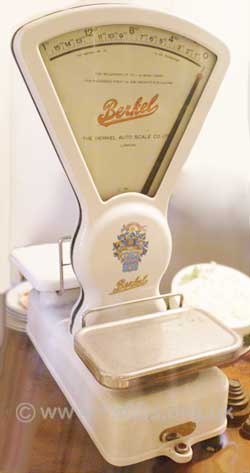
Type of spring scale that did the arithmetic for the shopkeeper - as seen from the customer's side. All that the customer sees is a scale and a pointer showing the weight. Photographed in the Tilford Rural Life Centre.
Pricing didn't seem to concern shopkeepers at all. They just announced the price as if it were obvious.
This worried my mother. She said that she had always been regarded as excelling in mental arithmetic at school, but there was no way that she could come up with prices so quickly. How could this be?
Explained: The simplicity of pricing with these shop spring scales
I was able to explain to my mother how shopkeepers could come up with prices so quickly when weighing out odd fractions of weights because I had worked on sales jobs in my school holidays.
To understand what was happening, you would need to view the scales from the shopkeeper's side of the counter. Then all becomes clear, because the two sides were very different.
The shopkeeper's side is shown in the shown in the following photo. At first glance the background is a mass of numbers arranged in arcs. The pointer is also a list of numbers. It is in fact a double pointer. Although the front part which the customer sees is blank, the numbers on the shopkeeper's side show is a list of prices per pound with the cheapest a the bottom.
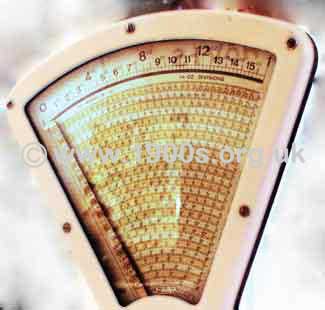
Shop scales based on compressing a spring underneath
the scale pan - as seen from the shopkeeper's side.
Photographed in the Tilford Rural Life Centre
The arcs are labelled with actual weights and the system is calibrated so that as the pointer finds its position for a particular weight, the shopkeeper can look for the price per pound on the pointer and read off underneath what the cost is for that weight. The following detail of the image should help you understand better.

Detail of the pointer and background on the shopkeeper's side, marked in prices per pound, where the prices are in the pre-1971 system of pounds, shillings and pence.
If you can add anything to this page or provide a photo, I would be pleased if you would contact me.
Text and images are copyright
sources: early 20th century material
sources: ww2 home front and other material
contact
the webmaster/author/researcher/editor
privacy policy

