 the
the'right' time timers clocks pocket
watches wrist
watches balance
scales for
weighing spring
scales for
weighing

Balances scales for weighing - very common in the past
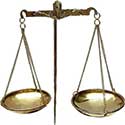
Balances - also known as scales and balance scales - measure weight by comparing unknown weights with various known or standard weights. In the past, they were more common in shops than they are today. This page describes the various shapes and sizes of these scales, made for different purposes, and the standard weights used with them.
____
By the webmaster based on experience, visits to museums and discussions with museum staff
How balance scales work
Balance scales work by comparing the unknown weight with various known weights, called standard weights. When they balance, the unknown weight is equal to the standard weight or weights which balance it. The following sketch shows the principle.
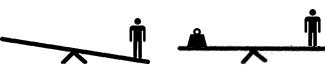
At the start of weighing, the balance arm is horizontal, but when the man (or anything else) goes on, his weight forces his side down. If known weights are put on the other side of the arm until the entire are arm is horizontal, the man weighs the same as the added weights.
Historically balances were the most widely used weighing devices in the past, but over time weighing devices based on compressing a spring became preferred where feasible.
Setting up balance scales
It was necessary for shopkeepers to set up their scales to balance exactly, so that the shop was not seen to be selling under-weight. Similarly shopkeepers would not want to be giving away more than they were charging for. The arms are correctly balanced when a small central pointer has swung to a vertical position. Unfortunately the pointers and adjustment weights are almost impossible to see in most of the photos and there are different arrangements for them depending on the type of scale, but they are there in some form - see for example in the following photo in which the arrangement is highlighted.
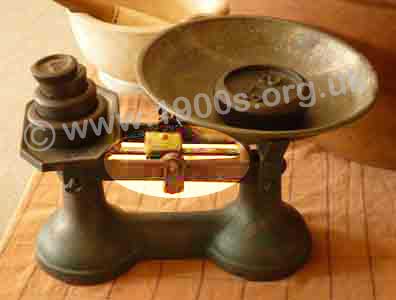
Balance scales with a sliding weight and mini-pointer to balance the arms (highlighted) - not balanced in the image. From the private collection of Angela Leahy.
Accuracy of balance scales in shops
In practice, balance scales were often too rough and ready for perfect balance, or maybe the shopkeepers had to work too fast to bother. Either way, it was normal practice to give customers the benefit of any doubt by putting just too much on the customer's scale pan and giving the customer time to register that this was happening. Presumably there was a skill in making the 'just' as small as possible. My grandmother was said to say, "I don't go to that grocer. He's a bit too tricky with the scales for my liking".
Types of scales for specific purposes
There were all sorts of different styles of balance scales, each one designed for a specific purpose and with their pans specially shaped for efficient use. Some examples are shown in the following photographs, along with the range of standard weights used with them.
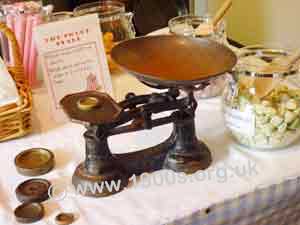
Early 1900s-style confectioners' scales for weighing out sweets
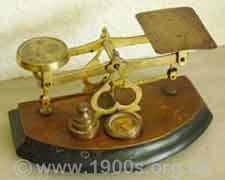
Delicate scales for weighing letters and packages ready for posting. From the private collection of Anne Vincent.
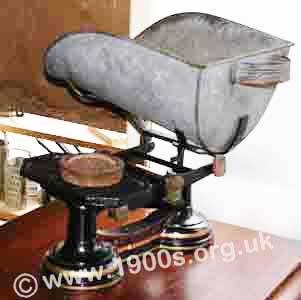
The pan of these scales is ideally shaped for digging into a sack of loose material, like sacks of grain or potatoes. They would have been used by corn chandlers and greengrocers. Photographed at Tilford Rural Life Centre.
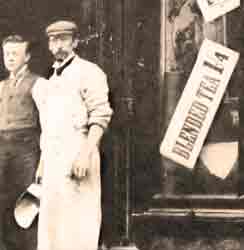
Pan shovel held by a tea merchant. Detail from a photograph in Farnham Museum.
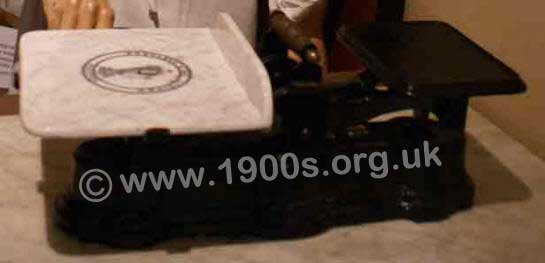
The 'goods' pans of the scales above and next are both flat and easy to clean, making them suitable for weighing out fats and cheese - although in practice a fresh piece of greaseproof paper would be placed on the pan for each customer in which their purchase was later wrapped. The pan shown above is marble and the next one is china. They would have been used by grocers. Photographed at Milestones Museum in Basingstoke and the Museum of Nottingham Life.
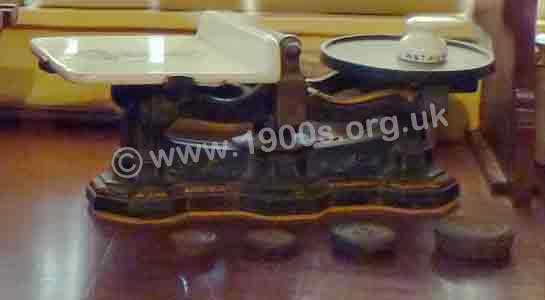
See the caption for the previous photo
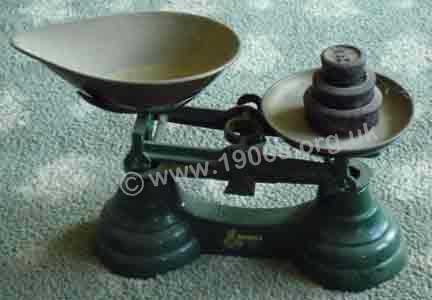
Scales ideally shaped for tipping out goods into a much smaller receptacle. Such scales would be suitable for greengrocers when tipping vegetables directly into customers' bags and for women when weighing out ingredients for baking. From the private collection of Angela Leahy.
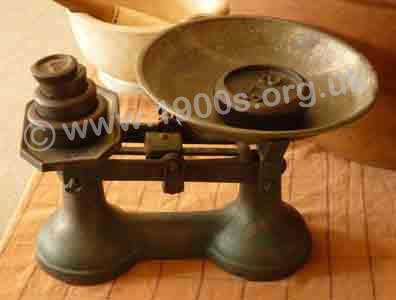
Scales using a sliding weight system as well as standard
weights. The sliding weight could be moved along its own arm fitting into
notches, as a quick way of weighing out smaller weights like ounces. From the private collection of Angela Leahy.
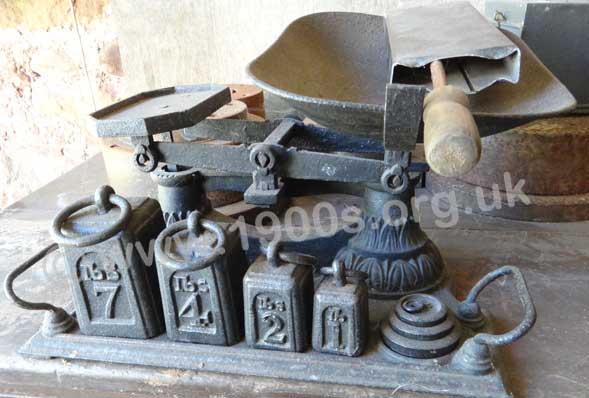
Believe it or not, my mother did a lot of her cooking and baking with scales like these. That was in the 1940s and 50s. The scales were inherited and would have been Victorian.
Types of weights
Most of the above photos show the weights that were used with the weights - generally round brass or iron ones that stacked for tidy storage.
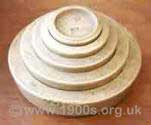
General purpose brass stacking weights
There were also heavy duty weights that incorporated handles for lifting, and there were extremely delicate weights which were used by pharmacists for making up prescriptions. The delicate weights were stored in air-tight boxes to avoid contamination from the air. They were shaped with 'necks and heads' so that they could easily be grasped with the tweezers that were stored with them to prevent greasy fingers from altering their weights. The following photographs were taken at Milestones Museum in Basingstoke.
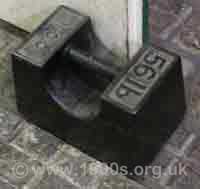
A 56 pound iron weight, perhaps not surprisingly used as a door stop.
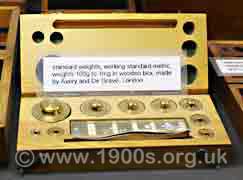
Weights for delicate work, like weighing out powders in a pharmacy. These weights were kept in an air-tight box with special tweezers for handling them.
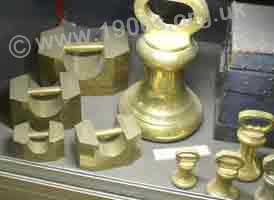
Heavy duty brass weights.
Disadvantages: shopkeepers need to work out prices
With balance scales, shopkeepers needed to work out prices in their heads (which they did not have to do with spring balances) but the calculations were not particularly arduous because it was normal practice to sell in simple fractions or simple multiples of a pound weight (or whatever was the appropriate unit of weight for the goods).
| sources | webmaster | contact |
Text and images are copyright
If you can add anything to this page or provide a photo, please contact me.

