

Old potteries - as manufacturing industries
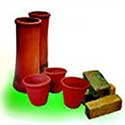
Pottery was a major manufactoring industry before the development of plastics. This page explains. It starts with some basics: what pottery is, the terms earthenware, stoneware, ceramic and terracotta; then goes on to explain what potteries were, their locations and why they once worked on an industrial scale.
____
by the webmaster: family recollections and research
First some basics:
What pottery is: earthenware, stoneware, and ceramic
All pottery is made from clay which has to be dug out of the ground. In this raw form it is moldable and when dry it cracks rather like mud from a puddle. It has to be heated to a high temperature to keep its shape and function. This is known as firing which takes place industrially in what is known as a kiln.
The type of clay, i.e. where the clay comes from and the temperature of the firing control the result - earthenware, porcelain or stoneware. Plant pots were made of earthenware which is slowly porous to water. Stoneware is glazed to make it waterproof, and porcelain is made from fine clay and is normally decorated in some way. A catch-all term for all types of fired clay is ceramic. There is more on the internet about the technical differences between clays and their treatment and uses.
All plant pots were made of earthenware, with those made of iron-rich clay being particularly prized for their reddish finish. Such pottery was known as terracotta.
Potteries and their locations
Potteries are where pottery is made.
Potteries were located on or near large sources of clay of a quality suitable for the type of ceramic to be be made. In the case of the Cole Pottery in Tottenham which specialised in flower pots, this was in north London clay.
Pottery as a manufacturing industry
It may surprise you to think of pottery as a manufacturing industry. Today, people think of it as a hobby or an art form. Before the development of plastics, though, a huge range of today's plastic objects had to be made of something else, e.g, wood, glass, metal - and of course pottery. Pottery was big business.
This section of the website is concerned with plant pots. Think of your local garden centre or perhaps your or a neighbour's houseplants or greenhouse. How many pots are there? You would probably lose count. In the past all these pots would have been made of pottery.
Below is a quote from an interview with Sid Cole, owner and manager of the Cole Pottery in its heyday.
FORTUNES FROM FLOWERPOTS
The Daily Mail 25 March 1936
The Cole Pottery in Tottenham ... is among the largest manufacturing firms in the country.
To give you an idea of the scale of the manufacture, here is another quote from Sid Cole.
TURNING OUT
250,000 FLOWER POTS EVERY WEEK
'News of the World' special
[dated from its
context as about 1935]
The firm was founded on its present site because of the quality of the famous London blue clay, which comes to the surface here. In places it goes down to a depth of 150 feet. There is an inexhaustible supply.
250,000 flower pots produced each week!
Furthermore Cole Pottery was known in its time to be a sizeable local employer. Here is a list of the jobs that the men were employed to do.
contributed Frank Marden, pottery worker in the 1950s
- Stokers – for the kilns to fire the pots, which were in use 24 hours a day, and for the boiler that provided power to the drying sheds
- Bricklayers – for building and maintenance of the kilns
- Wheelwrights/carpenters – for maintenance of the wagons which were used for various purposes including transport of the pots, often as far as 100 miles away
- Stable hands – for looking after the horses
- A blacksmith – for repairing the machinery and shoeing the horses
- Yardmen – for general duties such as working in the drying sheds and loading.
- Wedgers – who were trainee potters and who formed clay into balls for the potters
- Carmen/drivers – for delivering etc
- Travelling salesmen
- Office workers – for looking after the orders
- ... plus of course miscellaneous others including family members.
The pottery, in its heyday, was certainly regarded as a large manufacturing industry.
| sources | webmaster | contact |
Text and images are copyright
If you can add anything to this page or provide a photo, please contact me.

