 the school
system early
20th C Victorian
school
buildings classrooms
Victorian to
mid 20th C distressing
school
experiences writing
lessons early
20th C Christmas
letter from
pupil 1903 girls'
education
early 20th C the wider
curriculum
early 20th C prospects
after school
early 20th C
Silver Street School, Edmonton and Victorian town schools generally
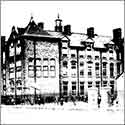
In the final years of Queen Victoria's reign, new specially designed school buildings were put up to accommodate the influx of children from the new housing estates that were springing up. This page describes the site and buildings of one such typical school, Silver Street School in Edmonton, along with some of the more major changes that took place there over the years.
____
By the webmaster based on the memoirs of her mother with contributions from former pupils and additional research
The main part of this page is based on Silver Street School in Edmonton, but photographs of other late Victorian schools in town centres, - including the one above - show that the general design was the same, although of course adapted for the size and shape of the site and the local building materials.
In those days, Silver Street was the A 406, The North Circular Road. It was part of the main road around north London and the main route from the northern Home Counties to the London docks and Dover.
Significant dates
After some years being planned and built, Silver Street School opened for pupils in 1901, almost certainly to coincide with the surge of new housing on Edmonton's Huxley estate. The plaque in the following photo shows that it was a Board School. New schools would no longer be called that just a year later, but the name carried on in the minds of the public.
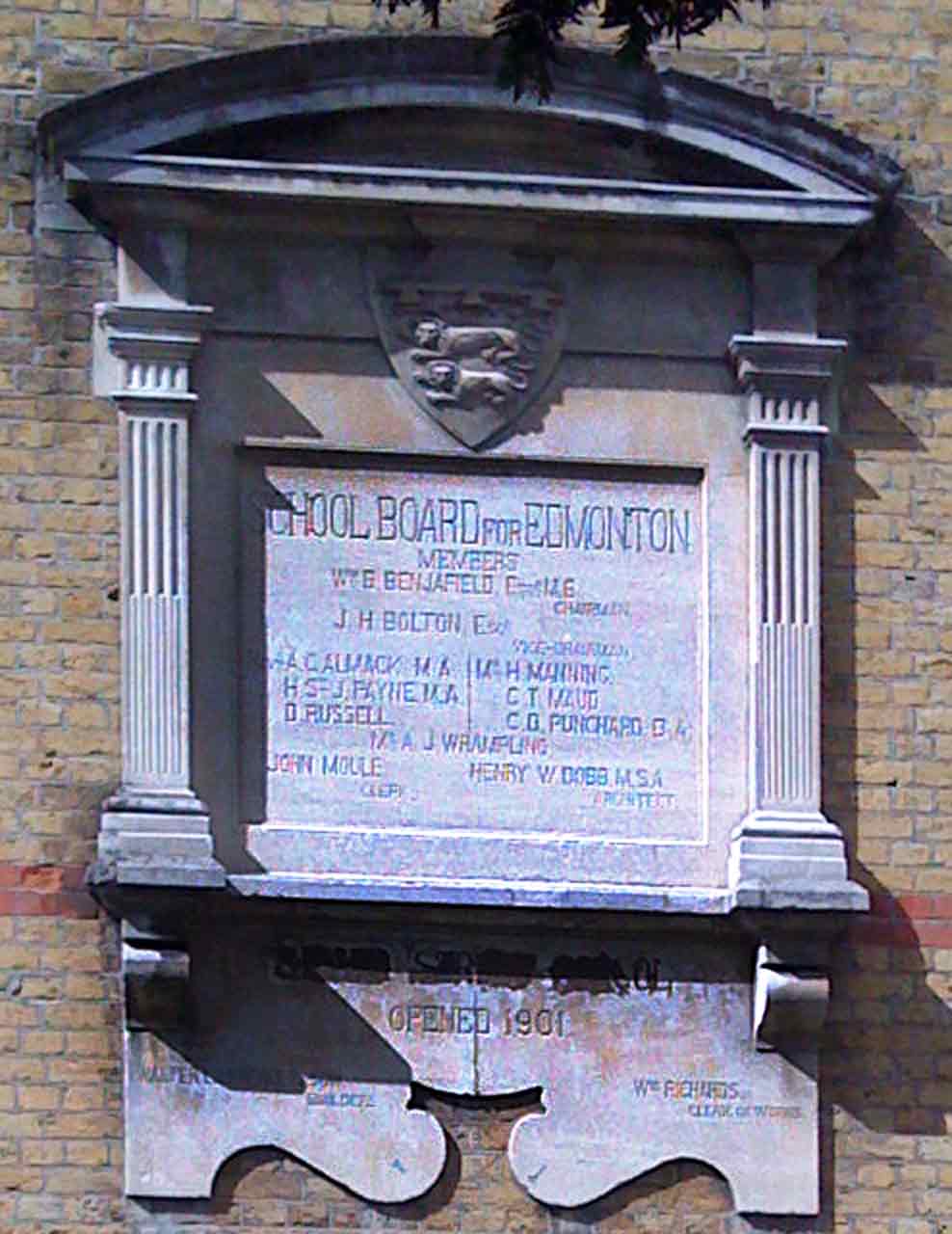
Plaque commemorating the opening of Silver Street School in 1901, and showing details of the Middlesex county crest, courtesy of John Cunningham.
As I write, the plaque commemorating this school opening is still displayed.
Design of the school inside
The school was designed to aid the segregation of boys and girls as described on the page about the school system. It therefore had three floors one for boys, another for girls and another for mixed infants.
There was a school hall and a staff room. The classrooms have their own page.
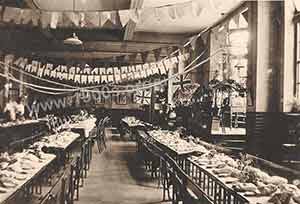
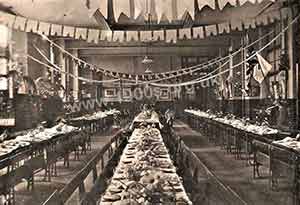
These two photos are of the school hall in the early years of the 20th century. It is difficult to believe that the elaborate table decorations are for the children. The hall is probably to be used for some civic event, it being the largest in Edmonton, but unfortunately even the original does not show details of the table decorations. The photo is courtesy of Simon Benbow.
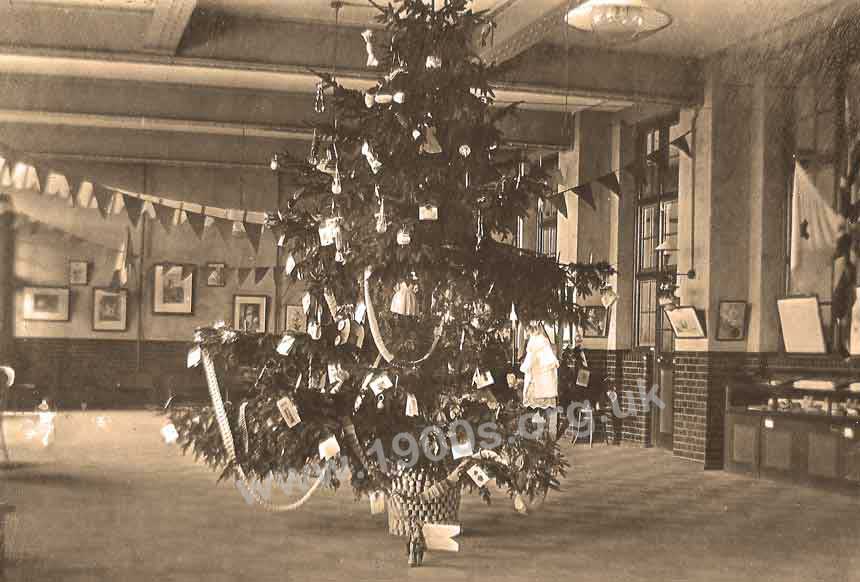
The school hall of Silver Street School, photo courtesy of Simon Benbow.
The playgrounds
In line with the policy of segregation, there were two playgrounds which effectively separated the older boys from the girls and the younger children.
The school lavatories
The lavatories consisted of about eight cubicles in a their own building outside the main school. It had the sewage pipe going the whole length. The lavatories didn't flush: they had to be flushed out all together from time to time with buckets of water, and this was another job for the school caretaker.
My mother's memoirs left no recollections of how segregation was handled in the lavatories. There was probably a separate lavatory building for the boys. Frank Clarke elaborates below:
contributed by Frank Clarke, personal experience
Even as late as the 1930s when I was at the school, there were no toilets in the building and it was necessary to make the long trip down the stairs and up toward the end of the playground to the "Karzy" as it was affectionately known.
The school playing field
There was a fairly small field which later enabled the school to expand. The end of the field was turned into an allotment during the 1914-18 war, and worked by the boys.
The cycle shed and the bicycles
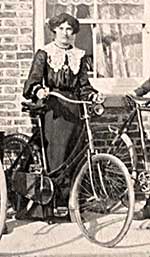
Woman with bicycle, early 1900s, courtesy of Moyra Hill
The children all lived within walking distance of the school, but there was a cycle shed for the teachers as they mostly arrived by bicycle.
My mother wrote that she liked to think back to the teachers. No cocking a leg or dashing along for them. The women would cycle along at a dignified pace with their cycle baskets on the handlebars in front of them.
The headmaster would get onto his bike elegantly by stepping onto a little bit of metal on the middle of the back wheel to raise himself onto the saddle. He was a well built, grey headed, imposing man who looked as though he was in command of any situation.
Changes from the 1930s
A new school for girls was opened in 1931 and the older girls joined it and left Silver Street School. The new school was called Hazelbury School, but probably similar schools were opening elsewhere.
contributed by Desmond Dyer, recollections
There were no older girls in Silver Street School in my time (the mid 1930s). They were transferred to Hazelbury Road School when it opened in 1931, which was no doubt tied in with the building of the council estates in Edmonton. So, although the doorway marked Girls would have been used by girls before 1931, it was afterwards for the junior boys (aged 7 to 11).
The top floor could be accessed through the Juniors entrance but the older boys (aged 11 to 14) had the separate main gate playground and stairway at the far end of the building.
When, as a junior boy, I was late for school, I would (illegally) go in the Seniors gate, run to the far end and use its stairway to the second floor. As there was no monitor there to catch latecomers, I could look as if I was coming back from the toilets after assembly.
contributed by Frank Clarke, comments
I was at Silver Street School in the late 1930s. Then the school was divided into three. The lower floor was known as the Infants which was for boys and girls. The second floor for the Junior Boys and the top floor for the Senior Boys.
Note that Frank Clarke's recollections show the then terminology for the usage of the three floors.
Changes from the 1940s
contributed by Peter Edrich
When my sister and I started Silver Street School, she in 1948 and I a year later, the ground floor was for infants and it was mixed boys and girls, the first floor was primary and the second floor secondary - also known as juniors and seniors respectively. These two floors were all boys because Hazelbury School for girls had opened in 1931. By the time my brother started school in 1954, Firs Farm Infant school had opened, and the first floor of Silver Street School became primary and the other two floors secondary. If you passed the 11 plus you went to one of the grammar schools in the area, but if you failed, you went to a secondary school like Silver Street until 15 and then went to work. Sometime in the 1950s the name was changed to Huxley County Secondary School, and RSA exams (Royal Society of Arts I suppose) exams were introduced. They were a sort of downgraded version of O level GCE so you could actually leave school with some kind of certificate.
The closure of Silver Street School
I understand that Silver Street school closed in 1972, but can anyone confirm this? The school which services the area now is the Aylward Academy in Windmill Road and I understand that it still uses the old Silver Street School building - but again, can anyone confirm this?
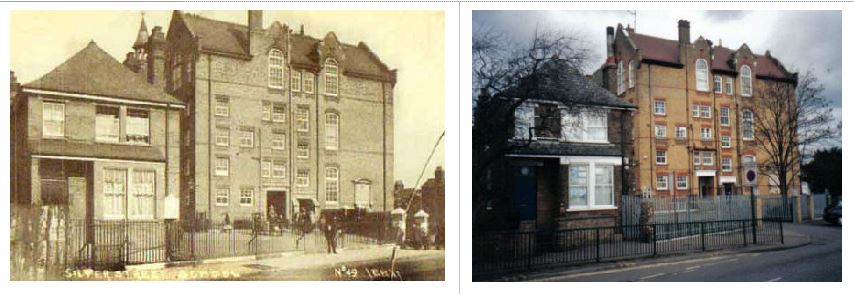
The first photo of Silver Street School is around 1910 and is from an old postcard, courtesy of Cliff Raven. The caretaker's house is on the left. Note the two doorways which were the infants' and girls' entrances and the separate gateway leading to the boys' playground with its boys' entrance at the other end. Also note the three storeys and the bell tower (back middle left) housing the bell which called the children to school.
The second photo is a more recent photo and was taken by Cliff Raven in 2005. The building has changed remarkably little. The bell tower has gone, what was the caretaker's house has benefited from replacement windows; and two trees have matured.
The following pictures show what I remember from the bus in my 1940s childhood when we visited relatives in Edmonton.
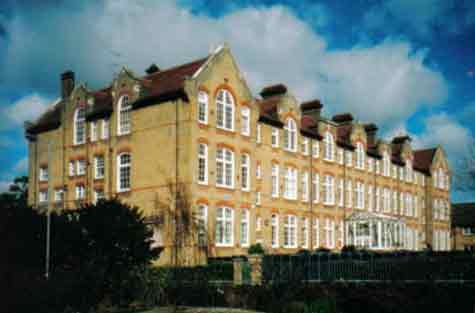
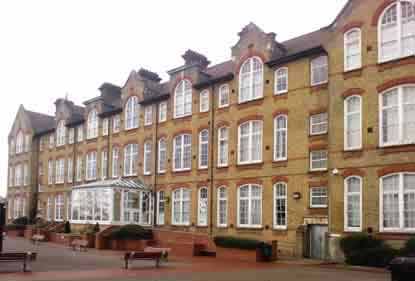
Views of the side of what was Silver Street School, taken further along Silver Street by Cliff Raven in 2005. He reports that the appearance of the building from this viewpoint is almost entirely unchanged from the early 1900s. Exceptions include the conservatory addition which went up when a new roof was put on in the 1970s. The bell tower was removed at the same time, and the building was given a sandblast clean.
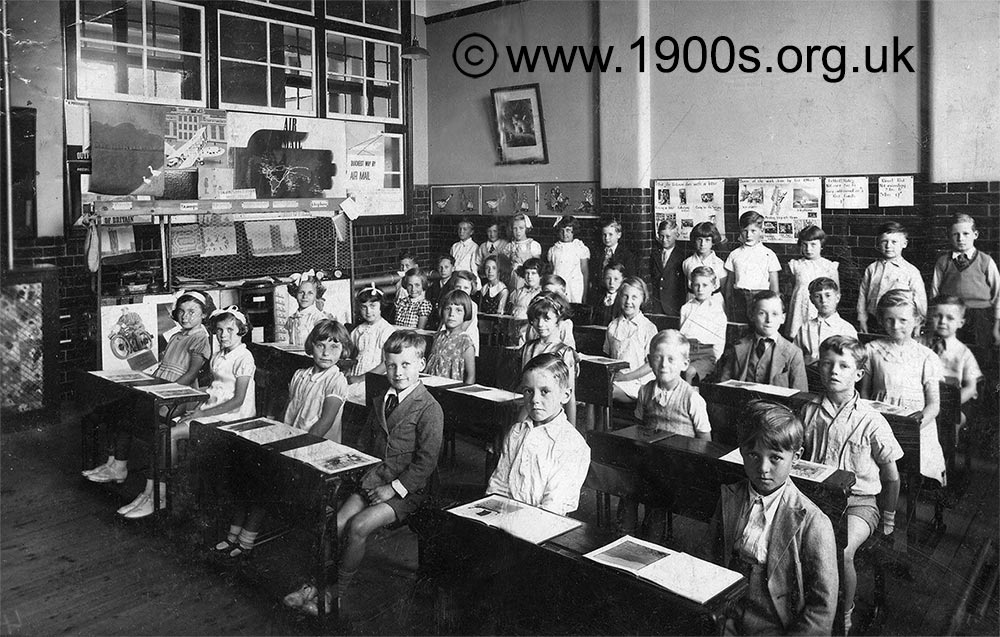
Photos of the pupils and teachers show parts of the school building as backgrounds, particularly the school hall with its parquet floor and gas lamps, and an original raked classroom.
Memorabilia
contributed by Tom Wallace
In the main hall was a glass case containing a small African spear. It was given to me by my uncle who served in Africa during the WW2, and I gave it to the school around 1946.
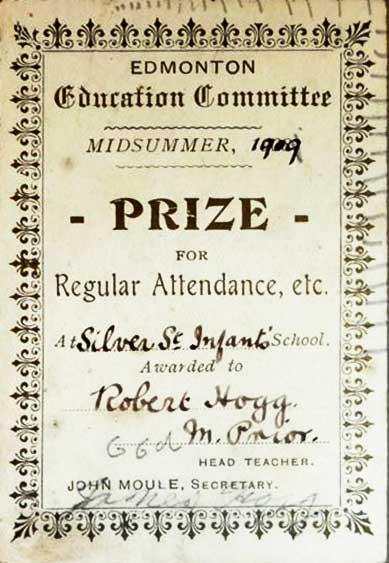
Early memorabilia of Silver Street School, courtesy of Graham Hogg. The prize book 'The Swiss Family Robinson' was awarded to his father Robert Hogg in 1909. On the right is a thumbnail of the inscription on the inside cover. Tap/click the image for an enlargement.
Former pupils who perished in World War Two
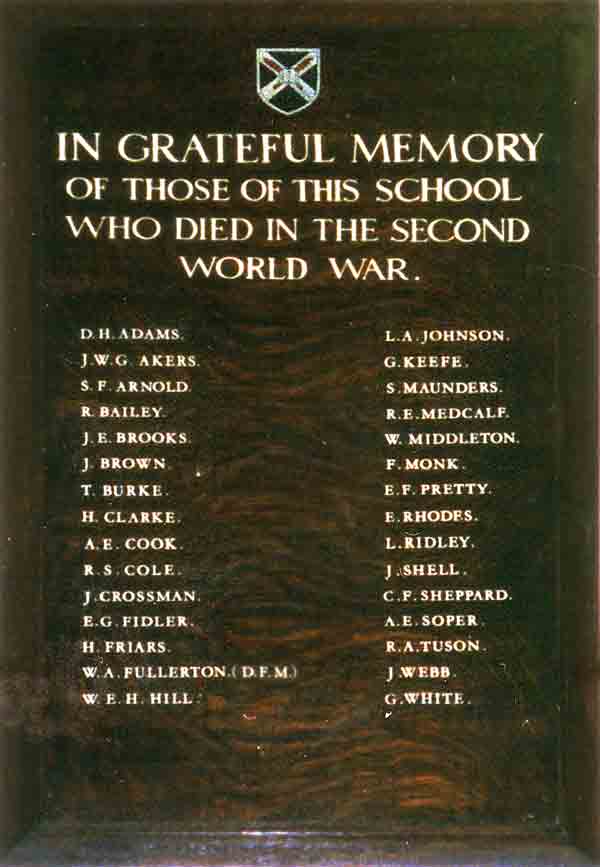
Plaque displayed in the Aylward School, now the Aylward Academy, the successor to Silver Street School, commemorating former pupils who died during the Second World War. This photo was supplied by Andrew Dickson. His cousin Jim Brown from the Fleet Air Arm is commemorated. He was 19 when he died.
The plaque also commemorates my uncle, Horace Clarke. I was too young to remember him but he was often talked about in the Clarke household of my father which suffered so badly in the Second World War blitz of Edmonton.
The R. S. Cole named on the plaque was no relation of my mother's family.
Children who attended Silver Street School over the years
There are numerous class photos from Silver Street School from which you may be able to recognise someone you know. Start.
| sources | webmaster | contact |
Text and images are copyright
If you can add anything to this page or provide a photo, please contact me.

