




 the school
system early
20th C Victorian
school
buildings classrooms
Victorian to
mid 20th C distressing
school
experiences writing
lessons early
20th C Christmas
letter from
pupil 1903 girls'
education
early 20th C the wider
curriculum
early 20th C prospects
after school
early 20th C

Classrooms in Victorian and Edwardian schools
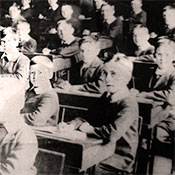
Class sizes in Victorian and Edwardian times were large by the standards of today, the classrooms were tiered like lecture theatres and teachers’ desks were raised up. This page describes them all and explains the significance for teaching methods. The page goes on to describe the children’s desks and seats and the heating arrangement of coal fires. Finally, the page considers how classrooms have changed over the years and compares them with those of today.
____
Extracted from the memoirs of the webmaster's mother(1906-2002) and edited by the webmaster with further research
Class sizes
In the early 1900s when I was at school, the average number of children in a class was 60.
Tiered or raked classrooms and teaching methods
In spite of the large classes, the teacher could easily see the pupils at the back of the class because the room was tiered - or 'raked' like a lecture theatre. On another page is an expandable image of a 1930s mixed sex tiered classroom, professionally photographed, probably because it was about to be replaced.
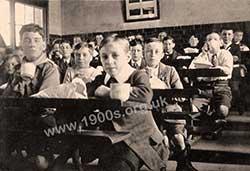
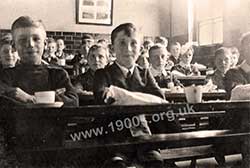
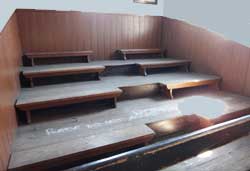
The first two photos are courtesy of Simon Binbow,
from his grandfather's time as a school teacher at
Silver Street School
in the early 20th century. Note the all-boys class.
The last photo shows an empty raked classroom which better shows what a raked classroom is.
The teacher's desk
The teacher sat at a specially high desk which had its own high chair, so that she could look out over the whole of the class. I say 'she' because girls and boys were taught separately, the boys by men teachers and we girls by women teachers.
Incidentally, all the women teachers were spinsters. Marriage was regarded as a full-time commitment; so when a woman teacher married, she had to give up teaching. All that changed during the wars when women had to take on the jobs of the men who were overseas fighting at the front.
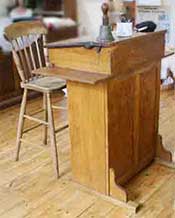
Teacher's high desk and high chair as used in schools in Victorian times and into the 1940s or later.
Teachers seldom walked around. They generally spoke while sitting at the high desk. In the photo, note the hand bell on the desk for getting the children's attention.
Teaching methods
The classrooms being like tiered lecture theatres and the teacher's desk being high up says a lot about the teaching methods. Children were expected to learn by being lectured at - although that term would not have been used - i.e. by having information fed into them as they sat passively to absorb it. Children's main active involvement was to copy what the teacher wrote on the blackboard. They wrote this into what we might today call their exercise book, but it was at the time generally known as their 'copy book'. They were also involved when a question was asked of the class and some of them put up their hands to answer. Some more than others were involved when they were singled out for discipline and other punishments.
The blackboard
When the teacher wanted to show us something, like letters to copy or sums to do, she wrote with chalk on a large blackboard, supported on a wooden easel which could be moved around if necessary.
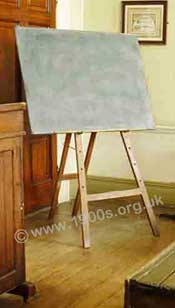
The blackboard on its moveable easel which teachers would write on with chalk
As the floors were tiered we could easily see the board from the back of the classroom.
When the teacher had finished with the blackboard or needed more space, one of the children would be told to clean it with a duster. Fortunately it cleaned easily because the dry chalk just rubbed off. With a lot of writing or a dirty duster, though, there could be quite a cloud of chalk dust which got up our noses if we were sitting near the front.
Children's desks and benches
When we started school, we small children sat on benches, but in later years we were supplied with desks.
School desks were essentially the same country-wide. The main differences between them were their size; whether they were singles or in pairs; and whether they had seats attached.
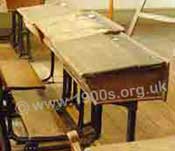
Classroom desks with plank-style wooden seats attached.
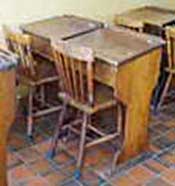
Classroom desks with chairs.
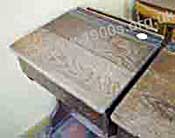
A classroom desk closed for use as a working surface. Note the indent along the top, by the inkwell for pens and pencils.
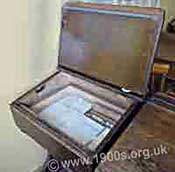
An open classroom desk, showing the space for a child to keep personal items.
For the younger classes, the desk seats were flat planks of wood which were attached to the body of the desk and on some desks they folded up to make it easier to get in and out
The oldest (and largest) children had chairs but the desks themselves were essentially the same. I suspect that all the children had chairs in private schools which charged fees, but I can't be sure.
All the desks had lids to lean on while reading or writing. The design was ideal as we had somewhere to keep our pencil boxes, etc. which in turn gave us a sense of belonging in 'our' classroom.
Heating in the classroom
There was a coal fire in each classroom in winter. All the fireplaces had to be cleaned, which was a job of the caretaker. Every winter evening he would also have to fill each coal scuttle with coal and firewood. Old exercise books were used for paper. One of my teachers hid away some of the coal in a cupboard on mild days for use later when it was cold, but when the headmistress found out, the teacher was reprimanded.
How classrooms changed between Victorian times and the mid-20th century
Note from the webmaster
Apart from the facts that the early 1900s classrooms
• were tiered
• were large enough for 60 children and
• were heated with coal fires,
my mother could have been describing the classrooms where I was taught in the 1940s and 1950s.
She could also have been describing Victorian schoolrooms as shown in various books and museums.
In fact her school was built in the last year of Queen Victoria's reign to earlier Victorian plans.
See also other types of school in the past.
Photographs taken by the webmaster in Blaise Castle House Museum and the Museum of Nottingham Life
If you can add anything to this page or provide a photo, I would be pleased if you would contact me.
Text and images are copyright
sources: early 20th century material
sources: ww2 home front and other material
contact
the webmaster/author/researcher/editor
privacy policy

