 the school
system early
20th C Victorian
school
buildings classrooms
Victorian to
mid 20th C distressing
school
experiences writing
lessons early
20th C Christmas
letter from
pupil 1903 girls'
education
early 20th C the wider
curriculum
early 20th C prospects
after school
early 20th C
The school system for working class children in Victorian times
This page gives firsthand experience of what was called the Board School in the later years of the Victorian era. Yet it is puzzling because Board Schools were abolished in 1902 and the page was written from recollections in the years around 1910. The assumption has to be that the descriptive terms and school administration were slow to change at schools themselves and in minds of ordinary people. If you are interested, there is plenty of factual information about when and why Board schools were set up and what they were replaced with. This website, though, is about everyday life. So please read what follows to discover firsthand the schooling system as seen through the eyes of ordinary working class children.
____
Extracted from the memoirs of the webmaster's mother (1906-2002) and edited by the webmaster with further research
Like other young children from working class backgrounds in the early 1900s, my brothers and I started our education at what was known as a Board School. It was Silver Street School in Edmonton, which was well situated at the edge of a large housing district in Edmonton.
Board Schools and separate curriculums of boys and girls
The school was typical of other Board schools in providing free education designed to equip boys for earning a living and girls for keeping house. For this reason alone it was hardly surprising that boys and girls were taught separately after the mixed infants classes which taught the basics like arithmetic and writing.
Separate entrances and segregation of boys and girls
The segregation of boys and girls went further than just the classroom teaching. Once children had grown older than what were called 'juniors', the two sexes were kept entirely separate. Boys and girls were taught separately on different floors.
There were three floors to the school building. The youngest children of mixed sexes were on the ground floor, girls on the first floor, and boys on the top floor. There were separate entrances for all three, and there were also separate playgrounds. The youngest children and the girls played in one playground, while the boys used a playground on the other side of the building.
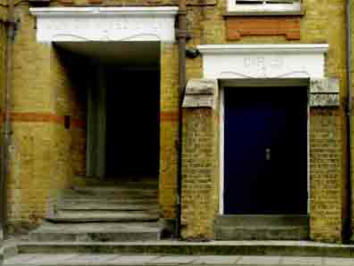
School entrances from one playground. Photographs courtesy of Cliff Raven. |
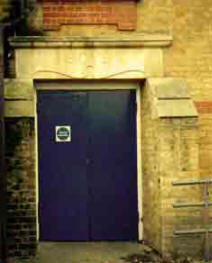
School entrance for boys leading from their own playground to the top floor. |
The engraved lintels over the separate entrances read as follows, but they do not quite match the descriptions here in the text. Presumably, as usually happens between a building's design and use, some changes become inevitable.
JUNIOR MIXED (GIRLS)
GIRLS
BOYS
Such lintels can still be seen on old buildings of Victorian and Edwardian schools, even where segregation has long since vanished.
The call to school each day
We were called to school by the school bell which was in its own bell tower, like church bells. It could be heard quite a distance away because there was so little traffic noise.
We started school at 9.00 am. Dinner-time [lunch-time] was from twelve until two, and home-time was at four. Most children brought a slice of bread and butter to school to eat in the playground at morning break, but they went back home for dinner. No food or drink was provided.
Checks on absentees
Checks were made on absentees by an inspector known as the School Board Man. He would make enquiries if a child was absent for any length of time, then send in his report. The School Board Man who came to our house was respected. He always wore sombre clothes and lived in a very nice house. Like everyone else, he went around on a bicycle.
His work was quite important as parents had been used to keeping children away from school when work had to be done at home or in the family business.
The school leaving age
Unless parents were prepared to pay or children passed what was known as the scholarship, the school leaving age was 14.
| sources | webmaster | contact |
Text and images are copyright
If you can add anything to this page or provide a photo, please contact me.

