 candlestick
phones wind-up
phones public phones
1920s-1930s manual
telephone
exchanges area codes
and
direct dialling using a
dial phone
1940s-1950s public phones
1940s-1950s costs of calls
1940s-1950s illegal
free calls
1940s-1950s house
phones
1940s-1960s telegrams
importance
in the past telegrams
from sending
to delivery

How to use red phone boxes with 'Button A Button B' phones
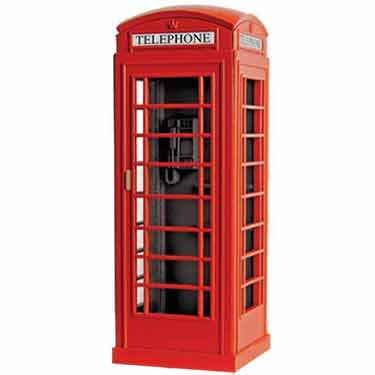
Recollections from the webmaster of making phone calls from Button A Button B phone boxes, with original firsthand contributions from others alive at the time, edited together by the webmaster.
Red public phone boxes were once common sights on British streets, although there were also plain wooden booths of public phones in train and bus stations and wall mounted ones in pubs and restaurants. This page describes in detail how to make and pay for a call using the Button A and Button B system - which was a feature of these old phones; it explains why people often had to wait outside the red box phones, even when they weren't in use; and it describes the creative ways that repurposed red phone boxes are used today, now that mobile phones have made the original use redundant. Highlights are the illustrations and the recollections from people who actually used these public phones as a norm.
The need for public phones in the past
Few families had phones at home in the early 1940s. So public phones were much-needed and in frequent use. Today we would call them 'pay phones' or 'Button A, Button B phones', because these buttons were unique to the time and an essential feature as they were the means of payment for calls.
How to make a phone call from a Button A, Button B public phone
To make sense of what follows, it may help to refer to the following photo of inside a red public phone box with its buttons A and B.
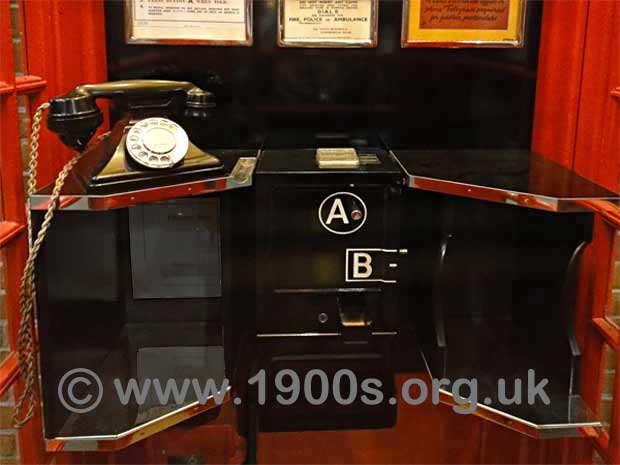
The arrangement inside a 1940s/1950s UK public phone box: the coin slots, button A, button B and the chute for returned coins. Photographed in Milestones Museum.
Get the right coins
In order to make a call from a public phone box, you had to have the right coins, small change as it was often called.
Getting the right coins was not too onerous because coins were in everyday use, as there were no credit cards and no electronic transfers of money. Nevertheless, it was not at all unusual to be stopped in the street and asked if you had change for a phone call. This was not begging for money, but proffering a coin of large denomination for several smaller ones. People always tried to oblige each other in this respect, and I never knew of anyone getting mugged when they got out a purse or delved into their pockets for money.
The coin slots
Inside the call box, callers first picked up the handset. Provided that the phone was working, they would then hear what was known as the dialing tone.
Then they put what coins that they thought would cover the call into the coin slots.
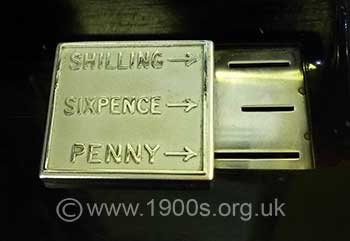
Coin slots in an old public phone
There were three different size slots to take different value coins as shown in the photo; for shillings, sixpences and pennies. The sixpence slot was smaller than the shilling one and the penny slot was the biggest. Old pre-decimal coins are illustrated elsewhere on the site.
Button A
Callers then dialled the number they wanted. The dialling process is described on another page.
Then they would hear the phone ringing at the other end. If it was picked up, the recipient would speak and when callers heard this, they pressed Button A to be heard, and the call went ahead, and was charged from this time.
If, as the caller and recipient talked, the call needed more money, pips sounded. If the caller didn't put in more coins, the call was cut off; if they did the call could continue.
Button B
If no-one answered once coins had been inserted, callers would press Button B to get their money returned. Back the coins came, down a narrow chute making a loud jingle. The chute is shown in the above photo, just below Button B.
How children made money from the Button Bs
How to make money from Button B - legally
contributed by Neil Barnes, personal experience
As a child, you did not pass a phone box without going in to push Button B, just on the off-chance that the last caller had forgotten to collect their left-over coins. It worked more often than you might have thought, wasn't illegal and 4d bought you a lot of sweets.
How to make money from Button B - probably ilegally
contributed by Ian Jolly, former telephone engineer
Really naughty children stuffed a rag up the refund chute on the way to school and on the way home pulled it out hoping that Button B had been pressed in the meantime. If so the refunded money, having been blocked by the rag, came tumbling out! As a telephone engineer, I often went to 'repair' phone boxes where that was the problem!
How to find and recognise a public phone box
On the streets
Public telephones could easily be recognised on the streets because they were in bright red telephone booths known as 'telephone boxes', and there were plenty of them around in populated areas. In rural areas they were close to post boxes, outside village shops or at crossroads. They were always red.
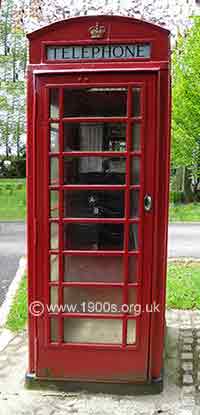
A red 'Button A Button B' public phone box, seen on the streets.
Photographed in Tilford Museum.
You will have noted from the earlier photo that the insides were red as well. Also shown, but difficult to see because of the black background, were large slots, one underneath the phone and the other the other side. One was suitable for holding a handbag, briefcase or shopping bag while phoning, so that it didn't need to stand on the floor and the other was for telephone directories. None are shown because they did seem get taken away by the public. There was, though, a display of local area codes on the wall. On another page gives a transcription of such a display showing the London area codes.
In bus and train stations
In bus and train stations, several public phones were normally located together, usually in more subdued wooden blocks of telephone booths.
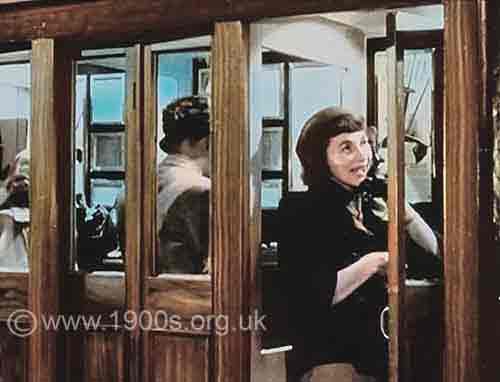
Wooden booths of public telephones as found in stations and other public places.
Screen shot from an old film.
As you can see from the photo, these phones were far from private as it was all too easy to overhear what was being said in the next booth.
In restaurants, pubs and small public areas
In relatively small public areas, like restaurants and pubs, public telephones were usually attached to a wall in readily visible places. There might be a single booth to provide privacy, but this wasn't common. If you were lucky and really needed privacy, you might the able to convince the owner to let you use their own phone in a back room, but a hefty tip would be expected. Phone calls were expensive in real terms.
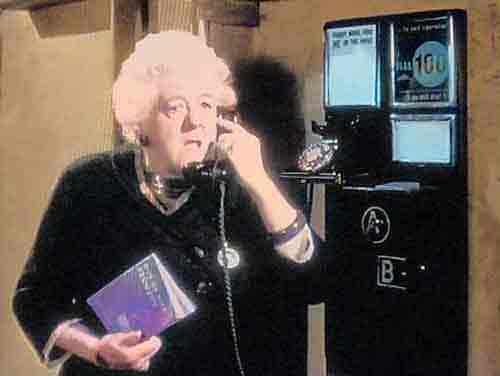
Wall-mounted public telephone as found in pubs and
restaurants.
Screen shot from an old film.
Emergency calls
Emergency calls were free from public call boxes. All a caller had to do was to dial 999 to get directly through to an operator who would just ask, "Which service do you require, Fire, Police or Ambulance?". The operator would put the caller through to the appropriate service which would take it from there.
Directory enquiries
Phoning to request a look-up for a number from a name and address was free. Just dial XOX.
Queues outside public phone boxes
Finding a public phone box did not necessarily mean that you could use it straightaway. It might not be working or be occupied. There was often a queue, and it was rather off-putting to try to chat while people were waiting outside, possibly even banging on the window if they thought that a conversation was taking too long.
Waits outside public phone boxes
You could often see people waiting outside a public phone box, even if it wasn't occupied. It was because they were waiting for an incoming call. Public phone boxes had their own numbers and could be phoned into. So people would arrange to phone one another at an agreed time and then wait outside the phone box until they heard its phone ring.
An embarrassing mistake in a public phone box
contributed by Amanda, full name supplied
I was walking by our local phone box one day when the phone inside started to ring. Not thinking (I was too young to know the implications) and trying to be helpful, I got in the box and answered the phone. Of course it was a man phoning his girlfriend by arrangement… but she wasn’t there or had stood him up, so all I could do was explain my motives and put the phone down. By my answering the phone, of course, he had to pay for the call, and phone calls were not cheap in those days.
Another use for a public phone box
contributed by Colin Benbow
Although in busy cities queues would form for public phones, in urban and rural areas where I lived this was unusual. I recall in my teenage years that if my friend and I wished to 'accidentally' bump into special young ladies, we would cover their likely routes of travel and use the public telephone to advise each other where a fortuitous meeting could occur.
The end of red public phone boxes, repurposed for new uses
Public phone boxes grew out of use once people started using mobile phones. So they started being sold off for other uses, while keeping the heritage of still being seen on the streets. The price was generally just one pound, which certainly encouraged sales. Buyers have included local councils, parishes, town centres, registered charities and private land owners.
The red public phone boxes had done well. They had started appearing on the streets in the 1920s, and, although there were earlier public phones, the bright red ones quickly became well-known and well-loved icons of Britain. Incidentally the older public phones also used the Button A Button B system along with a mouthpiece remniscient of candlestick phones.
The most common use for the 'repurposed telephone boxes' is the free library where local people donate books that they no longer want and borrow from the stock that is there. I see them around a lot. Most seem to rely on honesty, in that borrowing is free and no record is normally kept of who donates or borrows. It seems to work well.
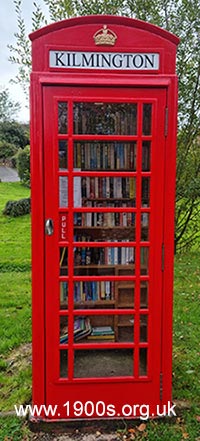
Red public phone box re-purposed as a library
I understand from the internet that there are other uses of the sold-off red phone boxes The most credible, it seems to me, are for free food banks, although I have never seen this use. If you have, please let me know. My contact details are below.
Other uses, according to the internet, are adverts for exhibitions, museums and art galleries; cafes and coffee shops with seating; mobile phone charging stations and even defibrillator stations. For such inventive uses, the phone box might need to be locked outsideduring specified hours and staffed during those specified hours. With this proviso, use is only limited by the creativity of local volunteers or perhaps the local council.
If you know of any examples, please let me know.
| sources | webmaster | contact |
Text and images are copyright
If you can add anything to this page or provide a photo, please contact me.

