





 candlestick
phones wind-up
phones public phones
1920s-1930s manual
telephone
exchanges area codes
and
direct dialling using a
dial phone
1940s-1950s public phones
1940s-1950s costs of calls
1940s-1950s illegal
free calls
1940s-1950s house
phones
1940s-1960s telegrams
importance
in the past telegrams
from sending
to delivery

Telegrams UK: their importance in the past
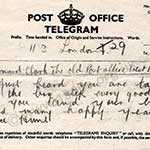
'Telegram' was a UK word. Outside the UK, telegrams were also known as wires or cables. They were the only way to get urgent messages through quickly when few households were on the phone. This page describes and illustrates the two types of telegram: the standard and the greetings type, both sent and received through the Post Office. It explains how people sent them and how they were delivered by telegraph boys. Charges are also included.
____
By the webmaster: her childhood recollections and further research with old telegrams and relevant documents
Why people in the UK sent telegrams in the past
Ordinary people, apart from governments and war correspondents, used to send telegrams for one of two reasons.
1. One reason was that very few ordinary households were on the phone in the first part of the 20th Century. There were public phones, and two people could use them to phone each other by agreeing to use them at a specified time. This of course was no use at all for urgent messages where contact was not by prior agreement. The only way to get messages through fast was by telegram from the local post office.
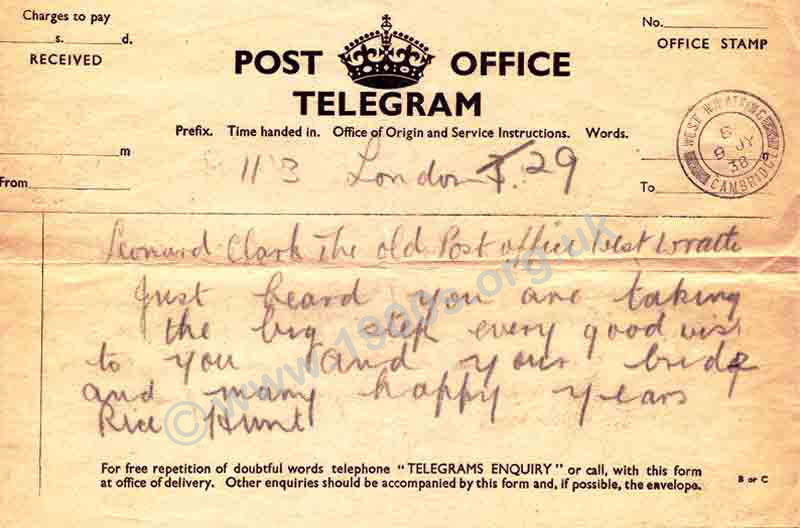
Standard telegram, 1938
2. The other reason for sending a telegram rather than a letter or greetings card was to make the recipient feel special on a special occasion. In those early years, it was often difficult to attend events that one was invited to. Cars were rare luxuries and travelling long distances normally involved taking a bus to the local railway station, then a train journey - frequently changing trains in London - and a bus at the other end. So when someone had to decline a wedding invitation or other special event, it was customary to show enthusiasm and support for the event by sending a specially designed greetings telegram. This was timed to arrive so that the best man could read it out to all the guests as part of his speech at the reception.
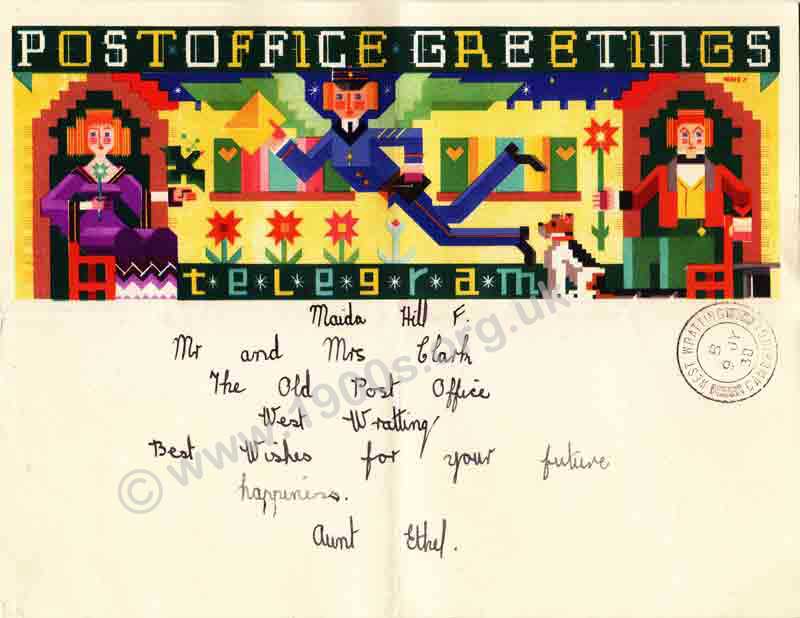
Greetings telegram, 1938
This practice like so many others, was interrupted during World War Two. However, I remember it well afterwards, in the early 1950s. The practice gradually died out as faster technologies were developed.
Both of the above telegrams were sent for my parents' wedding in 1938.
How to send a telegram in early-20th century Britain
To send a telegram, the sender had to contact a Post Office. In the first part of the 20th Century, this normally meant going there because few people had phones at home.
At the Post Office, staff had either to type the message into a teleprinter if it and the receiving post office had one or simply write it by hand and dictate it over the phone.
Later in the century, senders could phone directly to the Central Telegraph Office in London.
How telegrams were delivered to recipients
When the message was ready for delivery at a post office, a delivery boy, known as a telegraph boy had to cycle to the destination address to deliver it.
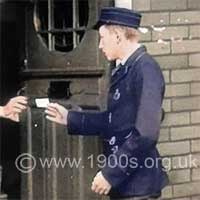
Telegraph boy delivering a telegram
Telegraph boys were of course used to cycling long distances but I am told that it was particularly tiring and irritating for events like weddings when there were any number of telegrams which all arrived at the post office at different times, and no-one knew in advance how many there would be. A delivery boy could cycle several miles to deliver a telegram only have to keep doing it all over again as new ones came through.
See also David Pickle's detailed piece about how the Central Telegraph Office handled telegrams in the final years of the service.
Charges for sending telegrams
Understandably, sending a telegram was expensive.
Charges for sending telegrams are listed in old money in an old undated Pocket Companion judged to be about 1938:
9 words 6d (to and within I.F.S., 12 words, 1/6). Every additional word, 1d. Names and addresses charged for. Free delivery within 3 miles. 6d a mile beyond. (I.F.S. stands for 'Irish Free State'. What became the Republic of Ireland was a Dominion of the British Empire until 1937.)
In view of these costs which were substantial at the time, the brevity of the messages is understandable. Because telegrams, were charged per word, every attempt was made to keep the number of words down. Eventually a form of shorthand developed, not unlike that used in text messages today. The charge for the greetings paper was an add-on. There would have been some choice of design, but subject to what was available at the receiving post office.
David Pickles explains how the charges for sending telegrams were paid. This probably changed little over time.
Greetings telegrams - examples
Three designs of telegram were sent as greetings at my parents' wedding in July 1938. Two were decorative and presumably cost more than the standard sort which was normally sent only in emergencies. Presumably senders chose the style of the greetings telegram at the time of sending, although whether their choice would be available at the destination Post Office was probably uncertain.
Tap/click for larger versions
Greetings telegram, 1938
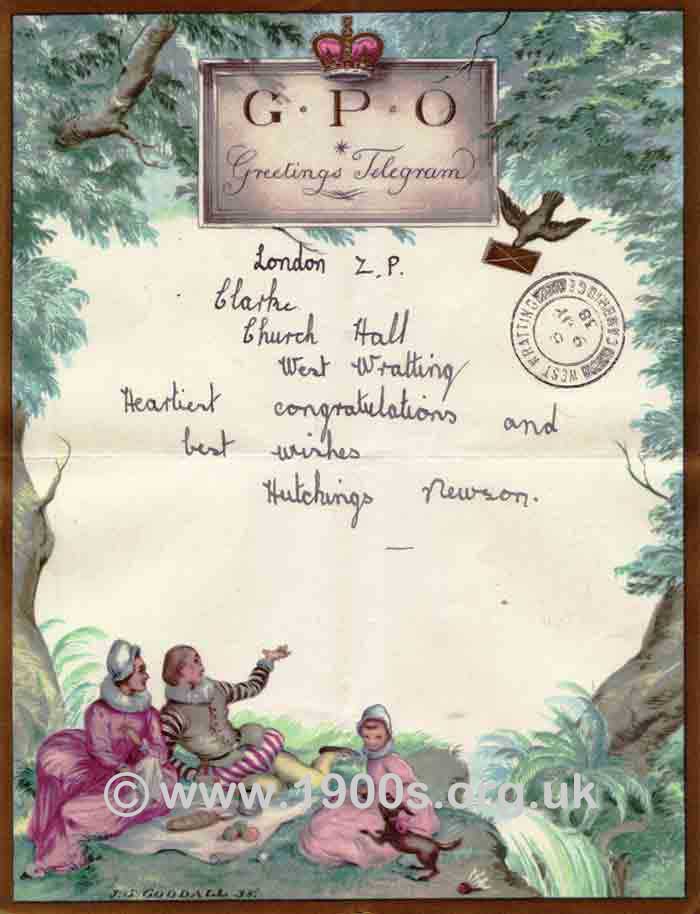
Greetings telegram, 1938
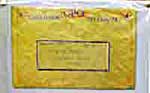
Gold-coloured envelope used for sending out greetings telegrams
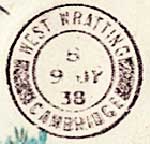
Stamp of post office receiving the telegram, showing the date received and the location of the Post Office.
You may be surprised that the address for the telegrams is given as a Post Office rather than a personal address. It was actually 'The Old Post Office', the house where my mother's parents lived, which had formerly been a regular Post Office.
The centre design in the above pictures was by far the most popular at my parents' wedding; there were only two of the first style and one of the standard style. Whether the sender of the standard style selected it on the basis of cost or whether the destination Post Office ran out of greeting forms can only be guessed at.
It is interesting that all the telegrams were handwritten by the staff at the destination Post Office. The West Wratting receiving Post Office was small in an extremely rural village which would not have had the latest equipment to print out the message onto paper tape. The enlarged images show that the Post Office wrote the standard telegram in pencil, whereas they wrote the greetings telegrams in ink, seemingly - but somewhat unsuccessfully - trying to make them look neater and more professional.
Text and images are copyright
If you can add anything to this page or provide a photo, I would be pleased if you would contact me.
sources: early 20th century material
sources: ww2 home front and other material
contact
the webmaster/author/researcher/editor
privacy policy

