 Sainsbury's
shops Co-op
shops Payantake shops small
family
grocers greengrocers dairies
and milk
deliveries types of milk
and milk bottles bakers
shops sweet
shops

Dairy shops, depots and deliveries 1940s-50s
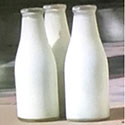
Milk used to be sold in special dairy shops and be delivered from milk depots to doorsteps by horse-drawn wagons or carts and later by motorised vans. This page gives more details of the dairy shop, the milk depot, the delivery vehicles and the delivery men, known as milkmen. It is lavishly illustrated and based on firsthand recollections.
____
By the webmaster based on her firsthand recollections and additional research with contributions from others who lived at the time
The dairy shop
I can just remember our dairy shop when I was a young child in the early 1940s. It was called the United Dairies or just the UD, and was very clean-looking with white paintwork and white tiles on the walls and shop counter. The assistants were women dressed in clean white overalls.
I wish I could say that the shop sold various types milk, butter and cream, but this was wartime - which was all I knew at the time - so there was no rich milk or cream. There was standard butter and hard cheese - but rationing allowed for very little per person. There was mainly margarine and a few other food essentials.
The shop soon close. It had probably done well before World War Two, but now it had little to sell and, as people had to register in a particular shop for their foodstuffs, they chose larger grocers. My mother registered at Sainsburys.
The dairy depot, however, continued for some years, as milk was generally delivered to households.
The dairy depots
Just behind the shop was the dairy depot which housed the horses and the wagons or carts that were used for the home deliveries. The houses were tethered along one wall and not in individual bricked off areas as I have seen since in films.
There was also an office there where the odd pint of milk could be bought.
My main impression of the depot was its huge size - larger than any building I had ever seen in my short life. The permanently wet concrete floor also stuck in my memory. I suppose that it was frequently sluiced down with water to keep it clean. The horses were not particular about where they did their business.
Milk deliveries and the milkman
Milk was always delivered to the doorsteps of houses, although extras in emergencies could be bought from the office in the dairy shop. When a milk bottle was empty, the woman of the house dutifully washed it out and left it on the doorstep for the milkman to collect on the next delivery. I understand that these empty bottles were then sterilised back at the depot before re-use.
In the early 1940s, the UD and the Co-op both delivered in our road from their horse-drawn wagons. My family always used the Co-op as she had been brought up to it because of its dividend. Its milk depot must have been some way away as I never saw it.
My mother always bought sterilised milk which was no-where near as nice as the UD's unsterilised milk. If she ran short, she would watch out for the UD delivery and nip across the road to buy a pint from him. I looked forward to it because it was delicious.
My mother would look out to see that no neighbours were watching and then go out to the road to shovel up any nearby horse's dung for the garden.
I must still have been very young when the horse-drawn deliveries were replaced by motorised vehicles.
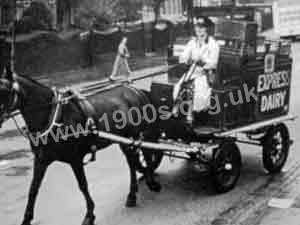
Milk deliveries during World War Two, horse drawn and with a woman driver. In the effects of Ena Cole.
The next two photos must have been taken after the end of the war because the men were back in their previous jobs. The carts were wagon-style.
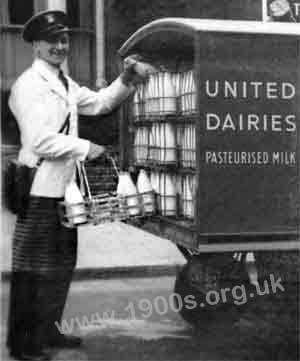
Milkman's uniform. Note the black peaked hat, the white overall, the leather shoulder bag for money and the protective apron.
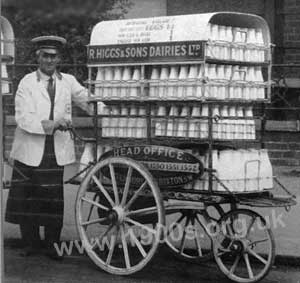
The milk bottles, rather than milk churns, in this photo suggest the mid-20th Century, but handcarts were used for milk deliveries in the early 1900s. Photographed in Eastbourne Museum of Shops.
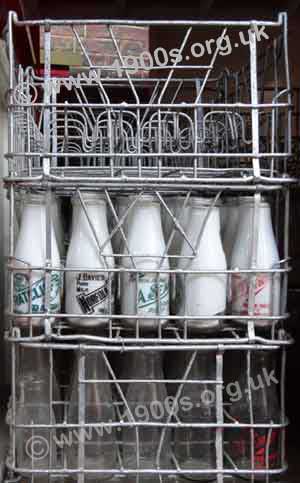
All the milk crates in and before the 1940s were metal as shown in this photographed taken in Beaulieu Motor Museum.
Milk carts came in all shapes and sizes and were not necessarily called carts. Older people would have referred to them as wagons if they were on the large side and covered.
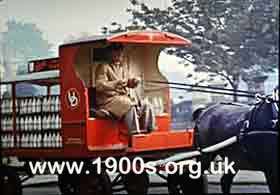
Horse-drawn 1940s United Dairies (UD) milk float. Screenshot from an old film.
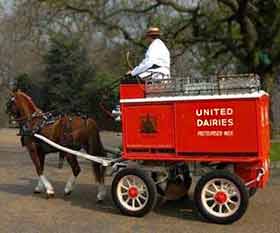
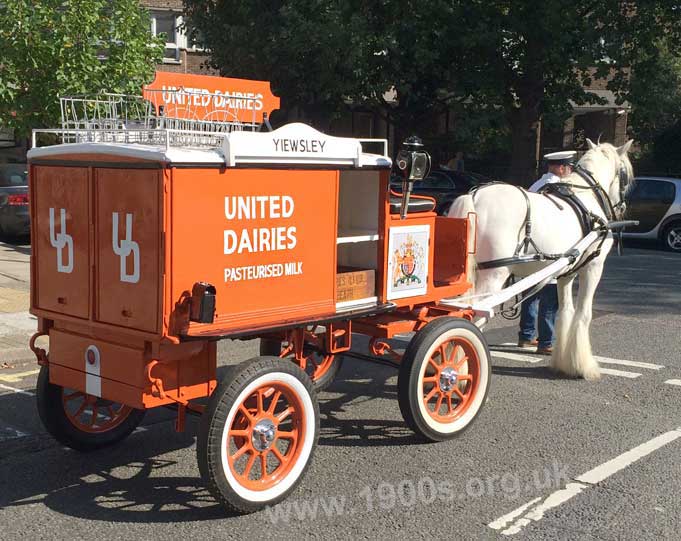
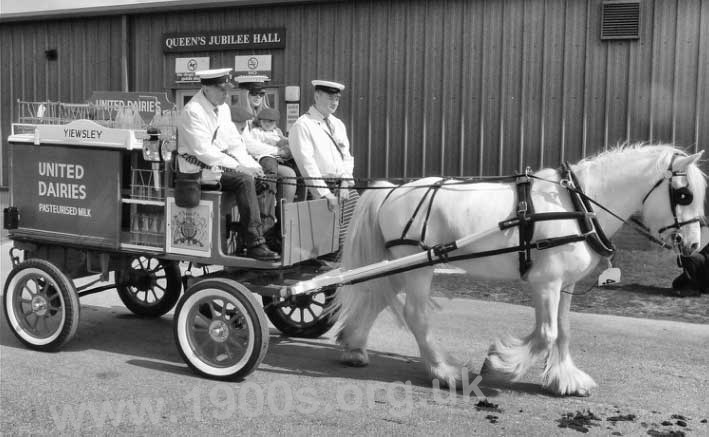
Horse-drawn 1940s United Dairies (UD) milk float, courtesy of Laurie Prior who describes it as, "Just like I used to see in the 1940s in Harrow-on-the-Hill".
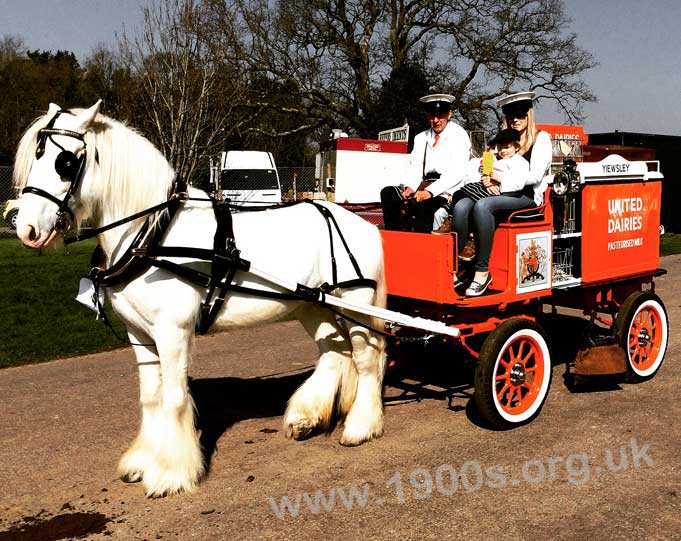
The following three images enlarge on tap/click. They were taken at the London Harness Horse Parade 2015, and are courtesy of Thomas Franklin whose family own several old carts and a horse for display purposes.
The milkman
The milkman always wore a uniform, which I was different from one diary to another. Milkmen I saw always had a white peaked cap, a white overall and a longish of apron to protect their trousers.
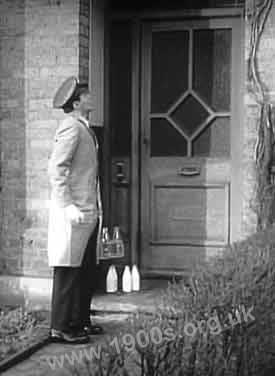
Milkman delivering milk
The milkman called for payment every week. He put the money into a large leather shoulder bag which had separate pockets for the different denominations of coins.
Cold weather and the milkman's gloves
In freezing weather when the milk was delivered early in the morning, it was not uncommon to find it frozen in the bottle. Then, as water swells up when it becomes ice, the bottle top was pushed up out of the bottle.
In winter the milkman's hands got very cold, as he needed his fingers free for handling the money. Like other delivery men in winter, he wore knitted gloves which were open at the top parts of the fingers.
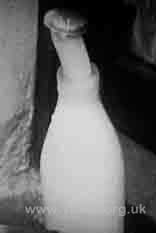
Milk bottle left on a doorstep in a cold winter. The frozen milk, having expanded, has pushed the top off the milk, and the milk is solid.
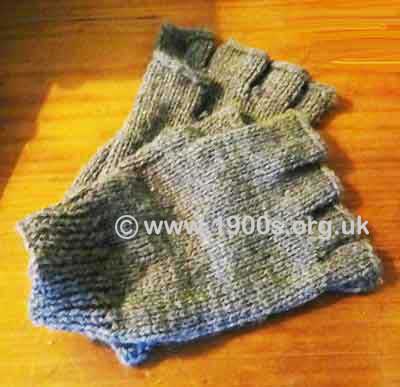
Fingerless gloves, as worn in cold weather by delivery men who handled money on customers' doorsteps
The milkman's cap badge
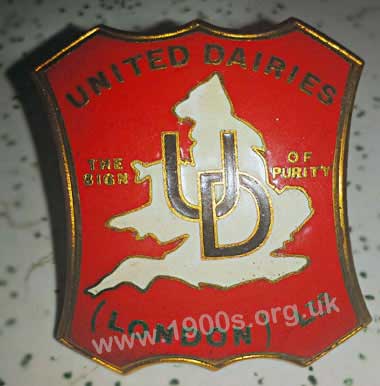
UD (United Dairies) milkman's cap badge, courtesy of David Hebden who reports that, as a child in the 1940s, he used to help his uncle with the milk deliveries, standing on the running board as the milk float moved from house to house.
| sources | webmaster | contact |
Text and images are copyright
If you can add anything to this page or provide a photo, please contact me.

