 Sainsbury's
shops Co-op
shops Payantake shops small
family
grocers greengrocers dairies
and milk
deliveries types of milk
and milk bottles bakers
shops sweet
shops

Small family grocer shops mid-20th century

Small family grocers seem to have been most common in rural areas where chain store grocers like Sainsburys, Co-ops and Payantakes did not exist. This page describes a typical rural family grocer and a small town one. Such grocers almost all disappeared towards the end of the century as families began to own cars and be able to drive to the emerging supermarkets.
____
Based on firsthand contributions with commentaries by the webmaster
Small rural grocers
My family lived in a village in rural Cambridgeshire during the Second World War, and the nearest grocer was several miles away. He or his driver delivered our grocery order to us and our neighbours in his van.
Ordering groceries
Grocery orders had to go in quite frequently, there being no fridges to keep milk and butter fresh.
Families who lived near the grocer would walk to the shop with their order, and those that lived a few miles away would cycle in.
Some families could phone in their order, but being on the phone was fairly unusual at the time. We were fortunate because we were on the phone due to my father being a wartime ARP warden. (He was young enough to be away in the forces, but, as an engineer, he was in a reserved occupation doing war work.) Being on the phone meant that my mother could phone in her order. Our neighbour was a doctor, so he too was in a reserved occupation and therefore on the phone.
The large family opposite, however was not on the phone. One of the children had to cycle to the grocer with the family's order which must have been a relentless chore as the family was so large.
Paying for the order
Our family had an account with the grocer, which meant that we paid by cheque once a month. Many of the families in rural areas, though, lived from hand-to-mouth and would have had to pay in cash. Fortunately, it was cheaper to live in the country than the town because there was enough land to grow one's own vegetables and keep rabbits and chickens for meat.
The grocer and his van driver
contributed by Neil Cryer, recollection
Regular delivery men on films always seem to know their customers by name and be on friendly terms with them, and this may have been the case in some areas.
However, I don't remember the man who did our deliveries being particularly friendly, but his rounds covered a wide area and there was no competition for his services. Also he had the additional chore of dealing with the coupons in everyone's ration books, although I didn't realise it at the time, he was probably quite old or even ill as otherwise he would have been conscripted into the forces. Being a grocer was not a reserved occupation as the women of the family were expected to take over.
Small town grocers
The following photo of a small town family grocer is of interest for several reasons:
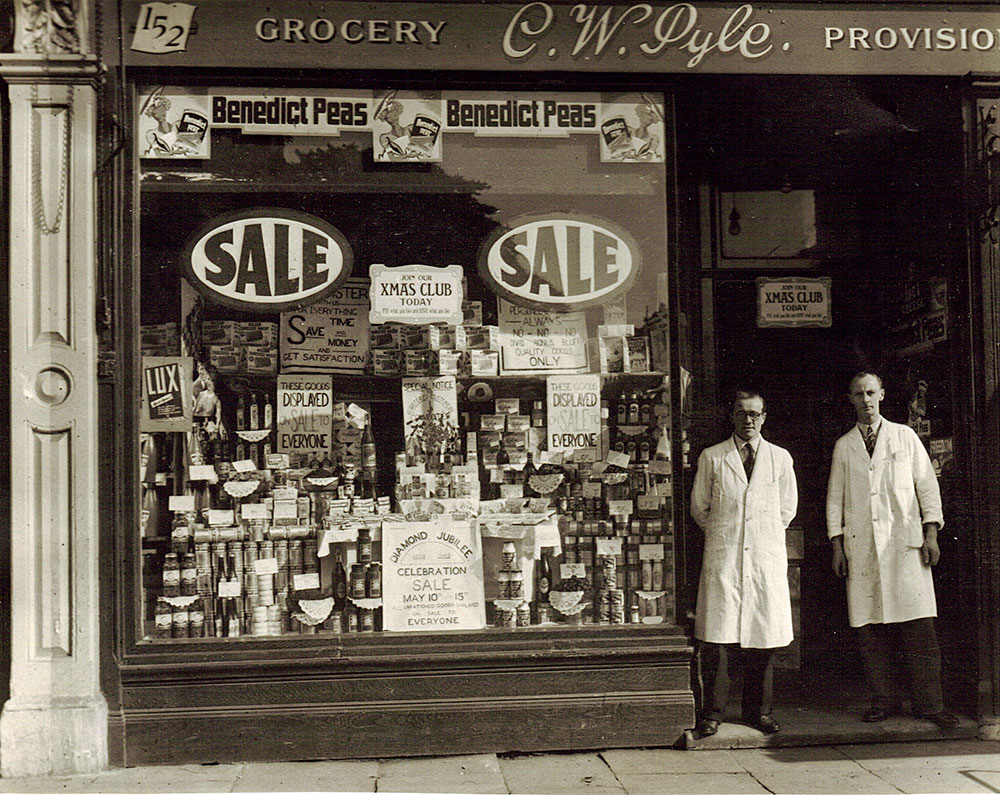
A family grocer shop in 1945, courtesy of Viv Nunn. The shop belonged to her grandfather, C.W.Pyle and has his name above the shop.
According to Viv Nun the shop was part of a row of shops. It traded until the early 1960s when the supermarkets started arriving.
The photo can be dated to 1945 because the placard in the window declares the shop's diamond jubilee (60 years), and computer enhancement of the original photo gives the dates as 1885-1945.
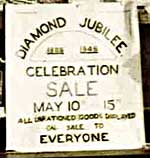
Detail of the Jubilee placard in the photo
The placard points out that all the goods displayed are off-ration and therefore on sale to everyone. This shows that the shop was trying get more trade by showing prospective customers that they did not have to stay with their registered grocer for anything other than rationed goods.
One wonders what the off-ration goods in the window are. The enlargement seems to show mainly tinned foods and bottled sauces.
The shop had a Christmas club and was currently having a sale.
Viv Nunn reports that the shop's paper bags were printed with something like 'Pyle's products please prudent people' - Pyle being the family name.
The white coats of the assistants are typical of what I remember seeing grocery staff wearing in the 1940s. In wartime of course, those staff were mainly women and older men.
| sources | webmaster | contact |
Text and images are copyright
If you can add anything to this page or provide a photo, please contact me.

