






 coal and its
importance
in the past the coal
yard/depot coal and coke
prices 1938/39 preparations
for a delivery
early 20th C arrival of a
coal delivery
early 20th C coal delivery
mid 20th century coalmen's
work coalmen's
appearance


Coal yards/depots when coal was Britain's main fuel
Coal yards - also called coal depots, for receiving, storing, and delivering coal were common sights when coal was widely used for heating and gas production. This page explores coal transportation to coal yards, their locations and how they were experienced in everyday life. Highlights are the images which bring the page to life.
____
By the webmaster based on childhood recollections, discussions with older people and additional research
Coal transportation to coal yards/depots
Before the middle of the 20th century goods were almost entirely transported by rail - as they had been since the development of the railways in the UK, around 1840. Coal was no exception, and it was quite common to see goods trains loaded with coal passing at a station or snaking round the countryside. Coal trains were always much longer than passenger trains, as it was most cost-effective to move coal in bulk. Sometimes, as a child, while standing on a station platform, I wondered whether a coal train would ever end.
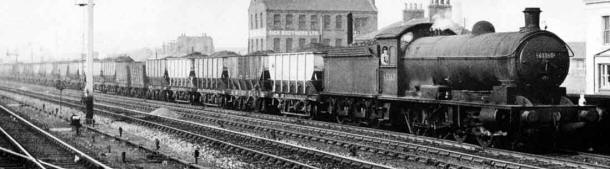
Train transporting coal. Note that it is so long that it seems to disappear into the distance. Also note the steam engine, which itself ran on coal. Photo courtesy of Dave Marden, author of Hidden Railways of Portsmouth and Gosport.
Location of coal yards/depots
For reasons of transportation, coal yards were located at or close to railway stations.
In Edgware, where I grew up, the coal yard was next to what was known locally as the 'steam station', so as not to confuse it with Edgware tube station. Both were in Station Road, the steam station being nearer to the High Street.
The steam station was part of the London and North Eastern Railway (LNER) railway company, which was primarily a passenger station, although it closed for passengers just after the outbreak of World War Two. I never knew it as a passenger station. It continued as a goods station until 1964, although I only remember the coal yard in the 1940s. The call for coal declined with the advent of cheap imported oil and north sea gas, and later the 1956 Clean Air Act.
Inside the coal yard/depot
Coal yards are such a rare sight in the UK today that when I saw this one in a rural area, I stopped to take photographs. So the colour photographs in this section are reasonably modern.
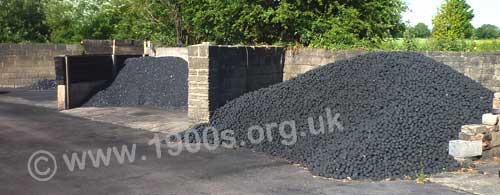
Heaps of various types and grades of coal stored in a coal yard.
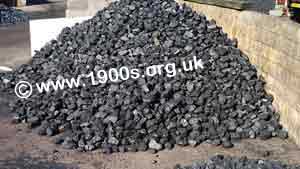
Coal in a heap
in a coal yard
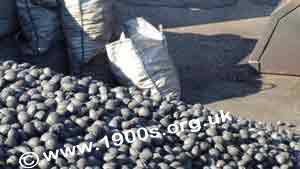
Coal preformed into nuggets in a heap in a coal yard.
My recollections of inside coal yards are not recent. They go back to the 1940s.
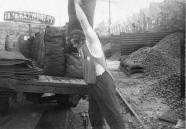
A coalman at a coal yard loading sacks of coal onto a delivery lorry. Photo courtesy of Terry Martinelli.
I used to go to the coal yard with my mother to order coal for our open coal fires and coke for the boiler which heated the water. This was during and just after World War Two.
As we entered the site, the steam station was on the left across what seemed to me to be a large expanse of tarmac, and the office of the coal yard, where we ordered our coal, was closer to the entrance on the right.
To me all coal looked fairly similar. However coal yards sold a range of different sizes, types and grades of coal which they kept in large heaps in separate bunkers.
Surviving delivery receipts from 1938 and 1939 show that my parents preferred coal called Derby Brights for the open fire and coke for the boiler. (These bills are from the Co-op London office which my parents patronised because the Co-op paid dividend.
Coal yard horses
In the early 20th century, shire horses used work at the Upper Holloway coal yard. They used to parade at the Lord Mayor of London's show each year. My grandmother used to clean their horse brasses, polish their harnesses and make their plumes.
David Houghton
Deliveries from the coal yard
Each coal yard delivered to quite a large area.
If you can add anything to this page or provide a photo, I would be pleased if you would contact me.
sources: early 20th century material
sources: ww2 home front and other material
contact
the webmaster/author/researcher/editor
privacy policy

